EGYPTIAN
ARCHAEOLOGY
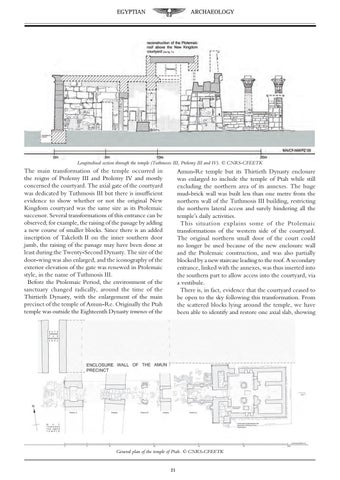
Longitudinal section through the temple (Tuthmosis III, Ptolemy III and IV). © CNRS-CFEETK
The main transformation of the temple occurred in the reigns of Ptolemy III and Ptolemy IV and mostly concerned the courtyard. The axial gate of the courtyard was dedicated by Tuthmosis III but there is insufficient evidence to show whether or not the original New Kingdom courtyard was the same size as its Ptolemaic successor. Several transformations of this entrance can be observed; for example, the raising of the passage by adding a new course of smaller blocks. Since there is an added inscription of Takeloth II on the inner southern door jamb, the raising of the passage may have been done at least during the Twenty-Second Dynasty. The size of the door-wing was also enlarged, and the iconography of the exterior elevation of the gate was renewed in Ptolemaic style, in the name of Tuthmosis III. Before the Ptolemaic Period, the environment of the sanctuary changed radically, around the time of the Thirtieth Dynasty, with the enlargement of the main precinct of the temple of Amun-Re. Originally the Ptah temple was outside the Eighteenth Dynasty temenos of the
Amun-Re temple but its Thirtieth Dynasty enclosure was enlarged to include the temple of Ptah while still excluding the northern area of its annexes. The huge mud-brick wall was built less than one metre from the northern wall of the Tuthmosis III building, restricting the northern lateral access and surely hindering all the temple’s daily activities. This situation explains some of the Ptolemaic transformations of the western side of the courtyard. The original northern small door of the court could no longer be used because of the new enclosure wall and the Ptolemaic construction, and was also partially blocked by a new staircase leading to the roof. A secondary entrance, linked with the annexes, was thus inserted into the southern part to allow access into the courtyard, via a vestibule. There is, in fact, evidence that the courtyard ceased to be open to the sky following this transformation. From the scattered blocks lying around the temple, we have been able to identify and restore one axial slab, showing
General plan of the temple of Ptah. © CNRS-CFEETK 21