EGYPTIAN
ARCHAEOLOGY
The temple of Ptah at Karnak Since October 2008 the Franco-Egyptian team at Karnak has been studying the temple of Ptah, which has inscriptions dating from the time of Tuthmosis III to that of the Roman Emperor Tiberius. Christophe Thiers and Pierre Zignani describe the main preliminary results.
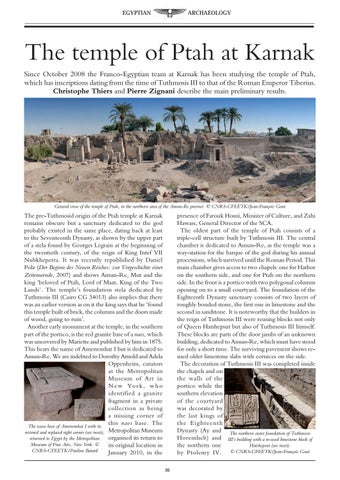
General view of the temple of Ptah, in the northern area of the Amun-Re precinct. © CNRS-CFEETK/Jean-François Gout
The pre-Tuthmosid origin of the Ptah temple at Karnak remains obscure but a sanctuary dedicated to the god probably existed in the same place, dating back at least to the Seventeenth Dynasty, as shown by the upper part of a stela found by Georges Legrain at the beginning of the twentieth century, of the reign of King Intef VII Nubkheperra. It was recently republished by Daniel Polz (Der Beginn des Neuen Reiches: zur Vorgeschichte einer Zeitenwende, 2007) and shows Amun-Re, Mut and the king ‘beloved of Ptah, Lord of Maat, King of the Two Lands’. The temple’s foundation stela dedicated by Tuthmosis III (Cairo CG 34013) also implies that there was an earlier version as on it the king says that he ‘found this temple built of brick, the columns and the doors made of wood, going to ruin’. Another early monument at the temple, in the southern part of the portico, is the red granite base of a naos, which was uncovered by Mariette and published by him in 1875. This bears the name of Amenemhat I but is dedicated to Amun-Re. We are indebted to Dorothy Arnold and Adela Oppenheim, curators at the Metropolitan Museum of Art in N e w Yo r k , w h o identified a granite fragment in a private collection as being a missing corner of this naos base. The The naos base of Amenemhat I with its Metropolitan Museum restored and replaced right corner (see inset), organised its return to returned to Egypt by the Metropolitan Museum of Fine Arts, New York. © its original location in CNRS-CFEETK/Pauline Batard January 2010, in the
presence of Farouk Hosni, Minister of Culture, and Zahi Hawass, General Director of the SCA. The oldest part of the temple of Ptah consists of a triple-cell structure built by Tuthmosis III. The central chamber is dedicated to Amun-Re, as the temple was a way-station for the barque of the god during his annual processions, which survived until the Roman Period. This main chamber gives access to two chapels: one for Hathor on the southern side, and one for Ptah on the northern side. In the front is a portico with two polygonal columns opening on to a small courtyard. The foundation of the Eighteenth Dynasty sanctuary consists of two layers of roughly bonded stone, the first one in limestone and the second in sandstone. It is noteworthy that the builders in the reign of Tuthmosis III were reusing blocks not only of Queen Hatshepsut but also of Tuthmosis III himself. These blocks are parts of the door jambs of an unknown building, dedicated to Amun-Re, which must have stood for only a short time. The surviving pavement shows reused older limestone slabs with cornices on the side. The decoration of Tuthmosis III was completed inside the chapels and on the walls of the portico while the southern elevation of the courtyard was decorated by the last kings of the Eighteenth Dynasty (Ay and The northern outer foundation of Tuthmosis Horemheb) and III’s building with a re-used limestone block of Hatshepsut (see inset). the northern one by Ptolemy IV. © CNRS-CFEETK/Jean-François Gout 20