EGYPTIAN
ARCHAEOLOGY
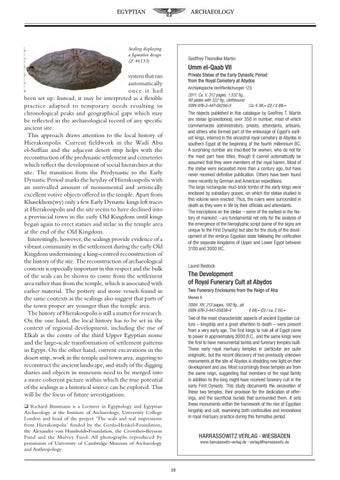
Sealing displaying a figurative design (Z 46133)
Geoffrey Thorndike Martin
Umm el-Qaab VII Private Stelae of the Early Dynastic Period from the Royal Cemetery at Abydos
system that ran automatically once it had been set up. Instead, it may be interpreted as a flexible practice adapted to temporary needs resulting in chronological peaks and geographical gaps which may be reflected in the archaeological record of any specific ancient site. This approach draws attention to the local history of Hierakonpolis. Current fieldwork in the Wadi Abu el-Suffian and the adjacent desert strip helps with the reconstruction of the predynastic settlement and cemeteries which reflect the development of social hierarchies at the site. The transition from the Predynastic to the Early Dynastic Period marks the heyday of Hierakonpolis with an unrivalled amount of monumental and artistically excellent votive objects offered in the temple. Apart from Khasekhem(wy) only a few Early Dynastic kings left traces at Hierakonpolis and the site seems to have declined into a provincial town in the early Old Kingdom until kings began again to erect statues and stelae in the temple area at the end of the Old Kingdom. Interestingly, however, the sealings provide evidence of a vibrant community in the settlement during the early Old Kingdom undermining a king-centred reconstruction of the history of the site. The reconstruction of archaeological contexts is especially important in this respect and the bulk of the seals can be shown to come from the settlement area rather than from the temple, which is associated with earlier material. The pottery and stone vessels found in the same contexts as the sealings also suggest that parts of the town proper are younger than the temple area. The history of Hierakonpolis is still a matter for research. On the one hand, the local history has to be set in the context of regional development, including the rise of Elkab as the centre of the third Upper Egyptian nome and the large-scale transformation of settlement patterns in Egypt. On the other hand, current excavations in the desert strip, work in the temple and town area, augering to reconstruct the ancient landscape, and study of the digging diaries and objects in museums need to be merged into a more coherent picture within which the true potential of the sealings as a historical source can be explored. This will be the focus of future investigations.
Archäologische Veröffentlichungen 123 2011. Ca. V, 312 pages, 1.332 fig., 90 plates with 332 fig., clothbound ISBN 978-3-447-06256-5 Ca. € 98,– (D) / £ 88,–
The objects published in this catalogue by Geoffrey T. Martin are stelae (gravestones), over 350 in number, most of which commemorate administrators, priests, attendants, artisans, and others who formed part of the entourage of Egypt’s earliest kings, interred in the ancestral royal cemetery at Abydos in southern Egypt at the beginning of the fourth millennium BC. A surprising number are inscribed for women, who do not for the most part have titles, though it cannot automatically be assumed that they were members of the royal harem. Most of the stelae were excavated more than a century ago, but have never received definitive publication. Others have been found more recently by German and American expeditions. The large rectangular mud-brick tombs of the early kings were enclosed by subsidiary graves, on which the stelae studied in this volume were erected. Thus, the rulers were surrounded in death as they were in life by their officials and attendants. The inscriptions on the stelae – some of the earliest in the history of mankind – are fundamental not only for the analysis of the emergence of the hieroglyphic script (some of the signs are unique to the First Dynasty) but also for the study of the development of the embryo Egyptian state following the unification of the separate kingdoms of Upper and Lower Egypt between 3100 and 3000 BC. Laurel Bestock
The Development of Royal Funerary Cult at Abydos Two Funerary Enclosures from the Reign of Aha Menes 6 2009. XIV, 213 pages, 100 fig., pb ISBN 978-3-447-05838-4
€ 68,– (D) / ca. £ 60,–
Two of the most characteristic aspects of ancient Egyptian culture – kingship and a great attention to death – were present from a very early age. The first kings to rule all of Egypt came to power in approximately 3000 B.C., and the same kings were the first to have monumental tombs and funerary temples built. These early royal mortuary temples in particular are quite enigmatic, but the recent discovery of two previously unknown monuments at the site of Abydos is shedding new light on their development and use. Most surprisingly these temples are from the same reign, suggesting that members of the royal family in addition to the king might have received funerary cult in the early First Dynasty. This study documents the excavation of these two temples, their provision for the dedication of offerings, and the sacrificial burials that surrounded them. It sets these monuments within the framework of the rise of Egyptian kingship and cult, examining both continuities and innovations in royal mortuary practice during this formative period.
q Richard Bussmann is a Lecturer in Egyptology and Egyptian Archaeology at the Institute of Archaeology, University College London and head of the project ‘The seals and seal impressions from Hierakonpolis’ funded by the Gerda-Henkel-Foundation, the Alexander von Humboldt-Foundation, the Crowther-Beynon Fund and the Mulvey Fund. All photographs reproduced by permission of University of Cambridge Museum of Archaeology and Anthropology.
HARRASSOWITZ VERLAG • WIESBADEN www.harrassowitz-verlag.de • verlag@harrassowitz.de
19