EGYPTIAN
ARCHAEOLOGY
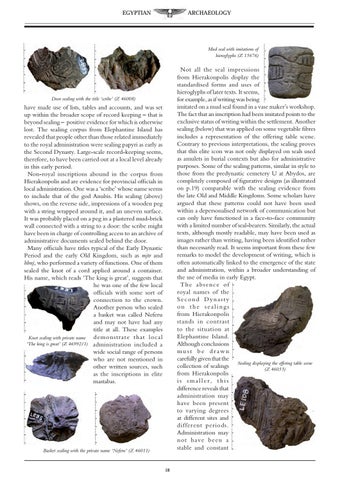
Mud seal with imitations of hieroglyphs (Z 15676)
Not all the seal impressions from Hierakonpolis display the standardised forms and uses of hieroglyphs of later texts. It seems, for example, as if writing was being imitated on a mud seal found in a vase maker’s workshop. The fact that an inscription had been imitated points to the exclusive status of writing within the settlement. Another sealing (below) that was applied on some vegetable fibres includes a representation of the offering table scene. Contrary to previous interpretations, the sealing proves that this elite icon was not only displayed on seals used as amulets in burial contexts but also for administrative purposes. Some of the sealing patterns, similar in style to those from the predynastic cemetery U at Abydos, are completely composed of figurative designs (as illustrated on p.19) comparable with the sealing evidence from the late Old and Middle Kingdoms. Some scholars have argued that these patterns could not have been used within a depersonalised network of communication but can only have functioned in a face-to-face community with a limited number of seal-bearers. Similarly, the actual texts, although mostly readable, may have been used as images rather than writing, having been identified rather than necessarily read. It seems important from these few remarks to model the development of writing, which is often automatically linked to the emergence of the state and administration, within a broader understanding of the use of media in early Egypt. The absence of royal names of the Second Dynasty on the sealings from Hierakonpolis stands in contrast to the situation at Elephantine Island. Although conclusions must be drawn carefully given that the Sealing displaying the offering table scene collection of sealings (Z 46033) from Hierakonpolis is smaller, this difference reveals that administration may have been present to varying degrees at different sites and dif ferent periods. Administration may not have been a stable and constant
Door sealing with the title ‘scribe’ (Z 46008)
have made use of lists, tables and accounts, and was set up within the broader scope of record keeping – that is beyond sealing – positive evidence for which is otherwise lost. The sealing corpus from Elephantine Island has revealed that people other than those related immediately to the royal administration were sealing papyri as early as the Second Dynasty. Large-scale record-keeping seems, therefore, to have been carried out at a local level already in this early period. Non-royal inscriptions abound in the corpus from Hierakonpolis and are evidence for provincial officials in local administration. One was a ‘scribe’ whose name seems to include that of the god Anubis. His sealing (above) shows, on the reverse side, impressions of a wooden peg with a string wrapped around it, and an uneven surface. It was probably placed on a peg in a plastered mud-brick wall connected with a string to a door: the scribe might have been in charge of controlling access to an archive of administrative documents sealed behind the door. Many officials have titles typical of the Early Dynastic Period and the early Old Kingdom, such as mjtr and hbnj, who performed a variety of functions. One of them sealed the knot of a cord applied around a container. His name, which reads ‘The king is great’, suggests that he was one of the few local officials with some sort of connection to the crown. Another person who sealed a basket was called Neferu and may not have had any title at all. These examples demonstrate that local Knot sealing with private name ‘The king is great’ (Z 46992/1) administration included a wide social range of persons who are not mentioned in other written sources, such as the inscriptions in elite mastabas.
Basket sealing with the private name ‘Neferu’ (Z 46011) 18