EGYPTIAN
ARCHAEOLOGY
Seals and seal impressions from Hierakonpolis Inscribed seals and seal impressions give insights into the administration forming the backbone of the Egyptian state. Richard Bussmann explores the potential of the early Old Kingdom seals from Hierakonpolis for investigating the establishment of royal power in a local context. Hierakonpolis has been recognised as a central place of state formation in Egypt ever since the Narmer palette was discovered in 1898. This artefact is one of the earliest representations of kingship in Egypt and quickly became a key piece for understanding the Egyptian state. However, research over the last few decades has shown that state formation must be understood within the wider context of early Egyptian society and requires a substantial theorising of the objectives of and approaches to investigating early states. Arising from this a greater emphasis is now placed on the question of what the state does rather than what it is, and the growing body of archaeological evidence suggests that the process of state formation was embedded in various local communities in very different ways. The analysis of the seals and seal impressions from Hierakonpolis contributes to the exploration of these overall questions. Most of the material was excavated by James E Quibell and Frederick Green in 1898 and 1899 in the town area of Hierakonpolis. The map they produced (Hierakonpolis, Part II, pl.LXXIII) shows the position of structures at the site. To some extent this allows the seals to be related to their original findspot. However, the exact provenance of the seals within the town is often difficult to define. Barbara Adams was able to reconstruct the archaeological context of many finds from Hierakonpolis on the basis of Green’s excavation notes, now kept in Cambridge. She combined information on the location of find contexts given in the notes with find context numbers written on the objects. Unfortunately, the context numbers of the seals were not written on them and have often been lost. In many cases only Green’s drawings and notes on the lids of the wooden boxes in which the seals were stored give a clue to the original findspot. Therefore, all the information on the context
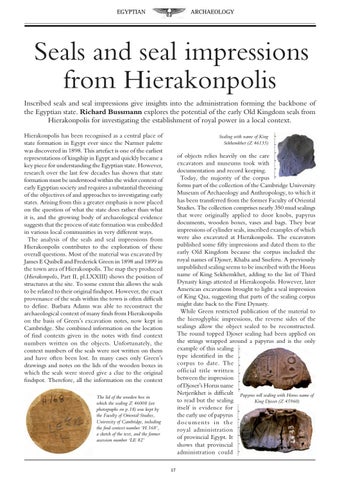
Sealing with name of King Sekhemkhet (Z 46135)
of objects relies heavily on the care excavators and museums took with documentation and record keeping. Today, the majority of the corpus forms part of the collection of the Cambridge University Museum of Archaeology and Anthropology, to which it has been transferred from the former Faculty of Oriental Studies. The collection comprises nearly 350 mud sealings that were originally applied to door knobs, papyrus documents, wooden boxes, vases and bags. They bear impressions of cylinder seals, inscribed examples of which were also excavated at Hierakonpolis. The excavators published some fifty impressions and dated them to the early Old Kingdom because the corpus included the royal names of Djoser, Khaba and Sneferu. A previously unpublished sealing seems to be inscribed with the Horus name of King Sekhemkhet, adding to the list of Third Dynasty kings attested at Hierakonpolis. However, later American excavations brought to light a seal impression of King Qaa, suggesting that parts of the sealing corpus might date back to the First Dynasty. While Green restricted publication of the material to the hieroglyphic impressions, the reverse sides of the sealings allow the object sealed to be reconstructed. The round topped Djoser sealing had been applied on the strings wrapped around a papyrus and is the only example of this sealing type identified in the corpus to date. The official title written between the impression of Djoser’s Horus name Netjerikhet is difficult Papyrus roll sealing with Horus name of to read but the sealing King Djoser (Z 45960) itself is evidence for the early use of papyrus documents in the royal administration of provincial Egypt. It shows that provincial administration could
The lid of the wooden box in which the sealing Z 46008 (see photographs on p.18) was kept by the Faculty of Oriental Studies, University of Cambridge, including the find context number ‘H.168’, a sketch of the text, and the former accession number ‘LE 82’
17