EGYPTIAN
ARCHAEOLOGY
A mud-brick staircase with a below-stairs cupboard in a house at Dendera
The badly-damaged wall of a modern mud-brick building in Qift
within any one village and between different villages. This seems worth considering when interpreting domestic architecture in the archaeological record. Modern houses are usually two storeys high with the main door opening straight on to the street, although better-off houses often have a front courtyard with trees. The first few brick courses at the bases of the walls are sometimes built in red brick and rendered with cement to protect the walls from damage caused by rising subsoil water, weather and animals. The bonding is normally one or two courses of stretchers alternating with a course of headers, usually with bricks on end at intervals. The brick courses are levelled with mud mortar which is sometimes repaired with, or replaced by, cement, and the wall faces can be rendered with a mud or cement plaster or left unrendered, especially in the case of walls other
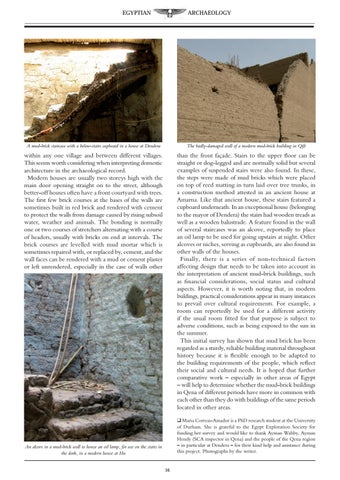
than the front façade. Stairs to the upper floor can be straight or dog-legged and are normally solid but several examples of suspended stairs were also found. In these, the steps were made of mud bricks which were placed on top of reed matting in turn laid over tree trunks, in a construction method attested in an ancient house at Amarna. Like that ancient house, these stairs featured a cupboard underneath. In an exceptional house (belonging to the mayor of Dendera) the stairs had wooden treads as well as a wooden balustrade. A feature found in the wall of several staircases was an alcove, reportedly to place an oil lamp to be used for going upstairs at night. Other alcoves or niches, serving as cupboards, are also found in other walls of the houses. Finally, there is a series of non-technical factors affecting design that needs to be taken into account in the interpretation of ancient mud-brick buildings, such as financial considerations, social status and cultural aspects. However, it is worth noting that, in modern buldings, practical considerations appear in many instances to prevail over cultural requirements. For example, a room can reportedly be used for a different activity if the usual room fitted for that purpose is subject to adverse conditions, such as being exposed to the sun in the summer. This initial survey has shown that mud brick has been regarded as a sturdy, reliable building material throughout history because it is flexible enough to be adapted to the building requirements of the people, which reflect their social and cultural needs. It is hoped that further comparative work – especially in other areas of Egypt – will help to determine whether the mud-brick buildings in Qena of different periods have more in common with each other than they do with buildings of the same periods located in other areas. q Maria Correas-Amador is a PhD research student at the University of Durham. She is grateful to the Egypt Exploration Society for funding her survey and would like to thank Ayman Wahby, Ayman Hendy (SCA inspector in Qena) and the people of the Qena region – in particular at Dendera – for their kind help and assistance during this project. Photographs by the writer.
An alcove in a mud-brick wall to house an oil lamp, for use on the stairs in the dark, in a modern house at Hu 16