EGYPTIAN
ARCHAEOLOGY
Small pieces of straw ready to be mixed with mud
An area of mud brick production. The bricks at the back are ready for use
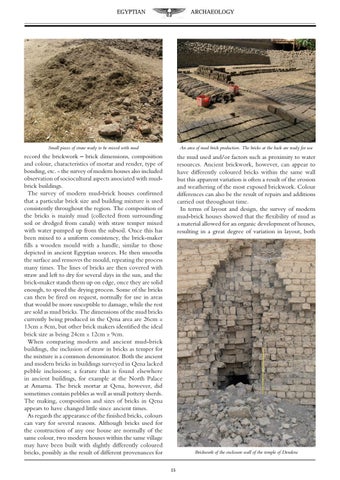
record the brickwork – brick dimensions, composition and colour, characteristics of mortar and render, type of bonding, etc. - the survey of modern houses also included observation of sociocultural aspects associated with mudbrick buildings. The survey of modern mud-brick houses confirmed that a particular brick size and building mixture is used consistently throughout the region. The composition of the bricks is mainly mud (collected from surrounding soil or dredged from canals) with straw temper mixed with water pumped up from the subsoil. Once this has been mixed to a uniform consistency, the brick-maker fills a wooden mould with a handle, similar to those depicted in ancient Egyptian sources. He then smooths the surface and removes the mould, repeating the process many times. The lines of bricks are then covered with straw and left to dry for several days in the sun, and the brick-maker stands them up on edge, once they are solid enough, to speed the drying process. Some of the bricks can then be fired on request, normally for use in areas that would be more susceptible to damage, while the rest are sold as mud bricks. The dimensions of the mud bricks currently being produced in the Qena area are 26cm x 13cm x 8cm, but other brick makers identified the ideal brick size as being 24cm x 12cm x 9cm. When comparing modern and ancient mud-brick buildings, the inclusion of straw in bricks as temper for the mixture is a common denominator. Both the ancient and modern bricks in buildings surveyed in Qena lacked pebble inclusions; a feature that is found elsewhere in ancient buildings, for example at the North Palace at Amarna. The brick mortar at Qena, however, did sometimes contain pebbles as well as small pottery sherds. The making, composition and sizes of bricks in Qena appears to have changed little since ancient times. As regards the appearance of the finished bricks, colours can vary for several reasons. Although bricks used for the construction of any one house are normally of the same colour, two modern houses within the same village may have been built with slightly differently coloured bricks, possibly as the result of different provenances for
the mud used and/or factors such as proximity to water resources. Ancient brickwork, however, can appear to have differently coloured bricks within the same wall but this apparent variation is often a result of the erosion and weathering of the most exposed brickwork. Colour differences can also be the result of repairs and additions carried out throughout time. In terms of layout and design, the survey of modern mud-brick houses showed that the flexibility of mud as a material allowed for an organic development of houses, resulting in a great degree of variation in layout, both
Brickwork of the enclosure wall of the temple of Dendera 15