EGYPTIAN
ARCHAEOLOGY
A survey of the mud-brick buildings of Qena Mud brick was the main building material used by Egyptians from antiquity until modern times. Maria Correas-Amador reports on her survey of mud-brick buildings in Qena, funded by an EES Centenary Award. At the end of 2009, the Egypt Exploration Society generously granted me a Centenary Award towards a survey of mud-brick buildings in Qena in Upper Egypt. The motivation for this project was the belief that further research was needed concerning technical aspects of mud-brick buildings, ancient and modern, together with investigation of the social and cultural aspects of life in and around the buildings. One of the main characteristics of vernacular architecture, regardless of its building materials, is the continuity of building methods throughout time, as well as the permanence of certain structural or design features that may remain unchanged for centuries or even millennia. Research suggests that this is the case for Egyptian vernacular mud-brick architecture, which now survives mainly in rural areas but which has been rapidly disappearing for the past decades, as red-brick and
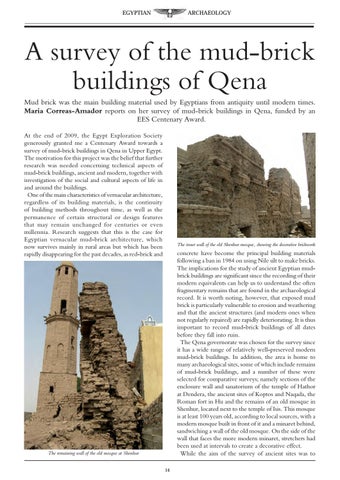
The inner wall of the old Shenhur mosque, showing the decorative brickwork
concrete have become the principal building materials following a ban in 1984 on using Nile silt to make bricks. The implications for the study of ancient Egyptian mudbrick buildings are significant since the recording of their modern equivalents can help us to understand the often fragmentary remains that are found in the archaeological record. It is worth noting, however, that exposed mud brick is particularly vulnerable to erosion and weathering and that the ancient structures (and modern ones when not regularly repaired) are rapidly deteriorating. It is thus important to record mud-brick buildings of all dates before they fall into ruin. The Qena governorate was chosen for the survey since it has a wide range of relatively well-preserved modern mud-brick buildings. In addition, the area is home to many archaeological sites, some of which include remains of mud-brick buildings, and a number of these were selected for comparative surveys; namely sections of the enclosure wall and sanatorium of the temple of Hathor at Dendera, the ancient sites of Koptos and Naqada, the Roman fort in Hu and the remains of an old mosque in Shenhur, located next to the temple of Isis. This mosque is at least 100 years old, according to local sources, with a modern mosque built in front of it and a minaret behind, sandwiching a wall of the old mosque. On the side of the wall that faces the more modern minaret, stretchers had been used at intervals to create a decorative effect. While the aim of the survey of ancient sites was to
The remaining wall of the old mosque at Shenhur 14