EGYPTIAN
ARCHAEOLOGY
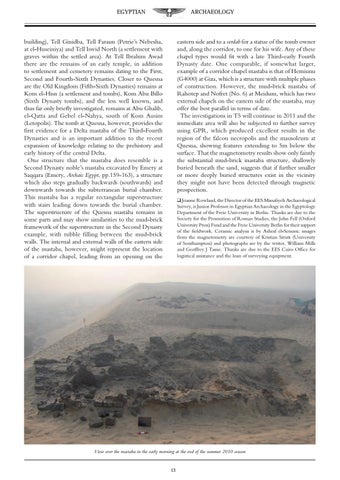
building), Tell Ginidba, Tell Faraun (Petrie’s Nebesha, at el-Huseiniya) and Tell Iswid North (a settlement with graves within the settled area). At Tell Ibrahim Awad there are the remains of an early temple, in addition to settlement and cemetery remains dating to the First, Second and Fourth-Sixth Dynasties. Closer to Quesna are the Old Kingdom (Fifth-Sixth Dynasties) remains at Kom el-Hisn (a settlement and tombs), Kom Abu Billo (Sixth Dynasty tombs), and the less well known, and thus far only briefly investigated, remains at Abu Ghalib, el-Qatta and Gebel el-Nahya, south of Kom Ausim (Letopolis). The tomb at Quesna, however, provides the first evidence for a Delta mastaba of the Third-Fourth Dynasties and is an important addition to the recent expansion of knowledge relating to the prehistory and early history of the central Delta. One structure that the mastaba does resemble is a Second Dynasty noble’s mastaba excavated by Emery at Saqqara (Emery, Archaic Egypt, pp.159-163), a structure which also steps gradually backwards (southwards) and downwards towards the subterranean burial chamber. This mastaba has a regular rectangular superstructure with stairs leading down towards the burial chamber. The superstructure of the Quesna mastaba remains in some parts and may show similarities to the mud-brick framework of the superstructure in the Second Dynasty example, with rubble filling between the mud-brick walls. The internal and external walls of the eastern side of the mastaba, however, might represent the location of a corridor chapel, leading from an opening on the
eastern side and to a serdab for a statue of the tomb owner and, along the corridor, to one for his wife. Any of these chapel types would fit with a late Third-early Fourth Dynasty date. One comparable, if somewhat larger, example of a corridor chapel mastaba is that of Hemiunu (G4000) at Giza, which is a structure with multiple phases of construction. However, the mud-brick mastaba of Rahotep and Nofret (No. 6) at Meidum, which has two external chapels on the eastern side of the mastaba, may offer the best parallel in terms of date. The investigations in T5 will continue in 2011 and the immediate area will also be subjected to further survey using GPR, which produced excellent results in the region of the falcon necropolis and the mausoleum at Quesna, showing features extending to 5m below the surface. That the magnetometry results show only faintly the substantial mud-brick mastaba structure, shallowly buried beneath the sand, suggests that if further smaller or more deeply buried structures exist in the vicinity they might not have been detected through magnetic prospection. q Joanne Rowland, the Director of the EES Minufiyeh Archaeological Survey, is Junior Professor in Egyptian Archaeology in the Egyptology Department of the Freie University in Berlin. Thanks are due to the Society for the Promotion of Roman Studies, the John Fell (Oxford University Press) Fund and the Freie University Berlin for their support of the fieldwork. Ceramic analysis is by Ashraf el-Senussi; images from the magnetometry are courtesy of Kristian Strutt (University of Southampton) and photographs are by the writer, William Mills and Geoffrey J Tassie. Thanks are due to the EES Cairo Office for logistical assistance and the loan of surveying equipment.
View over the mastaba in the early morning at the end of the summer 2010 season 13