EGYPTIAN
ARCHAEOLOGY
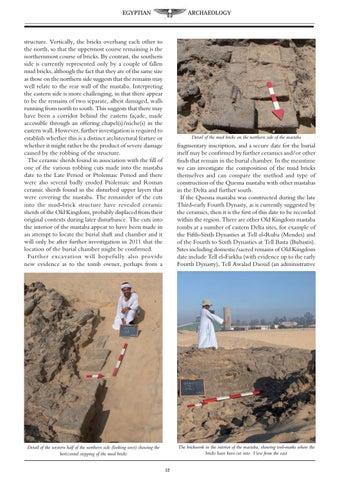
structure. Vertically, the bricks overhang each other to the north, so that the uppermost course remaining is the northernmost course of bricks. By contrast, the southern side is currently represented only by a couple of fallen mud bricks, although the fact that they are of the same size as those on the northern side suggests that the remains may well relate to the rear wall of the mastaba. Interpreting the eastern side is more challenging, in that there appear to be the remains of two separate, albeit damaged, walls running from north to south. This suggests that there may have been a corridor behind the eastern faรงade, made accessible through an offering chapel(s)/niche(s) in the eastern wall. However, further investigation is required to establish whether this is a distinct architectural feature or whether it might rather be the product of severe damage caused by the robbing of the structure. The ceramic sherds found in association with the fill of one of the various robbing cuts made into the mastaba date to the Late Period or Ptolemaic Period and there were also several badly eroded Ptolemaic and Roman ceramic sherds found in the disturbed upper layers that were covering the mastaba. The remainder of the cuts into the mud-brick structure have revealed ceramic sherds of the Old Kingdom, probably displaced from their original contexts during later disturbance. The cuts into the interior of the mastaba appear to have been made in an attempt to locate the burial shaft and chamber and it will only be after further investigation in 2011 that the location of the burial chamber might be confirmed. Further excavation will hopefully also provide new evidence as to the tomb owner, perhaps from a
fragmentary inscription, and a secure date for the burial itself may be confirmed by further ceramics and/or other finds that remain in the burial chamber. In the meantime we can investigate the composition of the mud bricks themselves and can compare the method and type of construction of the Quesna mastaba with other mastabas in the Delta and further south. If the Quesna mastaba was constructed during the late Third-early Fourth Dynasty, as is currently suggested by the ceramics, then it is the first of this date to be recorded within the region. There are other Old Kingdom mastaba tombs at a number of eastern Delta sites, for example of the Fifth-Sixth Dynasties at Tell el-Ruba (Mendes) and of the Fourth to Sixth Dynasties at Tell Basta (Bubastis). Sites including domestic/sacred remains of Old Kingdom date include Tell el-Farkha (with evidence up to the early Fourth Dynasty), Tell Awalad Daoud (an administrative
Detail of the western half of the northern side (looking west) showing the horizontal stepping of the mud bricks
The brickwork in the interior of the mastaba, showing tool-marks where the bricks have been cut into. View from the east
Detail of the mud bricks on the northern side of the mastaba
12