EGYPTIAN
ARCHAEOLOGY
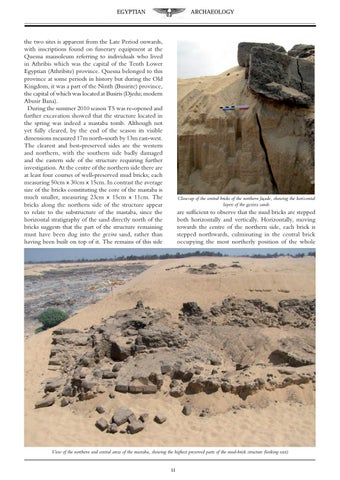
the two sites is apparent from the Late Period onwards, with inscriptions found on funerary equipment at the Quesna mausoleum referring to individuals who lived in Athribis which was the capital of the Tenth Lower Egyptian (Athribite) province. Quesna belonged to this province at some periods in history but during the Old Kingdom, it was a part of the Ninth (Busirite) province, the capital of which was located at Busiris (Djedu; modern Abusir Bana). During the summer 2010 season T5 was re-opened and further excavation showed that the structure located in the spring was indeed a mastaba tomb. Although not yet fully cleared, by the end of the season its visible dimensions measured 17m north-south by 13m east-west. The clearest and best-preserved sides are the western and northern, with the southern side badly damaged and the eastern side of the structure requiring further investigation. At the centre of the northern side there are at least four courses of well-preserved mud bricks; each measuring 50cm x 30cm x 15cm. In contrast the average size of the bricks constituting the core of the mastaba is much smaller, measuring 23cm x 15cm x 11cm. The bricks along the northern side of the structure appear to relate to the substructure of the mastaba, since the horizontal stratigraphy of the sand directly north of the bricks suggests that the part of the structure remaining must have been dug into the gezira sand, rather than having been built on top of it. The remains of this side
Close-up of the central bricks of the northern faรงade, showing the horizontal layers of the gezira sands
are sufficient to observe that the mud bricks are stepped both horizontally and vertically. Horizontally, moving towards the centre of the northern side, each brick is stepped northwards, culminating in the central brick occupying the most northerly position of the whole
View of the northern and central areas of the mastaba, showing the highest preserved parts of the mud-brick structure (looking east) 11