EGYPTIAN
ARCHAEOLOGY
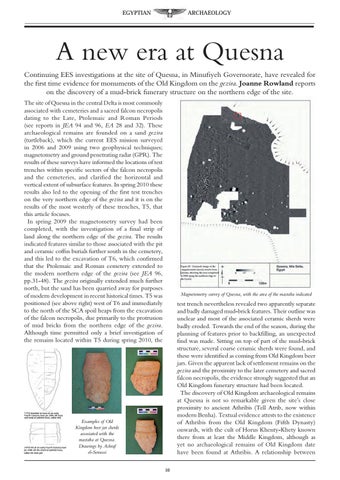
A new era at Quesna Continuing EES investigations at the site of Quesna, in Minufiyeh Governorate, have revealed for the first time evidence for monuments of the Old Kingdom on the gezira. Joanne Rowland reports on the discovery of a mud-brick funerary structure on the northern edge of the site. The site of Quesna in the central Delta is most commonly associated with cemeteries and a sacred falcon necropolis dating to the Late, Ptolemaic and Roman Periods (see reports in JEA 94 and 96, EA 28 and 32). These archaeological remains are founded on a sand gezira (turtleback), which the current EES mission surveyed in 2006 and 2009 using two geophysical techniques; magnetometry and ground penetrating radar (GPR). The results of these surveys have informed the locations of test trenches within specific sectors of the falcon necropolis and the cemeteries, and clarified the horizontal and vertical extent of subsurface features. In spring 2010 these results also led to the opening of the first test trenches on the very northern edge of the gezira and it is on the results of the most westerly of these trenches, T5, that this article focuses. In spring 2009 the magnetometry survey had been completed, with the investigation of a final strip of land along the northern edge of the gezira. The results indicated features similar to those associated with the pit and ceramic coffin burials further south in the cemetery, and this led to the excavation of T6, which confirmed that the Ptolemaic and Roman cemetery extended to the modern northern edge of the gezira (see JEA 96, pp.31-48). The gezira originally extended much further north, but the sand has been quarried away for purposes of modern development in recent historical times. T5 was positioned (see above right) west of T6 and immediately to the north of the SCA spoil heaps from the excavation of the falcon necropolis, due primarily to the protrusion of mud bricks from the northern edge of the gezira. Although time permitted only a brief investigation of the remains located within T5 during spring 2010, the
Magnetometry survey of Quesna, with the area of the mastaba indicated
test trench nevertheless revealed two apparently separate and badly damaged mud-brick features. Their outline was unclear and most of the associated ceramic sherds were badly eroded. Towards the end of the season, during the planning of features prior to backfilling, an unexpected find was made. Sitting on top of part of the mud-brick structure, several coarse ceramic sherds were found, and these were identified as coming from Old Kingdom beer jars. Given the apparent lack of settlement remains on the gezira and the proximity to the later cemetery and sacred falcon necropolis, the evidence strongly suggested that an Old Kingdom funerary structure had been located. The discovery of Old Kingdom archaeological remains at Quesna is not so remarkable given the site’s close proximity to ancient Athribis (Tell Atrib, now within modern Benha). Textual evidence attests to the existence of Athribis from the Old Kingdom (Fifth Dynasty) onwards, with the cult of Horus Khenty-Khety known there from at least the Middle Kingdom, although as yet no archaeological remains of Old Kingdom date have been found at Athribis. A relationship between
17/10 shoulder to base ofanOld Kingdom beer 17/10 shoulder to base ofofOld Kingdom beer jar jar 17/10 shoulder to base early (base and body of pointed base, collar beer (base and body of pointed base, collar rimrim beer jar)jar) Fourth Dynasty beer jar. (Nile silt base and body of pointed base, collar rim)
24/10 Old Kingdom beer 24/10 rimrim Kingdom beer jar jar 24/10 rim ofOld an early Fourth Dynasty beer (rim sherd of pointed base, collar beer (rim sherd of pointed base, collar rimrim beer jar)jar) jar. (Nile silt rim sherd of pointed base, collar rim beer jar)
Examples of Old Kingdom beer jar sherds associated with the mastaba at Quesna. Drawings by Ashraf el-Senussi 10