EGYPTIAN
ARCHAEOLOGY
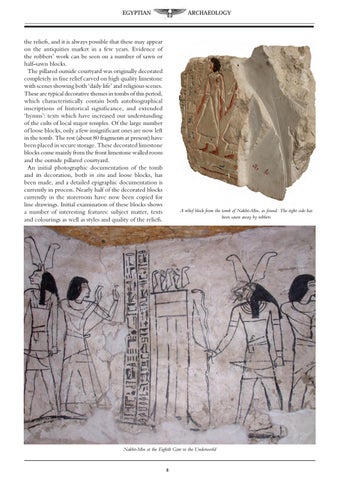
the reliefs, and it is always possible that these may appear on the antiquities market in a few years. Evidence of the robbers’ work can be seen on a number of sawn or half-sawn blocks. The pillared outside courtyard was originally decorated completely in fine relief carved on high quality limestone with scenes showing both ‘daily life’ and religious scenes. These are typical decorative themes in tombs of this period, which characteristically contain both autobiographical inscriptions of historical significance, and extended ‘hymns’: texts which have increased our understanding of the cults of local major temples. Of the large number of loose blocks, only a few insignificant ones are now left in the tomb. The rest (about 80 fragments at present) have been placed in secure storage. These decorated limestone blocks come mainly from the front limestone walled room and the outside pillared courtyard. An initial photographic documentation of the tomb and its decoration, both in situ and loose blocks, has been made, and a detailed epigraphic documentation is currently in process. Nearly half of the decorated blocks currently in the storeroom have now been copied for line drawings. Initial examination of these blocks shows a number of interesting features: subject matter, texts and colourings as well as styles and quality of the reliefs.
A relief block from the tomb of Nakht-Min, as found. The right side has been sawn away by robbers
Nakht-Min at the Eighth Gate to the Underworld