EGYPTIAN
ARCHAEOLOGY
Joseph Hekekyan, pioneer archaeologist Joseph Hekekyan is almost unknown inside or outside Egyptian archaeology, yet he carried out excavation and survey in Egypt of a quality far ahead of anything being done in the country at the time, or for many years afterwards. David Jeffreys describes Hekekyan’s extraordinary contribution. The geological work of Joseph Hekekyan (1807-75) at Memphis and Heliopolis remains one of the most ambitious attempts to tackle the topography and geology of the region, and was also in its day a model of clear and accurate scientific recording. His programme of geological drillings and area excavations was not widely publicised at the time, and references to his work in the twentieth century are largely drawn from secondary sources. Hekekyan’s original journals, notes, drawings and correspondence are now held in London, at the British Museum and the British Library, and in Cairo. Hekekyan was born in Istanbul to Catholic Armenian parents; his father Michirdiz was a translator at the court of Muhammad Ali in Cairo, and Joseph was sent to the UK to learn the skills needed at a time of rapid industrial expansion in Egypt: geology, mining, road and canal engineering, surveying and technical drawing, all of which were to be vital in his later archaeological work. He also, incidentally, commented on social aspects of Liverpool’s navvy community. Summoned to Egypt in 1830 he advanced rapidly, being put in charge of the flourishing cotton industry in the Delta, and four years later was appointed Director of the Cairo School of Engineering. He was a founder member of the Cairo Polytechnic (later Cairo University) and was commissioned to carry out important individual planning works (notably, the new National Museum in Giza). Hekekyan’s career was always closely linked to the fortunes of the powerful Armenian community in Egypt, and in particular to those of his relative Artin Bey, a courtier and minister whose daughter he was later to marry. During the hostility against Europeans and other foreigners after the death of Mohammed Ali, Artin Bey was accused of financial mismanagement and fell from favour; Hekekyan, who mixed socially with the European community and was never much of a courtier, being openly critical of all ‘oriental’ institutions, was retired in 1851. His forced retirement was probably due as much to the personal hostility of Mohammed Ali’s successor Abbas I as to his increasing problems from severe ophthalmia. In the late 1840s Hekekyan declined, on medical grounds, a commission to oversee an important coal-mining contract, which gave Abbas a pretext to relieve him of any further administrative responsibility.
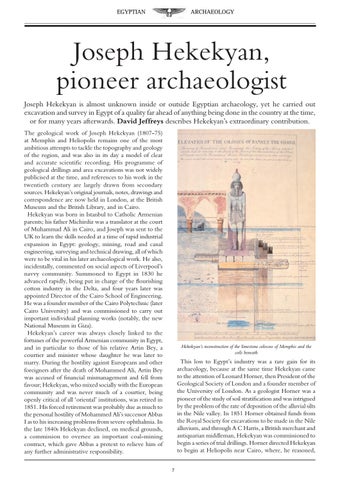
Hekekyan’s reconstruction of the limestone colossus of Memphis and the soils beneath
This loss to Egypt’s industry was a rare gain for its archaeology, because at the same time Hekekyan came to the attention of Leonard Horner, then President of the Geological Society of London and a founder member of the University of London. As a geologist Horner was a pioneer of the study of soil stratification and was intrigued by the problem of the rate of deposition of the alluvial silts in the Nile valley. In 1851 Horner obtained funds from the Royal Society for excavations to be made in the Nile alluvium, and through A C Harris, a British merchant and antiquarian middleman, Hekekyan was commissioned to begin a series of trial drillings. Horner directed Hekekyan to begin at Heliopolis near Cairo, where, he reasoned,