EGYPTIAN
ARCHAEOLOGY
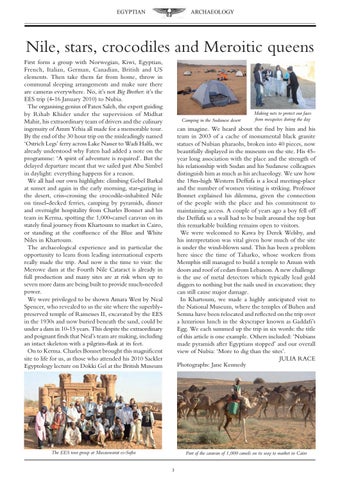
Nile, stars, crocodiles and Meroitic queens First form a group with Norwegian, Kiwi, Egyptian, French, Italian, German, Canadian, British and US elements. Then take them far from home, throw in communal sleeping arrangements and make sure there are cameras everywhere. No, it’s not Big Brother: it’s the EES trip (4-16 January 2010) to Nubia. The organising genius of Faten Saleh, the expert guiding by Rihab Khider under the supervision of Midhat Mahir, his extraordinary team of drivers and the culinary ingenuity of Amm Yehia all made for a memorable tour. By the end of the 30 hour trip on the misleadingly named ‘Ostrich Legs’ ferry across Lake Nasser to Wadi Halfa, we already understood why Faten had added a note on the programme: ‘A spirit of adventure is required’. But the delayed departure meant that we sailed past Abu Simbel in daylight: everything happens for a reason. We all had our own highlights: climbing Gebel Barkal at sunset and again in the early morning, star-gazing in the desert, criss-crossing the crocodile-inhabited Nile on tinsel-decked ferries, camping by pyramids, dinner and overnight hospitality from Charles Bonnet and his team in Kerma, spotting the 1,000-camel caravan on its stately final journey from Khartoum to market in Cairo, or standing at the confluence of the Blue and White Niles in Khartoum. The archaeological experience and in particular the opportunity to learn from leading international experts really made the trip. And now is the time to visit: the Merowe dam at the Fourth Nile Cataract is already in full production and many sites are at risk when up to seven more dams are being built to provide much-needed power. We were privileged to be shown Amara West by Neal Spencer, who revealed to us the site where the superblypreserved temple of Ramesses II, excavated by the EES in the 1930s and now buried beneath the sand, could be under a dam in 10-15 years. This despite the extraordinary and poignant finds that Neal’s team are making, including an intact skeleton with a pilgrim-flask at its feet. On to Kerma. Charles Bonnet brought this magnificent site to life for us, as those who attended his 2010 Sackler Egyptology lecture on Dokki Gel at the British Museum
can imagine. We heard about the find by him and his team in 2003 of a cache of monumental black granite statues of Nubian pharaohs, broken into 40 pieces, now beautifully displayed in the museum on the site. His 45year long association with the place and the strength of his relationship with Sudan and his Sudanese colleagues distinguish him as much as his archaeology. We saw how the 18m-high Western Deffufa is a local meeting-place and the number of women visiting is striking. Professor Bonnet explained his dilemma, given the connection of the people with the place and his commitment to maintaining access. A couple of years ago a boy fell off the Deffufa so a wall had to be built around the top but this remarkable building remains open to visitors. We were welcomed to Kawa by Derek Welsby, and his interpretation was vital given how much of the site is under the wind-blown sand. This has been a problem here since the time of Taharko, whose workers from Memphis still managed to build a temple to Amun with doors and roof of cedars from Lebanon. A new challenge is the use of metal detectors which typically lead gold diggers to nothing but the nails used in excavation; they can still cause major damage. In Khartoum, we made a highly anticipated visit to the National Museum, where the temples of Buhen and Semna have been relocated and reflected on the trip over a luxurious lunch in the skyscraper known as Gaddafi’s Egg. We each summed up the trip in six words: the title of this article is one example. Others included: ‘Nubians made pyramids after Egyptians stopped’ and our overall view of Nubia: ‘More to dig than the sites’. JULIA RACE Photographs: Jane Kennedy
The EES tour group at Musawwarat es-Sufra
Part of the caravan of 1,000 camels on its way to market in Cairo
Camping in the Sudanese desert
Making nets to protect our faces from mosquitos during the day