EGYPTIAN
ARCHAEOLOGY
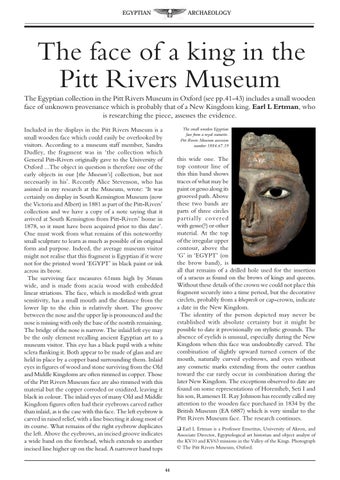
The face of a king in the Pitt Rivers Museum The Egyptian collection in the Pitt Rivers Museum in Oxford (see pp.41-43) includes a small wooden face of unknown provenance which is probably that of a New Kingdom king. Earl L Ertman, who is researching the piece, assesses the evidence. Included in the displays in the Pitt Rivers Museum is a small wooden face which could easily be overlooked by visitors. According to a museum staff member, Sandra Dudley, the fragment was in ‘the collection which General Pitt-Rivers originally gave to the University of Oxford ...The object in question is therefore one of the early objects in our [the Museum’s] collection, but not necessarily in his’. Recently Alice Stevenson, who has assisted in my research at the Museum, wrote: ‘It was certainly on display in South Kensington Museum (now the Victoria and Albert) in 1881 as part of the Pitt-Rivers’ collection and we have a copy of a note saying that it arrived at South Kensington from Pitt-Rivers’ home in 1878, so it must have been acquired prior to this date’. One must work from what remains of this noteworthy small sculpture to learn as much as possible of its original form and purpose. Indeed, the average museum visitor might not realise that this fragment is Egyptian if it were not for the printed word ‘EGYPT’ in black paint or ink across its brow. The surviving face measures 61mm high by 36mm wide, and is made from acacia wood with embedded linear striations. The face, which is modelled with great sensitivity, has a small mouth and the distance from the lower lip to the chin is relatively short. The groove between the nose and the upper lip is pronounced and the nose is missing with only the base of the nostrils remaining. The bridge of the nose is narrow. The inlaid left eye may be the only element recalling ancient Egyptian art to a museum visitor. This eye has a black pupil with a white sclera flanking it. Both appear to be made of glass and are held in place by a copper band surrounding them. Inlaid eyes in figures of wood and stone surviving from the Old and Middle Kingdoms are often rimmed in copper. Those of the Pitt Rivers Museum face are also rimmed with this material but the copper corroded or oxidized, leaving it black in colour. The inlaid eyes of many Old and Middle Kingdom figures often had their eyebrows carved rather than inlaid, as is the case with this face. The left eyebrow is carved in raised relief, with a line bisecting it along most of its course. What remains of the right eyebrow duplicates the left. Above the eyebrows, an incised groove indicates a wide band on the forehead, which extends to another incised line higher up on the head. A narrower band tops
The small wooden Egyptian face from a royal statuette. Pitt Rivers Museum accession number 1884.67.19
this wide one. The top contour line of this thin band shows traces of what may be paint or gesso along its grooved path. Above these two bands are parts of three circles partially covered with gesso(?) or other material. At the top of the irregular upper contour, above the ‘G’ in ‘EGYPT’ (on the brow band), is all that remains of a drilled hole used for the insertion of a uraeus as found on the brows of kings and queens. Without these details of the crown we could not place this fragment securely into a time period, but the decorative circlets, probably from a khepresh or cap-crown, indicate a date in the New Kingdom. The identity of the person depicted may never be established with absolute certainty but it might be possible to date it provisionally on stylistic grounds. The absence of eyelids is unusual, especially during the New Kingdom when this face was undoubtedly carved. The combination of slightly upward turned corners of the mouth, naturally curved eyebrows, and eyes without any cosmetic marks extending from the outer canthus toward the ear rarely occur in combination during the later New Kingdom. The exceptions observed to date are found on some representations of Horemheb, Seti I and his son, Ramesses II. Ray Johnson has recently called my attention to the wooden face purchased in 1834 by the British Museum (EA 6887) which is very similar to the Pitt Rivers Museum face. The research continues. q Earl L Ertman is a Professor Emeritus, University of Akron, and Associate Director, Egyptological art historian and object analyst of the KV10 and KV63 missions in the Valley of the Kings. Photograph © The Pitt Rivers Museum, Oxford.
44