EGYPTIAN
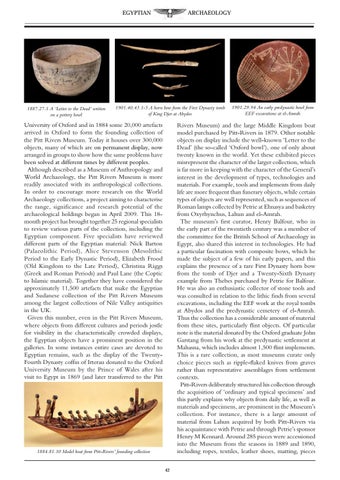
1887.27.1 A ‘Letter to the Dead’ written on a pottery bowl
ARCHAEOLOGY
1901.40.43.1-5 A horn bow from the First Dynasty tomb of King Djer at Abydos
University of Oxford and in 1884 some 20,000 artefacts arrived in Oxford to form the founding collection of the Pitt Rivers Museum. Today it houses over 300,000 objects, many of which are on permanent display, now arranged in groups to show how the same problems have been solved at different times by different peoples. Although described as a Museum of Anthropology and World Archaeology, the Pitt Rivers Museum is more readily associated with its anthropological collections. In order to encourage more research on the World Archaeology collections, a project aiming to characterise the range, significance and research potential of the archaeological holdings began in April 2009. This 18month project has brought together 25 regional specialists to review various parts of the collection, including the Egyptian component. Five specialists have reviewed different parts of the Egyptian material: Nick Barton (Palaeolithic Period), Alice Stevenson (Mesolithic Period to the Early Dynastic Period), Elizabeth Frood (Old Kingdom to the Late Period), Christina Riggs (Greek and Roman Periods) and Paul Lane (the Coptic to Islamic material). Together they have considered the approximately 11,500 artefacts that make the Egyptian and Sudanese collection of the Pitt Rivers Museum among the largest collections of Nile Valley antiquities in the UK. Given this number, even in the Pitt Rivers Museum, where objects from different cultures and periods jostle for visibility in the characteristically crowded displays, the Egyptian objects have a prominent position in the galleries. In some instances entire cases are devoted to Egyptian remains, such as the display of the TwentyFourth Dynasty coffin of Irterau donated to the Oxford University Museum by the Prince of Wales after his visit to Egypt in 1869 (and later transferred to the Pitt
1901.29.94 An early predynastic bowl from EEF excavations at el-Amrah
Rivers Museum) and the large Middle Kingdom boat model purchased by Pitt-Rivers in 1879. Other notable objects on display include the well-known ‘Letter to the Dead’ (the so-called ‘Oxford bowl’), one of only about twenty known in the world. Yet these exhibited pieces misrepresent the character of the larger collection, which is far more in keeping with the character of the General’s interest in the development of types, technologies and materials. For example, tools and implements from daily life are more frequent than funerary objects, while certain types of objects are well represented, such as sequences of Roman lamps collected by Petrie at Ehnasya and basketry from Oxyrhynchus, Lahun and el-Amrah. The museum’s first curator, Henry Balfour, who in the early part of the twentieth century was a member of the committee for the British School of Archaeology in Egypt, also shared this interest in technologies. He had a particular fascination with composite bows, which he made the subject of a few of his early papers, and this explains the presence of a rare First Dynasty horn bow from the tomb of Djer and a Twenty-Sixth Dynasty example from Thebes purchased by Petrie for Balfour. He was also an enthusiastic collector of stone tools and was consulted in relation to the lithic finds from several excavations, including the EEF work at the royal tombs at Abydos and the predynastic cemetery of el-Amrah. Thus the collection has a considerable amount of material from these sites, particularly flint objects. Of particular note is the material donated by the Oxford graduate John Garstang from his work at the predynastic settlement at Mahasna, which includes almost 1,500 flint implements. This is a rare collection, as most museums curate only choice pieces such as ripple-flaked knives from graves rather than representative assemblages from settlement contexts. Pitt-Rivers deliberately structured his collection through the acquisition of ‘ordinary and typical specimens’ and this partly explains why objects from daily life, as well as materials and specimens, are prominent in the Museum’s collection. For instance, there is a large amount of material from Lahun acquired by both Pitt-Rivers via his acquaintance with Petrie and through Petrie’s sponsor Henry M Kennard. Around 285 pieces were accessioned into the Museum from the seasons in 1889 and 1890, including ropes, textiles, leather shoes, matting, pieces
1884.81.10 Model boat from Pitt-Rivers’ founding collection 42