EGYPTIAN
ARCHAEOLOGY
Ancient Egypt in the Pitt Rivers Museum The Pitt Rivers Museum in Oxford is best known for its unique anthropological collections. It is less well-known, however, for its Egyptian material, described here by Alice Stevenson. In 1881 two of the ‘greats’ in the history of British archaeology were in Egypt for the first time; Flinders Petrie and General Augustus Henry Lane-Fox PittRivers. They happened upon each other in the shadow of the Great Pyramid as Petrie was undertaking his survey of the monuments in February of that year. This was one of Pitt-Rivers’ first trips abroad after coming into a large inheritance and he used the opportunity to pursue his interest in the question of the ‘antiquity of man’ by examining the technological nature and position of palaeolithic implements in situ at Qurneh. In doing so he became the first individual to take an interest in and publish on this most ancient aspect of the Egyptian archaeological record. Pitt-Rivers had, however, been collecting Egyptian antiquities for several years prior to this excursion to Egypt and such pieces formed only a small part of his much wider collection of archaeological,
ethnographic and antiquarian artefacts. As he explained in a paper to the Anthropological Institute in 1875, this collection was ‘arranged in sequence with a view to show... the successive ideas by which the minds of men in a primitive condition of culture have progressed in the development of their arts from the simple to complex’. Pitt-Rivers’ inheritance allowed him to expand this collection even further and, after their encounter at Giza, Petrie became one of several key individuals in Pitt-Rivers’ network of scholars, dealers and antiquarians, through whom he amassed an enormous number of artefacts. Eventually his collection began to outgrow the space available in his home and he sought to house his displays elsewhere. After exhibiting his material for a brief time at the Bethnal Green Branch of the South Kensington Museum (now the Victoria and Albert Museum), Pitt-Rivers donated part of his collection to the
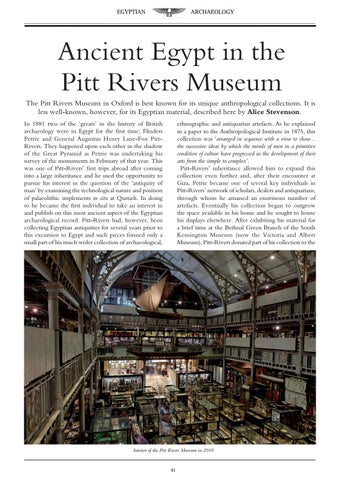
Interior of the Pitt Rivers Museum in 2010
41