No. 37 Autumn 2010
Price £5.95
EGYPTIAN ARCHAEOLOGY
T he B ulletin of T he E gypt E xploration S ociety
EGYPTIAN
ARCHAEOLOGY
EGYPTIAN ARCHAEOLOGY Bulletin of the Egypt Exploration Society www.ees.ac.uk
The opinions expressed do not necessarily reflect the aims or concerns of the Egypt Exploration Society Editor Patricia Spencer Editorial Advisers Peter Clayton Vivian Davies George Hart David Jeffreys Mike Murphy Chris Naunton Alice Stevenson John Taylor Advertising Sales Steve Partridge Egypt Exploration Society 3 Doughty Mews London WC1N 2PG Phone: +44 (0)20 7242 1880 Fax: +44 (0)20 7404 6118 E-mail: steve.partridge@ees.ac.uk Distribution Phone: +44 (0)20 7242 2268 Fax: +44 (0)20 7404 6118 E-mail: orders@ees.ac.uk Website: www.ees.ac.uk Published twice a year by The Egypt Exploration Society 3 Doughty Mews, London WC1N 2PG Registered Charity No.212384 A limited Company registered in England, No.25816 Original design by Jeremy Pemberton Set in Adobe InDesign CS2 by Patricia Spencer Printed by Commercial Colour Press Ltd Angard House, 185 Forest Road, Hainault, Essex IG6 3HU
The Book of the Dead. The eleventh mound of the Netherworld; spell 149 from the Book of the Dead of Nu (Eighteenth Dynasty). Photograph courtesy of the British Museum. See pp.21-24.
Number 37
Autumn 2010
Showcasing the Society
2
Good company in warm sunshine James J Batty
2
Nile, stars, crocodiles and Meroitic queens Julia Race
3
The Third British Egyptology Congress
4
EES Development Director
5
Recent events at Doughty Mews
5
Ian Mathieson (by David Jeffreys), Win Exley (Francine Prince), Lydia M T Barker (Jane Cooper)
6
Joseph Hekekyan: pioneer archaeologist David Jeffreys
7
Dahshur North: intact Middle and New Kingdom coffins Masahiro Baba and Sakuji Yoshimura
9
The Christian settlement at the Amarna North Tombs Gillian Pyke
13
Revealing new landscape features at Tell Basta Daniela Rosenow
17
King Sheshonqs at Bubastis Eva Lange
19
The Book of the Dead John Taylor
21
Digging Diary Patricia Spencer
25
Petrie finds revisited Tine Bagh
30
Tell Yetwal wa Yuksur Jeffrey Spencer
33
Bookshelf
35
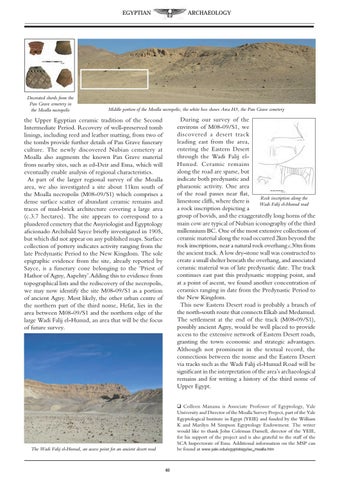
The Yale University Moalla Survey Project Colleen Manassa
38
Ancient Egypt in the Pitt Rivers Museum Alice Stevenson
41
The face of a king in the Pitt Rivers Museum Earl L Ertman
44
www.ccpress.co.uk
Š Egypt Exploration Society and the contributors. No part of this publication may be reproduced without prior permission of the publishers. ISSN 0962 2837
Cover illustration. Dahshur North. The Middle Kingdom mummy and mask of Senu after the opening of his coffin. Photograph Š Institute of Egyptology, Waseda University. See pp.9-12.
EGYPTIAN
ARCHAEOLOGY
Showcasing the Society Rosenow and Jeffrey Spencer, and in ‘Digging Diary’, but there are many other aspects to our work and we would like to showcase at the start of each issue the many and varied activities with which the Society is involved. It may take an issue or two for this new EES section to settle down and, as ever, we will appreciate feedback and suggestions for future content, but we hope that you will welcome, and like, this new approach. Please do let us know! PATRICIA SPENCER
The layout of Egyptian Archaeology has evolved gradually since the first issue in 1991 and this time we’ve made a more major change. Old friends such as ‘Notes and News’, ‘Events’ and ‘Membership Matters’ are being replaced by a varying number of pages at the beginning of each issue that will summarise recent EES news. The results of our own fieldwork and research, or of projects we helped to fund, are regularly featured in articles such as those in this issue by David Jeffreys, Gillian Pyke, Daniela
Good company in warm sunshine
From 13 to 27 March 2010 a tour of EES members, organised for us by The Traveller and South Sinai Tours, visited sites in Egypt from Alexandria to Luxor. The Society’s Vice President, Alan Lloyd, accompanied the tour as Guest Speaker, with our Cairo Representative Faten Saleh as Guide and Rosalind Phipps as Tour Manager for The Traveller. Safaa Mohammed represented South Sinai Tours. An EES member, James J Batty, sent this report to EA after the tour’s return home.
W Raymond Johnson of Chicago House dsecribing the work of the Oriental Institute in the temple of Luxor. Photograph: Barbara Pentlow
he answered courteously in his inimitable manner. To coin a phrase, we all have something to contribute to life ... but Alan needless to say had done his homework and made a huge contribution to our knowledge. All we had to do was to get out of bed at the requested time for breakfast and it was another fascinating day steeped in Egyptology and with good company in the warm sunshine. Any slight indispositions were attended to by Ros, Faten and Safaa and we were well looked after and wanted for nothing - it was like a large family tour. The ‘highlights’ for me were the ‘Pyramid Fields’ of Dahshur, Saqqara, Abu Sir and Giza, with a trip en route to the Fayum taking in the Meidum and Hawara pyramids. Other highlights were the Red and White Monasteries in Middle Egypt, Amarna and the western valley at Thebes to visit the Tomb of King Ay - away from the crowds. Site visits were also enhanced by the many Field Directors and team members who described their work to us. Unfortunately all good things come to an end: the two weeks simply flew past and I came home wishing that it could have been four weeks, but at least I had made a lot of new friends whom, insha’allah, I sincerely hope to see again in the not too distant future. JAMES J BATTY
Having returned from the EES members’ tour of Egypt as a first time participant, I thought I would pen you a few lines to express my appreciation of this tour. I missed the Anniversary tour of 2008 (see EA 33, pp.3738) for various reasons but was determined to partake of the next one if possible. Having been an EES member for many years and been with other organisations to Egypt, I had long thought that a members’ tour would be an obvious choice and I was not disappointed. It was beyond my expectations. Roughly a third of the members meeting at Heathrow had been on the previous tour but newcomers were made immediately welcome and it turned out to be the best trip that I have ever made to Egypt, with wonderful company. I am not going to go through the whole comprehensive itinerary [see the back of EA 35], but we wasted no time. We had a good flight - no strikes or volcanos to interrupt the schedule - and once arrived in Cairo we were rapidly ensconced in a coach by Ros, our outstanding Tour Manager, who, with Faten, Safaa and our driver Gallal, made such an important contribution to the success of the whole two weeks. The hotels and food were excellent; site fees and gratuities were all taken care of. Alan gave the lectures and was always available for questions, which Mandy Mamedow of the University of Potsdam/SCA team at Tell Basta describing ceramics found at the site. Behind her are Faten Saleh and Ros Phipps. Photograph: Barbara Pentlow
The EES group outside the reconstructed tomb of Ptahshepses at Abu Sir. Photograph: James J Batty
EGYPTIAN
ARCHAEOLOGY
Nile, stars, crocodiles and Meroitic queens First form a group with Norwegian, Kiwi, Egyptian, French, Italian, German, Canadian, British and US elements. Then take them far from home, throw in communal sleeping arrangements and make sure there are cameras everywhere. No, it’s not Big Brother: it’s the EES trip (4-16 January 2010) to Nubia. The organising genius of Faten Saleh, the expert guiding by Rihab Khider under the supervision of Midhat Mahir, his extraordinary team of drivers and the culinary ingenuity of Amm Yehia all made for a memorable tour. By the end of the 30 hour trip on the misleadingly named ‘Ostrich Legs’ ferry across Lake Nasser to Wadi Halfa, we already understood why Faten had added a note on the programme: ‘A spirit of adventure is required’. But the delayed departure meant that we sailed past Abu Simbel in daylight: everything happens for a reason. We all had our own highlights: climbing Gebel Barkal at sunset and again in the early morning, star-gazing in the desert, criss-crossing the crocodile-inhabited Nile on tinsel-decked ferries, camping by pyramids, dinner and overnight hospitality from Charles Bonnet and his team in Kerma, spotting the 1,000-camel caravan on its stately final journey from Khartoum to market in Cairo, or standing at the confluence of the Blue and White Niles in Khartoum. The archaeological experience and in particular the opportunity to learn from leading international experts really made the trip. And now is the time to visit: the Merowe dam at the Fourth Nile Cataract is already in full production and many sites are at risk when up to seven more dams are being built to provide much-needed power. We were privileged to be shown Amara West by Neal Spencer, who revealed to us the site where the superblypreserved temple of Ramesses II, excavated by the EES in the 1930s and now buried beneath the sand, could be under a dam in 10-15 years. This despite the extraordinary and poignant finds that Neal’s team are making, including an intact skeleton with a pilgrim-flask at its feet. On to Kerma. Charles Bonnet brought this magnificent site to life for us, as those who attended his 2010 Sackler Egyptology lecture on Dokki Gel at the British Museum
can imagine. We heard about the find by him and his team in 2003 of a cache of monumental black granite statues of Nubian pharaohs, broken into 40 pieces, now beautifully displayed in the museum on the site. His 45year long association with the place and the strength of his relationship with Sudan and his Sudanese colleagues distinguish him as much as his archaeology. We saw how the 18m-high Western Deffufa is a local meeting-place and the number of women visiting is striking. Professor Bonnet explained his dilemma, given the connection of the people with the place and his commitment to maintaining access. A couple of years ago a boy fell off the Deffufa so a wall had to be built around the top but this remarkable building remains open to visitors. We were welcomed to Kawa by Derek Welsby, and his interpretation was vital given how much of the site is under the wind-blown sand. This has been a problem here since the time of Taharko, whose workers from Memphis still managed to build a temple to Amun with doors and roof of cedars from Lebanon. A new challenge is the use of metal detectors which typically lead gold diggers to nothing but the nails used in excavation; they can still cause major damage. In Khartoum, we made a highly anticipated visit to the National Museum, where the temples of Buhen and Semna have been relocated and reflected on the trip over a luxurious lunch in the skyscraper known as Gaddafi’s Egg. We each summed up the trip in six words: the title of this article is one example. Others included: ‘Nubians made pyramids after Egyptians stopped’ and our overall view of Nubia: ‘More to dig than the sites’. JULIA RACE Photographs: Jane Kennedy
The EES tour group at Musawwarat es-Sufra
Part of the caravan of 1,000 camels on its way to market in Cairo
Camping in the Sudanese desert
Making nets to protect our faces from mosquitos during the day
EGYPTIAN
ARCHAEOLOGY
The Third British Egyptology Congress
Ready for registration at UCL on the Friday evening: Victoria Perry, Steve Partridge, Alice Stevenson and Roo Mitcheson
Richard Bussmann registering for the Congress
Gallery at the British Museum. At the end of the Congress Alan Lloyd (one of the EES Vice Presidents and a former Chair) summed up the proceedings, about which we have had Mark Lehner giving the keynote lecture on the really positive feed- Saturday evening, describing his work on the monument of Khentkawes at Giza back. Thanks are owed to all the sponsoring institutions, the BEC3 Organising Committee, and staff and volunteers from the EES, the BM and UCL and, of course, to all the speakers and session chairs who ensured that everything ran smoothly and to time. The venue and dates for BEC4 have not yet been fixed but we hope it will be held in Oxford in the latter part of 2012.
The Third British Egyptology Congress, organised by the Egypt Exploration Society, the Department of Ancient Egypt and Sudan at the British Museum and University College London, took place at the British Museum on 11th and 12th September 2010, with around 200 delegates, more than 60 papers, and 10 poster displays. On Friday 10 September a welcoming reception was hosted at UCL by the Friends of the Petrie Museum, giving delegates a chance to register in advance. Plenary talks at BEC3 were given by Michael Jones (American Research Center in Egypt), Patricia Spencer (EES), John Tait (UCL) and John Taylor (BM). On the Saturday evening Mark Lehner (Ancient Egypt Research Associates) gave a keynote lecture on the Tomb of Khentkawes at Giza, when the Congress delegates were augmented by a further 60 attendees. The talk Michael Jones during his plenary session talk, was followed by with a slide showing Coptic paintings cleaned, a reception in the conserved and restored by ARCE Egyptian Sculpture
The buffet before the arrival of 260 hungry Egyptologists!
Janet Johnstone of the Friends of the Petrie Museum who hosted the Friday evening reception
Delegates during one of the all-important coffee breaks
q Further photographs taken at BEC3 can be seen at: www.flickr.com/photos/egyptexplorationsociety/
Delegates enjoying the reception in the Egyptian Sculpture Gallery at the British Museum. Photograph: James Perry
Alan Lloyd and Vivian Davies at the reception. Photograph: James Perry
EGYPTIAN
ARCHAEOLOGY
EES Development Director financial times. She is aiming to diversify our income and is currently working with trusts, individuals and corporates, and she needs the combined knowledge of all of our members and supporters to help to secure a more buoyant future for the EES. Please contact her should you have a good fundraising idea by e-mail: victoria.perry@ ees.ac.uk, by phone: 07583 113756 or by writing to her at Doughty Mews. Finally, Vicky would like to say thank you to everyone who has already supported our Amelia Edwards Projects for 2010 - at Tell Basta and Tell Mutubis. We need to raise more than ever before and every donation can really make a difference to our teams in the field. For the first time, thanks to an initiative by Vicky, we have been chosen to receive match funding from an organisation called the Big Give as part of their 2010 Christmas Challenge. This means that your donation to the Amelia Projects this year will potentially be worth double! Please get involved today by donating and spreading the word throughout December at: www.thebiggive.org.uk. Thank you.
Victoria Perry (née Anstey) joined us in May this year following five years with the British Red Cross, firstly as a fundraiser and latterly as an Operations Director. She is passionate about Egypt, having previously gained an MA in Arabic from Edinburgh University, and (in a twist of fate) having lived on the same street as our EES office in Cairo! Though a regular face at Doughty Mews, she lives in Worcestershire with her husband and small dog, where she is always happy to be contacted by anyone with an interest in supporting the EES. When asked about the task ahead Vicky is open about the challenges that we face as an organisation, particularly in such difficult Victoria and her husband James Perry at their wedding in a bedouin tent on 29 August 2010. Photograph: Sara Beaumont
Recent events at Doughty Mews 12 August 2010. Bill Adams (here with his son Ernest) gave a talk to members describing his life and career. For a review of Bill’s autobiography, The Road from Frijoles Canyon, see p.37 17 July 2010. Peter Parsons answering questions after his Seminar, with Dorothy Thompson, on ‘A Tale of Two Cities’. The Saturday Seminars have continued to be popular with members and are almost always ‘sold out’
28 April 2010. On Vicky’s third day at work we had a visit from Kent Weeks (left), here outside the Office with Vicky, Chris, Steve and Roo April/May 2010. Tom Duffell, a student from Exeter University, worked as a volunteer in the Lucy Gura Archive putting glass negatives into new archivally-sound envelopes and relabelling them
August 2010. Chris uploaded to our YouTube page (www.youtube. a preliminary edit of some of the film footage shot by Hilary Waddington during the EES excavations at Amarna in the 1930s. An article by Chris about the making of the film was published in KMT 21 Fall 2010
30 September 2010. Thomas Booker rearranging shelves and books in the Library to create muchneeded space for new acquisitions
com/user/EgyptExplorSociety)
EGYPTIAN
ARCHAEOLOGY
Ian Mathieson, who died on 24 June 2010 at the age of 83, was a friend and colleague of EES missions working at Memphis and Saqqara, and at Amarna, for many years. He opened our eyes to the importance of ground-based remote sensing techniques and achieved astonishing results with his own Saqqara Geophysical Ian Mathieson at Saqqara in 2006. Photograph: Campbell Price Survey Project with Jon Dittmer, sponsored by the Glasgow Museums, (formerly by the National Museum of Scotland). He was also an inexhaustible fund of shared expertise, advice, humour and ideas, and generous donations of equipment during our collaboration with him over the past thirty years. Ian had a long and varied career in mineral exploration in the Middle East, and became interested in archaeology through his work in Iran. When we first got to know him he was running a successful business in Saudi Arabia, and soon after that opened an office in Cairo. Our first collaboration with Ian goes back to the early years of the Memphis survey when in 1982 he and his wife Padi agreed to conduct a resistivity meter survey over parts of the Memphis ruin field. At the same time he offered us our first piece of high-tech equipment – a Topcon Guppy total station, obsolete to his company but cutting edge and undreamed of to us as archaeologists! Since then EES projects have shared a series of increasingly complicated surveying instruments. Ian launched his own remote-sensing programme at Saqqara in the 1980s, starting at the Gisr el-Mudir, the enormous early dynastic enclosure west of the Step Pyramid. This Project has been extraordinarily successful in showing, with great precision, just how much archaeology (much of it quite unsuspected) still lies below the desert surface at the site. For recent results, see the article by Campbell Price, a member of Ian’s team, EA 34 pp.38-39. Ian’s passing is a huge loss, both profesionally and personally, and all our sympathy and best wishes go to Padi and the rest of Ian’s family. We will all miss him. DAVID JEFFREYS
Win Exley, who had worked for over 25 years at the Society as a volunteer (see EA 29 p.44), died on 10 August 2010 at the age of 87. Win was born in North Bierley, Yorkshire, and as a young woman was the smallest member of a troupe of stage players/dancers - the Leta Players. She performed in several pantomimes in Leeds in the old Win Exley at the theatre, including Alice in Wonderland Society’s Christmas Party in 1990 with Peter O‘Toole. She later moved to London and served during World War II as a lieutenant corporal in the Transport Division (ATS) of the army, from 1943 to 1946 looking after the barrage balloons and making sure they were all in flight, in the right place and at the right time. Win had to work on for a further year after the war ended and was sent to several places in Germany but despite having to work when everywhere was in disarray, she still found time to go dancing in the NAAFI and attended local plays and shows. Ever the traveller, she visited many places but the love of her life was Egypt and her first trip there in 1970 set her on a path of continual thirst for knowledge of the place, its people and literature. She learned how to translate hieroglyphs and eventually helped to catalogue slides, photographs and articles for the Egypt Exploration Society from where she retired in her eighties. She revisited Egypt several times and attended lectures and exhibitions all over the country and in Europe. Win left all her Egyptology books, photographs and slides to the EES. Win had a ready smile and laugh which made her eyes light up and made children and pets warm to her. Once met you could never forget her and she will be greatly missed by all her friends in the Society. FRANCINE PRINCE Lydia M T Barker, a member of the EES since 1976, left a significant collection of books on Egypt which her daughter has donated to the Society. Mrs Barker travelled widely throughout her life, with her family or on her own if they couldn’t keep up with her, notching up no fewer than five trips to Egypt and 20 to Morocco plus visits to Iraq, Jordan, Iran and Syria. Also a keen linguist, Mrs Barker, born in Lombardy, became proficient in Spanish, French, German and of course English, and found time to attend adult education evening classes and amass books on the history of art, philosophy and archaeology. A keen horsewoman, Mrs Barker hired her mount from stables in Wimbledon, and loved gardening, cultivating orchids, hoyas and camellias. She is survived by her son and daughter. Lydia Barker on JANE COOPER holiday in Egypt
Ian and members of his team working at North Saqqara in 2006 for the Saqqara Geophysical Survey Project. Photograph: Campbell Price
EGYPTIAN
ARCHAEOLOGY
Joseph Hekekyan, pioneer archaeologist Joseph Hekekyan is almost unknown inside or outside Egyptian archaeology, yet he carried out excavation and survey in Egypt of a quality far ahead of anything being done in the country at the time, or for many years afterwards. David Jeffreys describes Hekekyan’s extraordinary contribution. The geological work of Joseph Hekekyan (1807-75) at Memphis and Heliopolis remains one of the most ambitious attempts to tackle the topography and geology of the region, and was also in its day a model of clear and accurate scientific recording. His programme of geological drillings and area excavations was not widely publicised at the time, and references to his work in the twentieth century are largely drawn from secondary sources. Hekekyan’s original journals, notes, drawings and correspondence are now held in London, at the British Museum and the British Library, and in Cairo. Hekekyan was born in Istanbul to Catholic Armenian parents; his father Michirdiz was a translator at the court of Muhammad Ali in Cairo, and Joseph was sent to the UK to learn the skills needed at a time of rapid industrial expansion in Egypt: geology, mining, road and canal engineering, surveying and technical drawing, all of which were to be vital in his later archaeological work. He also, incidentally, commented on social aspects of Liverpool’s navvy community. Summoned to Egypt in 1830 he advanced rapidly, being put in charge of the flourishing cotton industry in the Delta, and four years later was appointed Director of the Cairo School of Engineering. He was a founder member of the Cairo Polytechnic (later Cairo University) and was commissioned to carry out important individual planning works (notably, the new National Museum in Giza). Hekekyan’s career was always closely linked to the fortunes of the powerful Armenian community in Egypt, and in particular to those of his relative Artin Bey, a courtier and minister whose daughter he was later to marry. During the hostility against Europeans and other foreigners after the death of Mohammed Ali, Artin Bey was accused of financial mismanagement and fell from favour; Hekekyan, who mixed socially with the European community and was never much of a courtier, being openly critical of all ‘oriental’ institutions, was retired in 1851. His forced retirement was probably due as much to the personal hostility of Mohammed Ali’s successor Abbas I as to his increasing problems from severe ophthalmia. In the late 1840s Hekekyan declined, on medical grounds, a commission to oversee an important coal-mining contract, which gave Abbas a pretext to relieve him of any further administrative responsibility.
Hekekyan’s reconstruction of the limestone colossus of Memphis and the soils beneath
This loss to Egypt’s industry was a rare gain for its archaeology, because at the same time Hekekyan came to the attention of Leonard Horner, then President of the Geological Society of London and a founder member of the University of London. As a geologist Horner was a pioneer of the study of soil stratification and was intrigued by the problem of the rate of deposition of the alluvial silts in the Nile valley. In 1851 Horner obtained funds from the Royal Society for excavations to be made in the Nile alluvium, and through A C Harris, a British merchant and antiquarian middleman, Hekekyan was commissioned to begin a series of trial drillings. Horner directed Hekekyan to begin at Heliopolis near Cairo, where, he reasoned,
EGYPTIAN
ARCHAEOLOGY
One of Hekekyan’s watercolour maps of Memphis
A pen and ink sketch of one of the sphinxes at Heliopolis
the standing obelisk of Senwosret I would give a reliable chronological benchmark against which to measure the rate of increase in the alluvium; and at Memphis, where a fallen statue of Ramesses II had been unearthed by Caviglia thirty years before. Our knowledge of this work is entirely due to the excellence of Hekekyan’s records: he had formed the habit of keeping a detailed journal, and made careful and detailed sketch plans and views which were sent to Horner in London. The work at Heliopolis was abandoned in 1852, but the work at Memphis was longer-term and included the sinking of geological pits right across the Nile valley. Harris’s instructions to Hekekyan were clear, and required him to keep a careful note of soil changes, depths and precise coordinates of his sites. A series of test pits (‘research pits’ in Hekekyan’s own words) was sunk across the width of the Nile flood plain from the desert edge in the west, at Saqqara village, to the western edge of the ruin field of Memphis, and beyond to Helwan on the east side. Hekekyan used a rudimentary type of auger with a screw head, designed specially for this kind of work. Within the confines of the ruin field the pits were more closely spaced, and across the basin of the Ptah temple enclosure were only two or three metres apart. The concentration of activity in this area soon bore fruit in the form of many statue fragments and architectural pieces, some of which are still in position. The detailed records of Hekekyan indicate that a whole complex of temples and statues lay along the two main axes of the
enclosure, with the principal entrance on the east. Apart from the formal account of the work, Hekekyan’s papers are packed with incidental detail about the local topography here and elsewhere, discussing such matters as place names (with some fairly wild surmises as to their origins); the progress of the annual floodwaters across the valley floor indicating low-lying areas and former water-courses; the loose blocks strewn across the ruin field; the contemporary vegetation and its relevance to possible underlying structures, and the attitude of the local people towards his enterprise. A striking feature is the sophistication of Hekekyan’s stratigraphic recording: in his work a geological approach was for the first time brought to archaeological data, and Hekekyan’s methods can be compared to the recording systems still in use in archaeology today in the UK and elsewhere. Hekekyan’s discoveries, if only they had gained more attention, would have set the scene for the archaeological topography of both Heliopolis and Memphis: he recorded the pedestal on which the famous travertine colossal statue of Ramesses II (found earlier by Caviglia, and still the centrepiece of any visit to Memphis) had stood; he discovered many other statues, including the granite colossus (also of Ramesses II) which for many years fronted the main Cairo rail station in ‘Ramsis Square’ before it was removed to the site of the new National Museum being built at Giza; he established where the city’s Roman riverfront had been; he proposed, for the first time with any credibility, what the city might actually have looked like. At Heliopolis, a site whose details are poorly understood even today, he identified the pedestal of the second obelisk, clarified the monumental layout of the temple precincts, and excavated one of the colossal sphinxes at the western approach to the city. He deserves to be better known. q David Jeffreys is Senior Lecturer in Egyptian Archaeology at the Institute of Archaeology, University College London and is Field Director of the EES Survey of Memphis. His PhD thesis has recently been published by the EES as The Survey of Memphis VII. The Hekekyan Papers and other sources for the Survey of Memphis (EES Excavation Memoir 95, 2010). Illustrations published courtesy of the British Library and the British Museum.
A page from Hekekyan’s journal showing the excavations in the Ptah temple
EGYPTIAN
ARCHAEOLOGY
Dahshur North: intact Middle and New Kingdom coffins The Waseda University Egyptian Expedition at Dahshur North has discovered intact tombs containing complete coffins from the Middle and New Kingdoms. Masahiro Baba and Sakuji Yoshimura describe the results of the recent excavations. Since 1996 the Waseda University Egyptian Expedition has been working at the cemetery site of Dahshur North located in the lower desert approximately 1km north-west of the pyramid of Senwosret III and 1km south-west of the pyramid of Khendjer. Initial excavations concentrated in the southern area, where the New Kingdom tombchapels of Ipay and Pashedu were discovered (see EA 15, pp.5-7 for the reuse of Ipay’s tomb by the ‘Royal Scribe’ Mes) but since 2004 a new area consisting of a small mound approximately 100m due west of Ipay’s tomb has been under investigation. Although the superstructure is now completely destroyed, the excavation of the small mound helped to determine that it covered a New Kingdom tomb-chapel belonging to an individual named Ta. In 2005 the investigation around this tomb-chapel revealed an intact shaft-tomb (Shaft 42) containing a Middle Kingdom coffin belonging to Senu, who bore the title ‘Commander’. The most recent excavations around Ta’s tomb-chapel have uncovered a further six intact coffins dating to the Middle and New Kingdoms. The fact that the foundation mound of the New Kingdom tomb-chapel covered and protected these earlier tombs probably explains why they remained undisturbed. Shaft 42, belonging to Senu, is c.4m deep, and the upper section is completely filled with chunks of tafl and
The small mound, here partly removed, which covered shaft 65
large brown rocks. At a depth of 2.6m, the south wall of the shaft opens into a burial chamber. Curiously, the wooden coffin had been placed in the opposite direction from normal burial custom; the long side with wedjateyes was facing west. Burial items consisted only of a large plate with a flat base found against the eastern side of the coffin. The coffin is box-shaped with a lid shaped like a pernu shrine, and all the exterior sides are painted yellow with blue bands, as is usual for religious texts. Inside the coffin the intact mummy was placed in a supine position with the head to the north and the face slightly to the east. The mummy had an exceptional cartonnage mask (see front cover and p.10) to which a wooden false beard and ears had been attached. Its most distinctive feature is a feathered decoration represented on the head and extending to the Dahshur: plan showing the distribution of tombs around the tomb-chapel of Ta
EGYPTIAN
ARCHAEOLOGY
sides of the face, have black stains and depicting a bird grains, and so would (vulture?) covering appear to have served the head of the as offering containers mask: a rare example for incense and food. of this design in Meanwhile, at the the Memphite area. entrance of the shaft, The mask is of the which was capped by type known as an a small tafl mound, at ‘extended mask’, least 11 pottery vessels reaching to the (including small cups, torso. a small ring-footed Other complete cup, a jar with a spout, Middle Kingdom a flat-based beaker, coffins were found a globular jar and in Shaft 65, located a beer bottle) were close to Senu’s retrieved. Almost all The coffin of Senu (1.82m x 0.57m x 1.05m) tomb. This shaft, of the vessels seem also filled with tafl, is c.4m deep and at the bottom of to have contained liquids. The evidence thus suggests the shaft are two chambers, both containing coffins. that, after making their offerings to the deceased, filling The coffin in the south chamber belongs to a ‘Ka-priest’ and sealing the shaft, the relatives of the deceased, or named Sebekhat and the one in the north chamber to participants in the funerary ritual, drank around the tomb Senetites, a ‘Mistress of the House’. and then discarded their containers in situ. The archaeological context of this shaft is remarkable The coffin of Sebekhat is of the box type with a vaulted in that it has enabled us to reconstruct fully the funerary lid, while that of Senetites is also a box type but with ritual. In both chambers, 23 miniature plates were a per-nu shaped lid. These two coffins closely resemble distributed on the floor, mainly concentrated in front of each other in colour and textual design; they are entirely the eye-panels on the east side of the coffins. These plates painted in orange, with yellow bands and blue texts.
The coffin of Sebekhat as found, with fragments of offering vessels on the floor of the chamber
The mask of Senu after conservation
10
EGYPTIAN
ARCHAEOLOGY
The coffin of Sebekhat (1.93m x 0.56m x 0.80m)
The inner coffin of Sebekhat (approx. 1.08m x 0.40m x 0.80m)
The coffin of Senetites (1.84m x 0.46m x 0.81m)
11
EGYPTIAN
ARCHAEOLOGY
Their eye-panels and false doors are finely decorated. Interestingly, this style is quite similar to the Thirteenth Dynasty coffin of Geheset recently found by the German mission at Dra Abu el-Naga, Luxor. The coffin of Sebekhat had an inner anthropoid coffin, noteworthy for its headdress with white bands decorated with rows of black faience ornaments. Another distinctive feature is the symmetric and symbolic use of papyrus and lilies (or lotuses) to decorate the chest. In the central column, religious texts consist of an offering formula to the Memphite god Ptah-Sokar-Osiris. We also discovered two anthropoid coffins dating to the New Kingdom in the area north-east of Ta’s tomb. The coffin of Wiay, a ‘Senior Craftsman of the Temple of Amun’, was found in an oblong pit-grave c.2.5m deep. When found, the coffin was covered with mats. Two red-coated jars sealed with mud stoppers were placed on the legs of the anthropoid coffin, serving as funerary goods. This anthropoid coffin is of the ‘Black Type’, entirely coated with black varnish, and the texts and figures are painted in yellow. Inside, a mummy was laid with a wooden stick on the body and a wooden headrest supporting its head. The title, ‘Senior Craftsman of the Temple of Amun’, may suggest that a Temple of Amun existed in the Memphite area. The other coffin, belonging to Tjay, a ‘Craftsman’, was also found in a pit-grave and covered with mats. A red-coated jar and a wooden stick were placed beside the coffin, which was accompanied by a smaller rectangular yellow coffin containing an infant mummy.
Above: The coffin of Tjay (1.91m x 0.62m x 0.61m) Below: The coffin of Wiay (2.05m x 0.54m x 0.82m)
As with Wiay’s coffin, Tjay’s anthropoid coffin is of the ‘Black Type’ and the face and collar are painted in a brilliant polychrome design. Inside the coffin, a wooden headrest was placed near the head. Regarding the date of the coffins, based on their style and the associated pottery, the New Kingdom coffins probably date to the late Eighteenth or early Nineteenth Dynasty, though complete black coffins of this period have rarely been found in the Memphite area. Among the Middle Kingdom coffins, those of Sebekhat and Senetites may be dated to the late Twelfth Dynasty. The mask found on the mummy in Senu’s coffin, however, presents particular features such as the feathered decoration, which seem to be primitive elements that eventually led to the innovation of the rishi decoration in the Seventeenth Dynasty. This coffin, therefore, probably dates to the Thirteenth Dynasty. Although discoveries of undisturbed tombs give us detailed evidence pertaining to burial custom, ritual, art and craftsmanship, they also raise further questions concerning the individuals. Why, among many Memphite cemeteries, were they buried at Dahshur North? Was it because of their social class or did it depend on the location of their residence? In this new, and until recently unknown cemetery, there are still many tombs to be excavated. Further investigation will undoubtedly provide new information to help answer these questions. q Masahiro Baba is a Junior Researcher at Waseda University and former Field Director of the Dahshur North Project of the Institute of Egyptology at Waseda University. Sakuji Yoshimura is the General Director of the Waseda University Egyptian Expedition. The field researches are supported by the Japan Society for the Promotion of Science through its grant-in-aid for Scientific Research. Photographs and plan © Institute of Egyptology, Waseda University.
The coffin of Wiay, after removal from the burial pit 12
EGYPTIAN
ARCHAEOLOGY
The Christian settlement at the Amarna North Tombs The work of the Panehsy Church Project is now focusing on the stone-built dwellings in and around the North Tombs of Amarna. Gillian Pyke provides an update on her research, part-funded by EES Centenary and Excavation Fund Awards. After recording the conversion into a church of the Eighteenth Dynasty tomb of Panehsy (EA 32, pp.810), an investigation was begun of the associated early Christian settlement to map its structures and study the material remains in the hope of revealing details of the lives of this early Christian community. All the Eighteenth Dynasty North Tombs, as well as numerous caves at various locations on the same level, on the cliff top or down the cliff-slope, were modified to become dwellings or associated structures and 72 probable dwellings have been identified. This is considerably more, and dispersed over a much wider area, than was first thought. The full north-south extent of the settlement is from beyond the tombs of Meryre II and Huya in the north to the wadi immediately south of stela U, with an eastern limit beyond the north-south wadi parallel to the cliff face. The disposition of the dwellings was determined by a number of factors, the most important of which for the inhabitants seems to have been the availability of some kind of shaded area, whether a tomb, cave or cliff overhang. The ledge at the level of the dynastic tombs provided a convenient exterior space, as did the cliff top, and these and less favourable locations were often modified to meet the requirements of the inhabitants.
Groups 370 and 375. A pair of dwellings focused on Eighteenth Dynasty tombs in the northern part of the settlement
While the general setting is isolated, most of the settlement overlooks the Nile valley and there is a high degree of intervisibility between dwellings. During the survey a clear hierarchy emerged in preferred locations for dwellings with the most favoured position having been on the ledge half-way up the cliff, using the dynastic tombs or caves as the focus. The second choice seems to have been dynastic tombs or quarry sites to the east of the cliffs. The least favoured location was the slope from the ledge down to the plain. The reasons behind the choices of location will depend on identifying the nature of the settlement which may have been either a Christian village or a monastic community. The organisation of the dwellings is greatly influenced by their setting, both geological and topographical. Each dwelling possesses an interior space, either a tomb, small quarry or cave. This is sometimes provided with a niche, cupboard and/or lamp niche, the former usually located towards the exterior to make use of the available light. A number of loom emplacements have also been identified in the northern part of the settlement, usually inserted into the front part of the tomb, or more rarely into the courtyard. In one case the loom emplacement required extensive modification of the dynastic architecture, with the removal of adjacent columns to provide more light. The presence of these looms and the investment of labour in modifying the space in which they were used indicates that cloth production was a significant aspect of community life. In the exterior space, the tomb faรงade or cliff face functions as an anchoring point for walls and beams for small rooms or shaded spaces,
Group 240. A pair of dwellings focused on two Eighteenth Dynasty tombs, one above the other 13
EGYPTIAN
ARCHAEOLOGY
some of which may be raised on an artificial platform flanking the entrance to the interior space. The adjacent area is open, using the remaining space on the ledge or its artificially constructed equivalent, reinforced with a sturdy revetment wall and with a drop beyond that was convenient for the disposal of refuse. Access between the dwellings is provided by narrow paths, sometimes augmented by a slight boulder-built revetment, and staircases built of stones or making use of the natural strata of the limestone. Limestone boulders and cobbles are the main building blocks of the settlement, with limestone chips, either from the dynastic excavation of the tombs or from the natural weathering of the rock, used for raised platforms. Evidence for the use of mud- or fired-bricks is extremely limited and confined to the area immediately around
the church in the tomb of Panehsy, where a rectangular structure immediately south of the church is of mixed construction with a barrel-vaulted mud-brick roof. The great consistency in the layout and construction of the individual dwellings comprising the settlement is striking, as is the fact that while a low level of technical expertise was required, the building process was labour-intensive and most dwellings would have been a group effort. The same was probably the case for the construction phase of the church conversion. The decoration of the church required a greater level of expertise, at least artistically. It is interesting to note that there are no remaining traces of painted decoration in any of the dwellings, apart from a series of red-painted crosses on the ceiling of the interior element of one, located just to the north of the church. Information on the inhabitants themselves is minimal,
Remains of an exterior room built against the façade of the Tomb of Meryre II
Cobble-built walls in Group 240, with part of a doorway reinforced with longer boulders in the centre of the photograph
A loom emplacement in Tomb 3C
Plan showing the extent of the North Tombs’ settlement by the end of the 2009 season
14
EGYPTIAN
ARCHAEOLOGY
Mixed construction building south of the church in the tomb of Panehsy
E::I:GH E J 7 A > H = : G H
but it is possible to gain some insights into their lives. The rubbish deposits include ash, bone and plant remains, as well as a domestic assemblage of pottery, indicating activities of food storage, preparation and consumption. The ceramic repertoire is consistent throughout the settlement and includes datable wares of the mid to late fifth century AD. The transport vessels indicate trading contact with north Africa and the Levant for wine and oil, and were also probably reused for storing water. Food must have had to be brought from the Nile valley, on which the community must have been dependent for its continued existence, despite its apparent isolation. The choice of the isolated and extreme location of the North Tombs settlement requires explanation, as it is not a practical location for self-sufficient habitation and there is no evidence for nearby quarrying or mining activity. The most likely reason is that of seeking to live on the desert edge as a religious testing ground; by living and surviving in a harsh environment the community could grow closer to God through their own hardship. Religious conviction, unfortunately, is quite intangible from an archaeological perspective but it is possible to piece together a compelling argument for the interpretation of the settlement as a monastic foundation. The central location, distinctive architecture and building materials of the church and associated buildings distinguish them as the focus of the settlement, the dwellings of which are remarkably uniform in their disposition, organisation and construction. This uniformity suggests a strong and possibly egalitarian group identity, perhaps with a single major episode of construction. The lack of modifications to the dwellings might suggest that the settlement was not particularly long-lived, although it lasted long enough for the decorative scheme of the church to be renewed three times. The industrial activity represented by the numerous loom emplacements is entirely in keeping with monastic economic strategies to sustain the community through trade with the Nile valley.
I=: H:8DC9 >CI:GB:9>6I: E:G>D9 I=>GI::CI="H:K:CI::CI= 9NC6HI>:H 8jggZci GZhZVgX]! ;jijgZ EgdheZXih BVgXZa B6Gw: ZY# 9jg^c\ i]Z &-i]"&+i] XZcijg^Zh 78! [gdb i]Z aViZ B^YYaZ @^c\Ydb id i]Z ZVgan CZl @^c\Ydb! e]VgVdc^X :\nei lZci i]gdj\] V eZg^dY d[ \gZVi eda^i^XVa VcY XjaijgVa X]Vc\Z# Dc\d^c\ ÒZaYldg` VcY gZhZVgX] ]VkZ i]gdlc cZl a^\]i dc Vaa hiV\Zh VcY VheZXih d[ i]^h [VhX^cVi^c\ ZgV# I]^h kdajbZ! gZhjai^c\ [gdb Vc ^ciZgcVi^dcVa Xdaadfj^jb Vi I]Z 7g^i^h] BjhZjb! VhhZbWaZh ldg` d[ eg^bZ ^bedgiVcXZ [gdb aZVY^c\ hX]daVgh ^c i]Z ÒZaY! VcY l^aa adc\ WZ V bV_dg hdjgXZ d[ gZ[ZgZcXZ [dg gZhZVgX]Zgh Vh lZaa Vh i]Z ^ciZgZhiZY aVnbVc#
O R I E N TA L I A L O VA N I E N S I A A N A L E C TA The Second Intermediate Period (Thirteenth–Seventeenth Dynasties) Current Research, Future Prospects
HGLWHG E\ 0$5&(/ 0$5e(
3((7(56
'%&% " Dg^ZciVa^V AdkVc^Zch^V 6cVaZXiV &.' Ä M"))+ e# Ä ]VgYXdkZg >H7C .,-".%")'."'''-"% .* :JGD 6 E6A6:D<G6E=>8 HIJ9N D; :6GAN LG>I>C< >C :<NEI >adcV G:<JAH@> I]Z egZhZci hijYn XdaaZXih! YZhXg^WZh! VcY ZkV" ajViZh i]Z ZVga^Zhi ViiZhiVi^dch d[ lg^i^c\ ^c :\nei [gdb V eVaVZd\gVe]^X ed^ci d[ k^Zl# I]Z Wdd` V^bh id egZhZci V i]dgdj\] ^ckZhi^\Vi^dc d[ i]Z YZkZadebZci d[ h^\c [dgbh! [gdb ^ih Òghi VeeZVgVcXZ VgdjcY ('*%78 jci^a i]Z gZ^\c d[ 9_dhZg XV# ',%%78 # >i [ZVijgZh i]Z Òghi"ZkZg eVaVZd\gVe]^X XdaaZXi^dc d[ Vaa VkV^aVWaZ h^\ch VcY ^chXg^ei^dch# I]Z hjgkZn eZgb^iiZY gZXdchigjXi^dc d[ i]Z XdbeaZm egdXZhh d[ XdY^ÒXVi^dc VcY gZ[dgb d[ i]Z :\nei^Vc hXg^ei i]Vi ÒcVaan gZhjaiZY ^c i]Z ]^Zgd\ane]^X lg^i^c\ d[ i]Z DaY @^c\Ydb#
O R I E N TA L I A L O VA N I E N S I A A N A L E C TA 7 FWbW[e]hWf^_Y IjkZo e\ ;Whbo Mh_j_d] _d ;]ofj E\ ,/21$ 5(*8/6.,
3((7(56
'%&% " Dg^ZciVa^V AdkVc^Zch^V 6cVaZXiV &.* Ä M>K"-') e# Ä ]VgYXdkZg >H7C .,-".%")'."'('+"( &%* :JGD I=: C:8GDEDA>H D; 6HH>JI 6 8VhZ HijYn d[ AdXVa :\nei^Vc ;jcZgVgn 8jaijgZ [gdb i]Z DaY @^c\Ydb id i]Z :cY d[ i]Z B^YYaZ @^c\Ydb ' kda# BVgXZa O>IB6C I]Z ]^hidgn d[ 6hh^ji ^c i]Z ;^ghi >ciZgbZY^ViZ O R I E N TA L I A EZg^dY VcY B^YYaZ @^c\Ydb ]Vh bV^can WZZc L O VA N I E N S I A lg^iiZc dc i]Z WVh^h d[ ^ih [Vbdjh cdbVgX]Va A N A L E C TA idbWh# I]^h hijYn iV`Zh V Y^[[ZgZci VeegdVX] The Necropolis of Assiut Wn [dXjh^c\ dc i]Z di]Zg [jcZgVgn gZbV^ch [gdb 6hh^ji# >i ^h WVhZY dc V XdbegZ]Zch^kZ XdaaZXi^dc d[ i]Z ÒcYh [gdb ZmXVkVi^dch XdcYjXiZY Yjg^c\ i]Z Òghi ]Va[ d[ i]Z '%i] XZcijgn! ^cXajY^c\ i]Z jcejWa^h]ZY ldg` Wn 9#<# =d\Vgi] VcY :# HX]^VeVgZaa^# I]Z hijYn egZhZcih V hjgkZn d[ i]Z ÒZaYldg` XdcYjXiZY! V heVi^Va VcVanh^h d[ i]Z H^ji^Vc cZXgdeda^h! VcY V i]dgdj\] VcVanh^h d[ i]Z VkV^aVWaZ [jcZgVgn ÒcYh! bVcn d[ l]^X] VgZ jcejWa^h]ZY# I]Z Vji]dg ^YZci^ÒZh VcY YZhXg^WZh [djg Y^hi^cXi e]VhZh d[ adXVa [jcZgVgn XjaijgZ Vi 6hh^ji! heVcc^c\ i]Z aViZ DaY @^c\Ydb! ;^ghi >ciZgbZY^ViZ EZg^dY VcY i]Z ZVgan B^YYaZ @^c\Ydb# I]Z hijYn Vahd igVXZh i]Z YZkZadebZci d[ i]Z H^ji^Vc hinaZ d[ Xd[Òc YZXdgVi^dc! [gdb i]Z aViZ +i] YncVhin id i]Z ZcY d[ i]Z &'i]# A Case Study of Local Egyptian Funerary Culture from the Old Kingdom to the End of the Middle Kingdom Text E\
0$5&(/ =,70$1
3((7(56
'%&% " Dg^ZciVa^V AdkVc^Zch^V 6cVaZXiV &-% Ä Kda# &/ MMM>>"(,& e#! Kda# '/ K>>>"((- e# Ä ]VgYXdkZg Ä >H7C .,-".%")'."'&%+"& &+% :JGD
q Gillian Pyke, director of the Panehsy Church Project, is a freelance Egyptologist and has been a member of the EES and Amarna Project expeditions to Amarna since 1993. She would like to thank Barry Kemp for his support of the project, and the EES and Wainwright Fund for their generous funding. Photographs by the writer.
7DC9<:CDI:CA66C &*(! 7"(%%% A:JK:C! 7:A<>JB ;6M (' &+ '' -* %% eZZiZgh5eZZiZgh"aZjkZc#WZ Ã lll#eZZiZgh"aZjkZc#WZ 15 93559_Adv_EgyptArcheo.indd 1
EGYPTIAN
ARCHAEOLOGY
British Museum Studies in Ancient Egypt and Sudan is a peer-reviewed online journal presenting research on all aspects of ancient Egypt and Sudan, and the presentation of these cultures in modern times. All articles can be downloaded, free-of-charge, and feature high-resolution colour images and artwork. This autumn, 13 papers from the 2009 colloquium The Egyptian Book of the Dead: recent research and new perspectives will be published.
To submit an article, or to find out more about BMSAES, please contact the editors: bmsaes@britishmuseum.org
http://www.britishmuseum.org/research/online_journals/bmsaes.aspx
16
EGYPTIAN
ARCHAEOLOGY
Revealing new landscape features at Tell Basta In 2009 the Egypt Exploration Society funded a survey at Tell Basta, as part of the work of the German-Egyptian Joint Mission at this important Delta site, as Daniela Rosenow reports. The German-Egyptian Joint Mission (University of Potsdam and SCA) has prioritised the documentation, conservation and reconstruction of the architectural and decorated remains of the great temple of Bastet in the past (see EA 32, pp.11-13). In recent years, however, we have extended our excavations to the south and east of the temple – areas that had not previously been the subject of systematic excavations or survey – hoping to reveal secondary temples, cemeteries and the settlement, to place the Bastet temple in context. As this covers an area of approximately 55 hectares an initial ground survey and geophysical methods are being used to seek evidence for the underlying geomorphology of the region in and around the temple. Magnetometry survey, carried out in spring and autumn 2009 and generously funded by the Egypt Exploration Society, has covered c.35,000m 2, using a Fluxgate Gradiometer. Areas south and east of the temple were chosen to test the potential of magnetometry for different types of archaeological deposits and topographic variations and the preliminary results indicate that subsurface structures can be detected, although the data is affected by strong local topographic variations and metallic and magnetic objects, especially those deriving from the military shooting range north-east of the temple. South of the temple a geophysical survey was undertaken in three different sections. In the area closest to the temple (Area B), the survey revealed a hitherto unknown structure of 70m x 80m.This building, the character of
Aerial view of the ancient site of Bubastis on the south-eastern edge of modern Zagazig, showing the areas scanned by magnetometry
which is still uncertain, lies parallel to the temple and seems to open to the west and not, as does the Bastet temple, to the east. The external walls are c.10m thick, and interior structures are also evident; these may even be of hard stone as they show much brighter than the brick wall’s signal in the processed data (reflecting a lower magnetic signal). Initial ground-truthing of the area, in six 10m x 10m squares, yielded pottery sherds and small fragments of limestone, quarzite and granite, in deposits that can be dated to the Graeco-Roman era. The remains of a mud-brick wall were then discovered in the westernmost part of the excavated area, 10–15cm below the surface, with only one or two courses preserved. The bricks are 50m x 25cm (only the surfaces were cleaned so we could not measure their depth). The wall is bordered
Magnetometer scan showing the newly-discovered mud-brick structure south of the temple of Bastet (Area B)
The mud-brick structure in Area B, first revealed by the magnetometer scan 17
EGYPTIAN
ARCHAEOLOGY
Late Period ceramics found in the upper layers of Area B
by a layer of clean yellow sand and limestone chips: revealing traces of the ancient foundation trench. In addition to GraecoRoman pottery, Third Intermediate Period and Late Period ceramics were also found in this area. The new structure is on a much higher level than the temple itself. Given that it is not clear if the temple of Bastet was still in use during the Roman Period, and that a Ptolemaic temple structure would probably have been made of hard stone not mud-bricks, the building could date back to the Third Intermediate Period or Late Period. The structure may never have been finished and it might also be possible that these building activities came to an end in the course of the Second Persian invasion at the end of the reign of Nectanebo II. Clearly, further work is needed to clarify the date of this structure. The two other sites south of the temple revealed features which are less well defined. Herodotus’ description informs us that this was the area where a canal flowed around the temple and it is possible to identify the remains of this canal in a region where nothing showed in the scanning. The structure on the edge of this area might represent a barque landing quay bordering the canal. This interpretation might be supported by the significant amount of dark alluvial clay found here by an Egyptian team in 2008. As visible in the photograph above right, this deposit combines material of different colours. Further south, initial ground-truthing revealed parts of Late Period and Graeco-Roman houses; the date suggested by ceramics and small finds. This settlement would thus extend beyond the presumed canal and outside the sacred area surrounded by a massive enclosure wall. Future excavations should elucidate further aspects of this area, and fill the topographical gap between the newly discovered settlement and the temple of Bastet. The area east of the temple has never been excavated but substantial remains of a massive temple enclosure wall, probably built by Nectanebo II, are still visible today. A
Different kinds of alluvium clay south of the temple, possibly indicating the existence of an ancient canal
surface survey in spring 2007 brought to light many small finds (terracotta figures, coins, glass and pottery fragments), most of them dating to the Graeco-Roman Period. Following Herodotus, the ancient settlement of Bubastis itself must be placed here, as he writes: ‘The temple is square, each side measuring a furlong. A paved road of about 3 furlongs length leads to the entrance, running eastward through the market place.’ (Herodotus II, 138) A geomagnetic survey undertaken in an area 300m east of the temple (the scanned area in the right bottom corner on the aerial view on p.17), revealed linear features that might be interpreted as the remains of ancient buildings and given the relatively small scale of these structures, it may be a housing area rather than a cult place. A certain number of circular features may represent furnaces, kilns, granaries or storage areas. An area with a lower magnetic signal may indicate the location of a buried chanel filled with Nile alluvium. Considering the extensive unexplored zone east of the temple, further magnetometry will be necessary before the selection of specific areas for excavation can take place.
Remains of the Late Period enclosure wall q Daniela Rosenow is a member of the Tell Basta Project. She would like to thank the Egypt Exploration Society for a grant from the Excavation Fund and Neal Spencer of the Department of Ancient Egypt and Sudan at the British Museum for his help and advice in the preparation of the English text. Photographs: The Tell Basta Project. Scans by the Institut für Geowissenschaften, University of Potsdam.
Magnetometer scan of an area south of the temple, possibly showing a barque landing quay 18
EGYPTIAN
ARCHAEOLOGY
King Shoshenqs at Bubastis The chronology and political history of the Third Intermediate Period is still a much disputed matter. Eva Lange considers the role which Bubastis played in the Twenty-Second Dynasty and publishes evidence for new kings named Shoshenq.
The current state of the temple of Bastet at Bubastis. View to the south-west
Psusennes II, the last king of the Twenty-First Dynasty, a line of Libyan chiefs had been settled at Bubastis for several generations and one of the descendants of the Bubastite Libyans, Shoshenq, became a leading personality in the reign of Psusennes II. He bore the titles of an armycommander, ‘Great Chief of Chiefs’ and ‘Great Chief of Ma(shwesh)’ and linked his family to the Tanite dynasty by the marriage of his son Osorkon (later Osorkon I), to Maatkare, a daughter of Psusennes II. After the death of that king, Shoshenq ascended to the throne (numbered by modern convention as Shoshenq I) and founded the Twenty-Second Dynasty, called the ‘Bubastite’ by Manetho, referring to the fiefdom of its founder. Shoshenq’s descendants, the kings of the Twenty-Second ‘Libyan’ Dynasty, chose the principal goddess of Bubastis, Bastet, as their main deity and the city might also have served as a temporary royal residence. Thus, the ancient site of Bubastis (modern Tell Basta), might be expected to provide traces of the, as yet, barely illuminated history of the Libyan Period in Egypt,. Recent discoveries by our joint German/Egyptian mission have contributed new evidence to discussion of the history of this period. In 1994, a piece of a door lintel made of limestone was discovered in the western part of the central yard of the temple of Bastet. The object, which probably belonged to a small chapel, shows the upper part of a royal titulary with five out of the original six symmetrically arranged columns preserved. The inscription refers to a ‘King of Upper and Lower Egypt Tutkheperre Setep[enre] (or Setep[enamun])’.... ‘Son of Re Shoshe[nq] Meriamun’. As I have shown in an article (Gottinger Miszellen 203 (2004) pp.65-72), this titulary belongs to a relatively unknown King Shoshenq, who is also attested on an ostrakon found by Emile Amélineau at Abydos in 1897.
At first sight the history of the Twenty-Second and Twenty-Third Dynasties seems to be a tangled sequence of seemingly contemporary kings named Osorkon, Shoshenq and Takeloth, often using very similar throne names, which only adds to the confusion. Despite significant progress in the investigation of the political and cultural history of this period, large uncertainties still remain. One of most notable questions concerns the number of Libyan rulers called Shoshenq, for whom scholars assign variable numbers within different chronological models, which has, in the past, caused much confusion in the literature (for a new standardization of the numbering of those kings, see EA 32, pp.38-39 and the reference below). Recently, discussion of the chronology and political history of the Libyan Period has been revived by fresh evidence for the existence of hitherto unknown kings called Shoshenq, which came to light during the excavations of the Tell Basta Project at the site of the ancient city of Bubastis. Together with Tanis, the town and hinterland of Bubastis formed the heartland of the Twenty-Second Dynasty, especially during the first half of this dynasty when the rulers paid attention to the city, enlarging and embellishing the temple of Bastet, the divine mistress of Bubastis. The favouring of the town by the Twenty-Second Dynasty rulers can be traced back to major historical events at the end of the New Kingdom. After defeating the Libyans and their allies, the Sea-Peoples, who had invaded the western Delta, Ramesses III placed the captured Libyans in military settlements within Egyptian territory and Bubastis seems to have been one of the main settlements. As such it formed the base for the development of a powerful Libyan elite. By the time of 19
EGYPTIAN
ARCHAEOLOGY
Relief of Shoshenq Tutkheperre (H:0.32m, W:0.54m, D:0.54m) from the temple of Bastet The titulary of a King Shoshenq found by Edouard Naville on a relief block in the temple of Bastet (Naville, Bubastis (1887-1889), p.46 EEF, 1891)
Epigraphic drawing by the writer of the relief of Shoshenq Tutkheperre
to vessels or small statues, such as shabtis. However, the broken back sides of the fragments have no traces of glazed surfaces, which they should have had if they came from vessels so their identification as parts of shabtis seems more likely. While most of the fragments showed only some strokes of decoration, three have the remains of cartouches as well as parts of inscriptions presenting the titles of a King Shoshenq Meriamun. Since the only preserved epithet is the often used ‘Beloved of Amun’, this could refer to one of several kings: candidates from the Twenty-Second Dynasty are: Shoshenq I (Hedjkheperre), Shoshenq IIa (Heqakheperre), the above mentioned new Shoshenq IIb (Tutkheperre), Shoshenq IIc (Maakheperre) Shoshenq III (Usermaatre), Shoshenq IV (Hedjkheperre SiBast), Shoshenq V (Aakheperre), while a candidate from the contemporary Twenty-Third Dynasty is Shoshenq VI (Usermaatre-Meriamun). It is also possible that, again, this is an entirely new King Shoshenq at Bubastis. Only further investigation will help to solve the mystery. These new finds from Bubastis are most intriguing. The door lintel of Shoshenq Tutkheperre points not only to the hitherto unknown existence of this king, but also to his building activity at the temple of Bastet. The faience pieces may have been part of objects dedicated by this king (or another) to the temple of Bastet but they could also have come from items of funerary equipment, such as shabtis, opening up the possibility that at least one of the Shoshenqs might have been buried at Bubastis. We also need to try to establish what process led to these objects finding their way into a Roman context. Further archaeological investigation might answer our questions and ongoing fieldwork in Tell Basta’s formerly untouched areas is likely to reveal more new and surprising evidence for the site’s, and Egypt’s, history.
He is most likely to have reigned in the early Twenty-Second Dynasty, but the question as to his exact position within the dynasty remains uncertain. What is clear, however, is that this new king, Shoshenq Tutkheperre, now officially numbered as Shoshenq IIb, conducted some kind of building activity at Bubastis. Another limestone relief, mentioned by Naville, the first excavator of Bubastis, and showing remains of a titulary of a King Shoshenq, might also be ascribed to the same king and may have even been part of the same building. Another significant discovery was made in March 2009 during the archaeological investigation of the previously unexplored entrance area of the temple of Bastet. Here, in ‘Area A’ (north-east of the entrance hall), where we excavated a large Roman installation, we also opened a new trench to clear the stratigraphic sequences of the archaeological layers underneath the Roman building. At 0.66m below the level of the limestone pavement of Roman times but still within Roman layers (as shown by the associated pottery) a context consisting of small pieces of polished limestone and fragile fragments of decorated faience came to light. The slightly curved surfaces of the faience fragments suggests that they may have belonged Fragments of objects made of faience with traces of the cartouches of a King Shoshenq Meriamun Above left: part of the name Shoshenq Below left: the lower part of a cartouche Below: the name Sho[shenq] Meriamun
q Eva Lange is an Egyptologist at the University of Potsdam and Director of the Tell Basta Project, a German/Egyptian Joint Mission. She would like to thank her colleagues from the Supreme Council of Antiquities for their great support. Illustrations: © Tell Basta-Project. For the discussion of the numbering of the kings named Shoshenq, see: G P F Broekman, R J Demarée and O Kaper (eds), The Libyan Period in Egypt. Historical and Cultural Studies into the 21th-24th Dynasties. Egyptologische Uitgaven 23, 2009, pp.444-5. 20
EGYPTIAN
ARCHAEOLOGY
The Book of the Dead A new exhibition offers a once-in-a-lifetime opportunity to see some of the finest illustrated funerary papyri from the British Museum, together with key pieces from other major collections – including the longest Book of the Dead in existence. John Taylor explains the aims and content of the exhibition.
The heart of Hunefer is weighed in the balance before Osiris. Nineteenth Dynasty. EA 9901/3
The papyrus rolls entitled ‘the Spells for Coming Forth by Day’, now known as the Book of the Dead, equipped their owners with the magical knowledge they would need to pass safely though the many dangers of the netherworld and to enjoy a blissful afterlife. Each roll is a unique source, containing a selection from a rich repertoire of about 200 spells. The illustrations which accompany many of the texts include some of the most famous images of Egyptian mortuary beliefs, such as the weighing of the heart and existence in the agricultural ‘paradise’ of the Field of Reeds. The British Museum’s
exhibition will feature these scenes from the papyri of Ani and Anhai, juxtaposed with examples from other, less familiar, manuscripts. Two Books of the Dead will be exhibited in their entirety: the beautiful coloured papyrus of Hunefer and the Greenfield Papyrus, which, measuring 37 metres from end to end, is the longest funerary manuscript known from ancient Egypt as well as being a masterpiece of draughtsmanship. The exhibition explains how the Book of the Dead was used, by relating the spells to the various situations which the dead person was expected to encounter during
The Opening of the Mouth ceremony (upper register) and the ba descending to the mummy (centre right). Papyrus of Nebqed, Eighteenth Dynasty. Louvre N.3068. Photograph © Louvre Museum, Paris 21
EGYPTIAN
ARCHAEOLOGY
The ba of Astemakhbit unites with her mummy. Twenty-First Dynasty. EA 9904/2
Sunrise scene, papyrus of Anhai. Twentieth Dynasty. EA 10472/1
A guardian of the Netherworld, papyrus of Ani. Nineteenth Dynasty. EA 10470/11
Three of the seven cows of heaven, papyrus of Nakht. Eighteenth Dynasty. EA 10471/9
The rudders of heaven, papyrus of Nakht. Eighteenth Dynasty. EA 10471/9 22
EGYPTIAN
ARCHAEOLOGY
The high priest and king Herihor and his wife Nodjmet. Papyrus of Nodjmet, Twenty-First Dynasty. EA 10541
Anhai and her husband harvest crops and sail in the Field of Reeds. Twentieth Dynasty. EA 10472/5
23
EGYPTIAN
ARCHAEOLOGY
Book of the Dead spells on the mummy bandages of Hor. Mid-Ptolemaic Period. EA 10265
the passage to eternal life. There are spells to keep the mummy safe from harm in the tomb, to empower the dead to control all aspects of their personality and their environment, to repel the attacks of snakes and crocodiles, to penetrate the gates and demon-haunted caverns of the beyond, and ultimately to pass through judgement and enter into the eternal realm. Recent research has thrown new light on the evolution of the Book of the Dead and on the process by which some of the famous manuscripts were produced. A section of the exhibition considers how Books of the Dead were made, with examples of scribes’ and painters’ equipment and a range of unusual papyri which permit a glimpse over the shoulders of the men at work: unfinished manuscripts, changes in handwriting and artistic style on the same roll, mistakes and anomalies. Modern methods of reconstructing papyri from fragments are illustrated, while scientific imaging techniques have resulted in
Spell 30B on the heart amulet of Nakhtamun. Eighteenth Dynasty. EA 15619
new discoveries, including revealing the identity of a scribe whose name was deliberately obliterated on his own papyrus. Besides papyri, the display will include coffins, masks, statues and amulets which reflect the practical use of the spells and illustrate the varied ways in which they could be placed in the tomb. Thus some papyri were concealed inside hollow figures of Osiris, while at a later date the spells were written on the linen bandages of the mummy itself. Some of the papyri in this exhibition are unlikely to be displayed again in the foreseeable future because of the sensitivity to light of some of the pigments on their surfaces. This applies particularly to the realgar-based reds and the yellows which are made from orpiment, both of which derive from arsenic sulphide and are very susceptible to degradation by exposure to light. Such restrictions will be necessary if these unparalleled documents are to survive to inspire and instruct future generations.
A shabti of Pashedu, with spell 6 of the Book of the Dead. Nineteenth Dynasty. EA 34113
Osiris figure of Anhai, the container for her Book of the Dead. Twentieth Dynasty. EA 20868
q John Taylor is Assistant Keeper in the Department of Ancient Egypt and Sudan, the British Museum. The BP-sponsored exhibition, Journey through the Afterlife: ancient Egyptian Book of the Dead, will be at the British Museum, 4 November 2010 to 6 March 2011. All photographs courtesy of the British Museum unless stated otherwise.
The coffin of Nesbanebdjed, inscribed with spell 26. Twenty-Second Dynasty. EA 6657 24
EGYPTIAN
ARCHAEOLOGY
Digging Diary 2009-10 Summaries of some of the archaeological work undertaken in Egypt during the Winter of 2009-10 and the Spring of 2010 appear below. The sites are arranged geographically from north to south, ending with the Oases. Field Directors who would like reports on their work to appear in EA are asked to e-mail a short summary, with a website address if available, as soon as possible after the end of each season to: patricia.spencer@ees.ac.uk PATRICIA SPENCER Abbreviations: ED Early Dynastic; OK Old Kingdom; FIP First Intermediate Period; MK Middle Kingdom; SIP Second Intermediate Period; NK New Kingdom; TIP Third Intermediate Period; LP Late Period; GR GraecoRoman; GPR Ground Penetrating Radar; GPS Global Positioning System. Institutes and Research Centres: ARCE American Research Center in Egypt; BM British Museum, London; CFEETK Franco-Egyptian Centre, Karnak; CNRS French National Research Centre; CONICET National Scientific and Technical Research Council, Buenos Aires; CSIC Spanish National Research Council; DAI German Institute, Cairo; IFAO French Institute, Cairo; NVIC Dutch-Flemish Institute, Cairo; OI Oriental Institute, University of Chicago; PCMA Polish Centre for Mediterranean Archaeology; SCA Supreme Council for Antiquities, Cairo: Swiss Inst Swiss Institute for Architectural Research and Archaeology, Cairo; USR research group of the CNRS. WINTER 2009-10 (November to March) Lower Egypt Memphis, Kom Tuman. Since 2001 a New Univ of Lisbon mission, led by Maria Helena Trindade Lopes, has been working at the ‘Palace of Apries’. Post-excavation analysis of materials found during 2008, at the area known as the ‘Mercenary camp’, were studied and a habitat structure was identified, divided into two main areas: a ‘kitchen’ with fire structures and some Greek decorated sherds, and an external area with a well and associated ceramics. Deir Abu Maqar (Wadi Natrun): Survey work continued by the Leiden Univ/NVIC team, led by Karel Innemée, around the monastery of St Macarius, within the new perimeter wall of the monastery. So far more than 160 structures, ranging from pottery dumps to manshubiyyas and large walled complexes, have been mapped. In
Saqqara, New Kingdom Necropolis. The unfinished tomb discovered in 2010 with, behind, the gated restored tomb of Tatia. The modern building on the right is the shelter built by the expedition over the tomb of Meryneith. Photograph: © The Leiden Museum and Leiden University Expedition
addition to the pottery kilns mapped in 2009, at least three locations that must have served as metal workshops, have been found. Judging from surface finds, the industrial activity around the monastery dates back to the 9th century and later. A large cemetery area has been found W of the monastery, containing simple shallow graves as well as small mausoleum-like structures. Saqqara: The Leiden Museum of Antiquities and Leiden Univ team, directed by Maarten Raven and Harold Hays, continued work in the NK necropolis, uncovering a new unfinished tomb S of those of Ptahemwia and Meryneith and probably also of the time of Akhenaten and Tutankhamun. The undecorated and uninscribed tomb consists of an unfinished courtyard with a central shaft and three cult chapels in the W. Apart from a burned layer with fragments of NK funerary objects it is largely devoid of objects. There are several Coptic burials (some with decorated textiles and simple jewellery) in niches cut in to the tops of the walls and remains of a chapel against the SE corner had a fragmentary Ramesside stela for the ‘Scribe and Controller of God’s Offerings’, Merymaat. Work in the (reused OK) shaft of Khay had to be abandoned in view of the bad condition of the rock, but the 5.25m deep shaft of Tatia was excavated. It has two (N and S) robbed-out chambers and two fragments of a ‘Book of the Dead’ papyrus of a man called Suner were found. A Latvian team, led by Bruno Deslandes, undertook a GPR survey N of the tombs of Meryneith and Maya, where ED galleries were explored in 2008-09 and identified the possible location of the original entrance of the underground complex. www.saqqara.nl Upper Egypt Ehnasya el-Medina. The National Archaeological Museum, Madrid team, led by Maria Carmen Pérez Die, continued the cleaning, excavation and documentation of the temple of Heryshef. In the early MK/TIP necropolis, excavation revealed rectangular vaulted structures, aligned N-S, filled with rubble from the collapsed vaults. The burials beneath the rubble comprised skeletons placed in
stucco coffins accompanied by pottery bottles. Under the coffins a compact level of clay-like earth was found, with very fragmented ‘Meydum bowls’. A geological and palaeoenvironmental study was made of the temple and cemetery, and magnetic surveying was carried out but with limited success because of the high content of pottery and burned brick fragments in surface levels. www.heracleopolismagna.es Qarara: The Inst of Egyptology, Univ of Tübingen expedition, directed by Béatrice Huber, worked on the settlement in the centre of the site, where two trenches were excavated. In the first, a row of three ovens was discovered. In the second an 8m x 8m tower with walls 1m thick and a central spiral staircase was revealed. It has no entrance in the first floor. The tower had been burned twice before it was finally abandoned. All the structures are built directly over the Coptic cemetery. In the far S of the cemetery a test pit revealed a wider variety of burial standards than had been assumed until now. Bernard Moulin carried out an extended geological and coring programme. Drilling in the modern village revealed traces of occupation from the Late Roman Period onwards. The geological formation of the W part of the Gebel Qarara up to the N part at Qarara/Qasr el-Banat was described in detail. A survey of this area revealed many small places of occupation; one is situated on the top of the gebel, 200m above the valley. www.ianes.unituebingen.de/forschung/aegyptologie/projekte/index/html
Sharuna (Kom el-Ahmar): The expedition of the Inst of Egyptology, Univ of Tübingen, led by Béatrice Huber, continued work in the hermitages on the desert fringe at el-Ghalida. A previous survey had revealed structures assembled around an early pharaonic reused rock-tomb, now completely filled with sand. There is also a
Egypt Exploration Society Expeditions WINTER/SPRING Tell Yetwal wa Yuksur: The Delta Survey team, led by Jeffrey Spencer (BM) and in collaboration with the PCMA, was able to add an area of 0.32ha to the 2009 magnetic map bringing the total area scanned to 4.72 ha. The general condition of the site, with much highly-magnetic fired brick in the surface dust, made further magnetometry inappropriate but trial excavations were made on the buildings already identified to determine their condition and date (see further pp.36-37). Constructional details and the small amount of pottery found indicate a date for the buildings of around the fifth century AD. Sais (Sa el-Hagar): Penny Wilson (Univ of Durham) and Heba Abd el-Gawad visited and surveyed several neighbouring sites, including a Roman site at Kom Surad, now mostly destroyed but with extensive pottery scatters in fields around a former mound. One potential
(www.ees.ac.uk)
ancient settlement is at Naharriya, S of Sais, where drill augers found settlement layers 5m below the surface. Karl Lorenz studied some of the ButoMaadi Period pottery found at Sais and identified links with material from Buto and Tell Farkha. www.durham.ac.uk/penelope.wilson/sais.html
Quesna (Minufiyeh): Work, directed by Joanne Rowland (Freie Univ, Berlin), focused on the cemetery and sacred falcon necropolis. In the corner of the W structure T3 was re-opened, revealing the well-preserved NW corner of the wall surrounding the necropolis and confirming that the structure had been entered and badly damaged in the past. Finds included ceramics predominantly of the Ptolemaic Period. Over 8,000 bird bones were recovered. Two new trenches were opened on the N edge of the gezira: T6 has nine burials (probably Ptolemaic or early Roman), three within double-vessel ceramic coffins, and all aligned E-
25
W. T5 unexpectedly revealed late 3rd/early 4th Dyn sherds, within the top layers of a mud-brick structure. Another new area of investigation (SW edge of the gezira) produced disturbed or possibly re-deposited archaeological material: T7 has Ptolemaic to Roman ceramic sherds and T8 contained fragments of faience shabtis, together with surface layers dense in limestone chips and ceramic sherds. Saqqara: With the kind co-operation of Mark Lehner and the Ancient Egypt Research Associates, Peter French (aided in the first week by Janine Bourriau) undertook a study season on the Anubieion pottery which had been transferred to Giza. This had the dual purpose of analysing previously uncatalogued material and preparing selected sherds for Field School teaching, concentrating on pottery from the Coptic reoccupation of the temple site.
EGYPTIAN
ARCHAEOLOGY
monastic cemetery. The hilltop above the tomb was excavated uncovering a tower of 9m x 9m with walls 1.5m thick and still standing to 1.5m in height; its entrance had been on the second floor. An escape tunnel under the wall had been left unfinished. Late Roman pottery was sparse but many glazed wares have been found, so this hermitage can be dated to the 10th century, much later than the others in the vicinity. Work continued also in the rock necropolis (directed by Luis Gonzálves), completing research in tomb T24, where falcon and ibis mummy galleries were uncovered. A new tomb (M8b, end of OK) was opened; it has a chapel with an anepigraphic falsedoor. The court of the tomb was reused for burials in Ptolemaic and Coptic times. www.ianes.uni-
man-made caves excavated above it. A new cave (No.8) was discovered and excavated. It contained predominantly early MK sherds but outside were found numerous papyri sealings, a scarab, more early MK ceramics, a well preserved papyrus with a three-line hieratic inscription and a large stela of the reign of Senwosret II, about an expedition to Bia-Punt. More materials from the shrine of upright megaliths outside Cave 7 were analysed, including a second Minoan potsherd and an opium poppy capsule, also probably from Crete, and three rectangular pieces of ebony, now charred and broken. http//archaeogate.org Sohag: The ARCE expedition (Autumn 2009 and Spring 2010), directed by Michael Jones, continued cleaning and conservation on the Late tuebingen.de/forschung/aegyptologie/projekte/index/html Antique wall paintings inside the church of the Antinoopolis: The mission, directed by Rosario Red Monastery. Excavations in the nave revealed Pintaudi, from the Istituto Papirologico ‘G. remains of the original floor and colonnades, Vitelli’, Univ of Florence concentrated mainly on perplexing evidence for the development of the the church which was probably the main healing church walls, traces of the early modern village centre of St Colluthos. Work in the S part revealed that occupied the nave and a large corpus of a row of differently shaped rooms, of which the corresponding ceramics. On the E apse some most important is a long, roughly centrally-placed of the earliest (?6th century) figural paintings in apsidal hall decorated with pilasters along the the church were discovered. A study season was walls, and with engaged columns in the apse. To devoted to the ceramic material. www.arce.org the W a much-used additional chamber with an Luxor: The OI’s Luxor Temple blockyard especially large niche was probably the shrine of a conservation programme, directed by W Raymond holy person. At the W end of the church is a large Johnson and co-ordinated by Hiroko Kariya atrium with rows of rooms (probably enkoimeteria assisted by Tina Di Cerbo, continued preparations - sleeping places for the incubants) along its lateral for the blockyard open-air museum, supported by porticos. A new project by Peter Grossmann the World Monuments Fund (a Robert W Wilson and Elizabeth O’Connell (BM) began to survey Challenge to Conserve Our Heritage grant) that the houses of which substantial remains are still opened to the public on 29 March 2010. E of the preserved. On a larger scale similar work was Luxor Temple sanctuary platforms now support undertaken for the rest of the town by M Spanu reassembled fragment groups from the MK to the with the aid of aerial (balloon) photographs. J Islamic Period. Mason Frank Helmholz and his Heidel re-investigated the so-called Deir el-Hawa, crew restored 107 wall fragments of Amenhotep N of Antinoopolis, which has substantial remains III to the original E interior wall of the solar court of a huge column and can be identified with the These fragments complete a barque scene of Amun monastery of a stylite mentioned in a documentary followed by a relief of Amenhotep III and the papyrus. royal ka. The whole barque scene, which preserves Athribis: The joint Univ of Tübingen/SCA many painted details, was carved in the reign of mission, directed by Rafed El-Sayed, focused Amenhotep III, destroyed under Akhenaten, work in the Temple of Ptolemy XII on the restored for Tutankhamun, appropriated for ambulatory and the W enclosure wall, where Horemheb, and enlarged in the reign of Seti I. In over 30 stone blocks were moved. The epigraphic collaboration with the SCA and ARCE cleaning survey and recording of the inscriptions and scenes of the 3rd century AD Roman fortification wall on the outer enclosure walls were completed. in front of the temple and abutting the E pylon Conservation treatments of wall paintings of Ramesses II was begun, supervised by Pamela concentrated on corridor C5 and ambulatory L1. Rose. http://oi.uchicago.edu/research/projects/epi/ The remains of a church and the paved court S of Karnak: the temple were recorded. In the rock necropolis 1. Archaeological researches and restoration the forecourt of the speos was cleared from debris programmes continued inside the precinct of and over 150 tombs were surveyed and mapped Amun-Re under the auspices of the CFEETK by GPS in the S necropolis area. www.athribis.uni(SCA/CNRS USR 3172), led by Mansour Boreik tuebingen.de and Christophe Thiers. In front of the 1st Pylon, Mersa/Wadi Gawasis: Coastal geologists, N of the Ptolemaic baths, the team led by Mansour working as part of the expedition of Boston Univ Boreik uncovered a large complex of Roman and the Univ of Naples ‘l’Orientale’, directed by baths and a reused false door stela of Useramun. Kathryn Bard and Rodolfo Fattovich, determined Excavation of the sphinx avenue between Luxor that 4,000-5,000 years ago the lower Wadi and Karnak brought to light another wine press Gawasis was a large sheltered harbour, with the and many reused Ptolemaic blocks (with empty cartouches). Study of the Ptah temple continued, supervised by Christophe Thiers and Pierre Zignani; a Coptic settlement was excavated upon the first mud-brick precinct wall. Laurent Coulon (CNRS-Lyon) pursued the excavation and study of the chapel of Osiris Nebdjefau and started a restoration programme of the mudbrick structures near by. Michèle Broze (Univ Brussels) and René Preys (Univ Leuven) continued the epigraphic survey of the Ptolemaic gate of the 2nd Pylon. Susanne Bickel (Univ Bäsel) and Jean-Luc Chappaz (Geneva Museum) undertook a short campaign to complete the Athribis. The church in the forecourt of the Temple of Ptolemy XII. study of the gate of the 10th Pylon. Photograph © The Athribis Project
26
François Leclère (BM) completed the excavation programme of the temple of Osiris from Koptos; the artefacts and ceramics were studied for publication. Nadia Licitra (Univ Paris IV) studied the Treasure of Shabaka, especially the N area where Ptolemaic/Roman houses were excavated. Didier Devauchelle and Ghislaine Widmer (Univ Lille 3) studied demotic graffiti on the outer walls of the Ptah temple and ostraca kept in the Sheikh Labib storeroom. The restoration programme mainly concerned the inner rooms of the temple of Ramesses III, sandstone and limestone blocks and the naos base of Amenemhat I in the temple of Ptah. At the entrance to the Open Air Museum, the reconstruction of the Netery Menu shrine is still in progress. www.cfeetk.cnrs.fr/ 2. The OI epigraphic team, directed by W Raymond Johnson, worked at Ramesses III’s Khonsu Temple, supervised by senior epigrapher Brett McClain in collaboration with the SCA and ARCE, on the epigraphic recording of reused inscribed stone-block material in the flooring and foundations of the temple This documentation is necessary before floor restoration work makes the material inaccessible. Most of the material seems to be from an earlier, dismantled Khonsu Temple. http://oi.uchicago.edu/research/projects/epi/
3. In the Precinct of Mut, the Brooklyn Museum expedition, led by Richard Fazzini, focused on the area of the Taharqo Gate, whose N wall was finally found, mostly destroyed and buried under later debris. More of the 25th Dyn approach was uncovered, running SW not W as expected. The roadway’s Ptolemaic S boundary wall continued westward, probably built on landfill, as was the W wall of the corridor running parallel to the gate’s S wall, also excavated this year. The border between the gate’s S wall and the precinct’s Tuthmosid N enclosure wall was found, confirming that it remained the precinct’s N limit in the early 25 Dyn. The buildings SW of the gate remain puzzling; a substantial mud-brick wall runs along the W limit of the excavations from the S wall of the gate’s approach to the S limit of the walls excavated in 2009; this level appears to be Roman but the building’s plan and relation to the baked brick building (a bath?) to the S is still unclear. The expedition also rebuilt a chapel of Horudja ‘Chief Seer of Heliopolis’, some of whose blocks had been re-used in a later building on the site. It is the only chapel of Horudja in Upper Egypt and is the smallest chapel standing at Karnak. www. brooklynmuseum.org/features/mut
Western Thebes: 1. In the Valley of the Kings an SCA team, directed by Zahi Hawass and with Ahmed elLeithy as Field Director, continued work in the area facing KV 30 (owner unknown), to relocate tombs excavated by Davies: KV50, KV 51, KV52 and KV53 (no owners known). Excavation revealed 18th Dyn blue painted pottery, tools and hieratic and figured ostraca. These include depictions of sexual scenes with women and animals, as well as a sketch of a seated queen presenting an offering. Cartouches of Ramesses II were also found on the ostraca. In the middle of the excavation area was found a dug-out area in the limestone, which may have been used for holding food or drinks. In the West Valley the team found stairs similar to those that lead to KV 24 and KV25 (owners unknown). www.drhawass.com
2. At Dra Abu el-Naga, the Spanish-Egyptian mission directed by José M Galán (CSIC, Madrid), continued work. The ceiling of the painted burial chamber of Djehuty, ‘Overseer of the Treasury’ under Hatshepsut, discovered last year, has been secured by setting up an iron structure in its interior. Excavation revealed six ‘wallet’ spacers of an 18th Dyn girdle. The other two shafts of Djehuty’s tomb-chapel were also cleared. While the one that opens in the transverse hall can be
EGYPTIAN
Kom el-Hettan. The monumental red granite head found in the Peristyle Court. Photograph: The Colossi of Memnon and Amenhotep III Temple Conservation Project
dated to the 26th Dyn, that located in the open courtyard, next to the façade, was probably intended for a close relative of Djehuty. Cleaning started of the walls of the chapel and fallen blocks were replaced. In the tomb of Hery (TT 12), the ceiling of the innermost chamber was consolidated prior to excavation next season. 3. At Khokha the OI team, led by W Raymond Johnson, began a condition study and preliminary photographic documentation of the tomb of Amenhotep III’s Steward of Malkata Palace, the nobleman Nefersekheru (TT 107), in preparation for the stabilisation and drawing of the portico. http://oi.uchicago.edu/research/projects/epi/
4. The Centro di Egittologia Francesco Ballerini, Como team, directed by Angelo Sesana, at the Temple of Millions of Years of Amenhotep II, finished excavation in the columned courtyard and a lot of filling materials came to light: painted blocks, probably belonging to the original temple structure, fragments of pottery and poorlypreserved mud-brick walls, with bricks stamped ‘Neferiw’. In the N part of the courtyard, fragments of painted plaster and a mud-brick ramp in bad condition are all probably related to the funerary chapel discovered last year and are thus earlier than the construction of the temple. Two TIP burials investigated contain only coffin fragments, shabtis, ceramic sherds and skeletal human remains. Another TIP tomb (P-L9) was partially cleared. In the large chamber, accessible from two shafts about 6m deep, were four limestone Canopic vases, faience shabtis and a wooden coffin with the mummy (both in bad condition) which had many gilded beads and small amulets. In the S side of the temple, work continued inside another (probably MK or SIP) tomb with a descending ramp, a corridor and at least two rooms, all filled with sand and many vases. www.cefb.it 5. At the Temple of Amenhotep III at Kom elHettan The Colossi of Memnon and Amenhotep III Temple Conservation Project directed by Hourig Sourouzian carried out the yearly monitoring of the Colossi which showed no movement nor tilting. In co-operation with the Inst of Geological Sciences of Armenia, the survey of the statues continued. Further sondages were made around the pedestals of the Colossi, and fallen fragments from the statues collected. Documentation and conservation continued on the two royal colossi of the 2nd Pylon; the foundation pit of the colossi was excavated, and new foundations were poured on which the statues will be raised next season. In the Peristyle Court, a 2.5m high monumental
ARCHAEOLOGY
red granite royal head wearing the white crown W wall and the NE corner. www.hierakonpolis.org was discovered. A piece of the beard, and part Nag el-Hagar: A joint team of the Swiss of the back slab, found in previous seasons, were Institute and the SCA Aswan, directed by Regina joined to the head. In the W portico the torso of Franke (Ludwig Maximilians Univ Munich) and a quartzite royal standing statue was reassembled Mohammed el-Bialy, continued work in the and raised near the one already re-erected. Work late Roman fortress at Nag el-Hagar (18km S of on the S Stela continued. The causeway leading Kom Ombo) with a study season (coins, ostraca, to the Peristyle Court was uncovered, mapped pottery). www.swissinst.ch and protected. Desalination and restoration of the Elephantine: The DAI/Swiss Inst team, led by sandstone remains continued. Peter Kopp, Dietrich Raue and Cornelius von 6. At Medinet Habu the OI epigraphic Pilgrim, continued work in the N area of the documentation project, led by W Raymond Museum garden and in the SW area of the town Johnson and supervised by senior artists Susan enclosure of the 2nd and 1st millennia BC. In the Osgood and Margaret De Jong, continued work area of the Museum garden the late 19th century in the small Amun temple of Hatshepsut and building complex cut into the 2nd Dyn town wall, Tuthmosis III in the barque sanctuary and its was investigated. The architectural history of the ambulatory. Photography of the four Akoris NK temple of Satet and of the old building of columns was completed by Yarko Kobylecky. the Elephantine Museum was studied. Small finds The conservation team, supervised by Lotfi and lithic tools of the 3rd and 2nd millennia BC, Hassan, worked in the new blockyard built against Nubian, NK and Late Roman pottery, pigments, the inside of the S Ramesses III enclosure wall. OK seal impressions, rock-inscriptions and The inventorying, documentation and moving fragments of GR temple decoration were studied. of the miscellaneous fragmentary architectural www.dainst.org (http://www.dainst.org/index_56_de.html) and sculpture fragments from the old blockyard Dakhla Oasis: continued, and over 2,000 blocks have now been 1. At Amheida the New York Univ excavations, transferred. http://oi.uchicago.edu/research/projects/epi/ led by Paola Davoli, continued work in the street Elkab: The BM expedition, led by Vivian Davies, E of the large late Roman house (B1), which was continued study of decoration in the tombs of partly privatised and equipped with a stibadium (a Sobeknakht and Renseneb. Cleaning and initial form of dining room) in its middle phase (midrecording were completed of the decoration inside 4th century AD). The street W of B1 was also the tomb of Bebi, and recording begun of the excavated; there too, a doorway was fitted, and doorway inscriptions. Steady progress was made in part was vaulted. To the N of B1, excavation began cleaning and documenting the tomb of Senwosret. of a large 10-room structure, preserved to c.3m Among the scenes now visible on the W wall is in height, with a central pillared hall. Extensive one showing the funeral cortege and another remains of collapsed roofing, including thousands depicting hunters returning from an expedition. of iron nails, were recovered, along with the A new ground-plan was made of the tomb of impressions on the earth of two carved wooden Ahmose Pennekheb together with photographic panels probably from a screening wall. This space documentation of its decoration, which is more was originally part of the Roman bath, then reused substantial than previously recorded, including in the 4th century for an as yet unknown purpose. remains of a scene from the rear of the tomb Work continued on study and reassembly of blocks showing the tomb-owner and members of his from the various periods of the Temple of Thoth family worshipping a figure of Osiris. and on decoration of a re-creation of B1 with its Hagr Edfu: The BM team, led by Vivian Davies, paintings. www.amheida.org extended the topographical survey to the S end of 2. The Monash Univ team, led by Gillian Bowen, the necropolis, adding a large number of tombs explored four areas in and around the church at and other structures to the map. Study continued Deir Abu Metta, where excavation revealed that of the decorated pharaonic tombs (nos.1-3), with the church was built above earlier structures that especially good progress made in recording the continued to the N. Their function is unknown secondary motifs and inscriptions on the S wall but at some point after the church was erected, and in the niche of tomb no.3. A programme of they were used as a cemetery. Two intact pit site conservation and documentation, directed by graves, oriented W-E, were found with the heads Elisabeth O’Connell and funded by an ARCE of the deceased to the W in typical Christian grant, focused on several features prioritised for fashion. Several empty graves were also found. recording based on their range of characteristics The internal architecture of the church is badly and at-risk status. A surface survey of pottery was preserved and only sections of the foundations for undertaken and plans and sections were drawn the colonnades survive in the W. Further graves or revised for tomb no.3, a rock-cut tomb with and scattered human bones confirm that the a mud-brick pyramid superstructure, a rockchurch too was used for burials, although it is as cut corridor terminating in a large chamber and yet uncertain whether this was before or after it fronted by a well-built stone pylon and a rock-cut was abandoned for religious purposes. There are tomb reused in Late Antiquity. two building phases in the W tower; the division Hierakonpolis: The BM expedition, directed of the area into four rooms, separated by a corridor, by Renée Friedman, continued excavation in the is the later phase as is the addition of storage bins to elite predynastic cemetery at HK6 and four new tombs were discovered: two contained dogs and one a large domestic bull. Following a magnetometry survey to detect more predynastic brewery sites, excavations were undertaken at HK24B near the Fort by Izumi Takamiya (Kinki Univ Japan) revealing a brewery structure and associated mud-brick granary and at HK11C by Masahiro Baba (Waseda Univ) revealing a large rectangular structure filled with ash and other ash pits. A survey by Fred Hardtke (Macquarie Univ) discovered several new rock art sites. Conservation efforts at the Enclosure of Khasekhemwy (the Fort) Temple of Amenhotep II. The large chamber of tomb P-L9, of the Third completed the stabilization of the interior Intermediate Period. Photograph: Franco M Giani
27
EGYPTIAN
ARCHAEOLOGY
its SE. Ceramic evidence indicates that the site was occupied from the fourth to sixth centuries AD.
depths of up to 17.5m, provided information both on the archaeological www.arts.monash.edu.au/archaeology/ stratigraphy and the natural ground on 3. The Monash Univ excavations at Ismant which the settlements were built. Based el-Kharab (Kellis), directed by Colin Hope, on preliminary dating, the earliest finds, concentrated on the large painted residence (see from Kom el-Asfar, are TIP. Most of EA 34, pp.20-24) in the N sector of the village. the pottery dates to the Roman and The remaining portion of the central room Late Antique Periods. (atrium?) was cleared revealing a triple doorway Buto: into a W central main living space. The impressive 1. The DAI team, directed by Ulrich wooden sills survived and sections of trellis-work Hartung, continued excavations of may have formed part of the doors. The W room ED building structures north of the is decorated with a masonry design in green, above modern village of Sekhemawy. The which is geometric stuccowork. This room and investigations focused on the W part of Tell el-Ghaba. Ovens in Area VIII. Photograph: Silvia Lupo room 7 to its N contained well-preserved sections a mid-1st/2nd Dyn building complex of the roofing structure. A S-connecting room and on structures dating to the early 1st Dyn. The the layers of the temple. Undisturbed levels were was completely undecorated but yielded fragments latter comprise several rooms arranged side by side detected dating back to the TIP and LP, separated from Book 1 of Homer’s Odyssey. Work began in a row adjoining an open courtyard with round by several layers of limestone from the GR levels. in the SW corner of the building on the service silos. Probably each of these rooms constitutes The limestone derives from a pavement, which apartments which show extensive remodelling and a separate household unit as almost all yielded a may have been the famous dromos of Bubastis, are undecorated; the burial of an adult goat was fireplace with scattered bread mould fragments, as connecting the Temple of Hermes in the centre of discovered below the floor in one area. www.arts. well as a grinding stone. www.dainst.org/buto the city with the temple of Bastet, as described by monash.edu.au/archaeology/ 2. The continuation of the University of Poitiers Herodotus (II, 137-138). See also pp.17-20. team’s excavations, directed by Pascale Ballet, at Tell el-Ghaba (North Sinai): The Archaeological SPRING 2010 (March to June) the NE slope of Kom A revealed new evidence Salvage Project of North Sinai, led by Silvia Lupo Lower Egypt for the LP and Ptolemaic occupation and the (CONICET - Univ of Buenos Aires), continued Tell el-Balamun: Unusually dry conditions this subsequent use of the area for pottery production in work at this site which, in the Saite Period, was year offered an opportunity for the BM/PCMA Roman times. Reinvestigation of the Ptolemaic/ an E Delta frontier outpost, excavating W of a expedition, directed by Jeffrey Spencer, to Roman bath complex, partly excavated during the large area of ovens uncovered in previous seasons. complete the magnetic survey of the great temple 1960s by the EES, have been enlarged to the S. Four more ovens were found, some containing enclosure with the mapping of the remaining small The results provide not only new insights into the faience slag, Egyptian pottery and faunal remains. area of 0.84ha NW of the temple of Amun. The functional organisation of the bath (wastewater The impressive amount of recovered fish bones foundation of a square mud-brick building to the outflow, latrines) during its second construction was studied, while local and imported pottery SE of the temple, detected by the 2005 magnetic phase (beginning of the 1st century BC) but also (mostly from Cyprus) was registered, drawn survey, was excavated, confirming once again the shed light on its development from a Greek tholos and photographed. A magnetic survey, carried accuracy of the magnetic map. The foundation bath to Roman thermae. www.dainst.org/buto out in co-operation with the PCMA and led by had been built above TIP strata and was cut by Tell el-Farkha (Ghazala): The mission of the Tomasz Herbich, surveyed an area of 6.56ha, Ptolemaic pits, so must be LP. The TIP deposits Inst of Archaeology, Jagiellonian Univ, Krakow/ located unknown buildings and registered the around the structure proved to be the site of a Archaeological Museum Poznan/PCMA, led approximate limits of the site which run to the bakery with remains of ovens and many fragments by Marek Chłodnicki and Krzysztof Ciałowicz, edge of a paleolagoon, fed by the extinct Pelusiac of pottery bread-moulds. www.britishmuseum.org/ continued work. On the W Kom the next layers branch of the Nile. research/research_projects/excavation_in_egypt.aspx of occupation (Naqada IIIB) were uncovered, Giza: The SCA team, directed by Zahi Hawass Taposiris Magna: The SCA/Dominican revealing earlier phases around what was probably and led in the field by Essam Shebab, continued Republic team, directed by Zahi Hawass and a kind of courtyard. In the N part of this structure work in front of the Sphinx Temple and the led in the field by Kathleen Martinez and Sayed a complex of small rooms is still visible. On the Chephren Valley Temple. At a depth of 7m was El-Tahawy, conducted a geophysical survey and E Kom four new graves were excavated. Grave found a stone rubble layer c.4cm thick over a mudexcavations within the temple, revealing a large 109 (OK - the last phase of the site’s occupation) brick floor. A mud-brick wall, c.8m long, in front headless granite statue of a Ptolemaic king. The has an extended skeleton in a pit and no funerary of the Valley Temple is part of the enclosure wall original gate on the W side of the temple was also equipment. Grave 111 (turn of the 1st and 2nd built by Tuthmosis IV to protect the temples. It discovered together with limestone foundation Dyns) was lined with mud-brick and divided into is founded on a layer of sand c.4.5m-5.5m deep, stones which may have been part of a sphinx two chambers; the larger one for the contracted which accumulated between the OK and NK. avenue leading to the temple. burial, with pottery and miniature alabaster www.drhawass.com Kafr es-Sheikh Governorate. Robert Schiestl vessels, the smaller one with only beer-jars. Abu Sir: The Czech Inst of Egyptology mission, conducted the first season of a new DAI regional Grave 112 (undateable) belonged to an infant directed by Miroslav Verner, explored a group of survey, in the area around Buto, aimed at lying in a contracted position and covered with 4th-5th Dyn mastabas in S Abusir. In A38 and A54 understanding better the archaeological history of a mat. Grave 114 (provisionally Dyn 0) has a (deputy field director Miroslav Bárta) intact burials the region as well as changes in the landscape over mud-brick superstructure preserved to a height in box shaped wooden coffins were revealed. the millennia. An area to the E and NE of Buto of c.1m. The burial contained pottery and stone Examination and documentation continued of was investigated by surface surveying and basic vessels, a rectangular schist palette and a necklace inscriptions and pottery from the Saite-Persian documentation at 11 sites and auger core drilling of stone beads. On the N part of the E Kom, shaft tomb of Menekhibnekau (deputy field was undertaken at Kom el-Asfar, Kom el-Gir, Kom the ED settlement was excavated and remains of director Ladislav Bareš). See EA 36, pp.33-35. Saleh and Kom Sidi Salem. The coring, reaching mud-brick walls uncovered. A road leading from Saqqara: An SCA team, directed by Zahi Hawass the NE to the SW (to the E façade of the and with Abdel Hakim Karara as Field Director, mastaba 10) was discovered. www.farkha.org continued excavation of OK tombs near the Gisr Tell Basta: Excavation by the joint Univ el-Mudir, W of the Step Pyramid, revealing the of Potsdam/SCA team, led by Eva Lange, tomb of the ‘Overseer of Officials’ and ‘Overseer continued in the entrance area of the huge of the House of Silver and Gold’ Ptahshepses. Roman installation next to the entrance Stone stairs lead to an entrance and court, with a hall of the temple of Bastet. Living quarters chapel containing a false door on its E wall. The and a kiln made of burned bricks (2ndW wall has scenes of craftsmen, hunting, fishing 4th centuries AD based on pottery and and fowling and an offering list. www.drhawass.com associated finds) were discovered and seem to be the remains of buildings noted by Upper Egypt Naville in 1889. NK-LP artefacts (statuettes, Medinet el-Gurob: The Univ of Liverpool scarabs etc), perhaps from a still unexplored Gurob Harem Palace Project, led by Ian Shaw, cemetery, also came to light as they were made progress with mapping, surface pottery reused and became part of the building collection, auger boring, and geophysical survey. material. The deep trench in X/2 was Excavation also began both in the N part of extended to investigate the chronology of the palace and in the pyrotechnical area NE of Ismant el-Kharb (Kellis). Room 7 of the painted Roman residence showing the layers in the entrance area of the temple the palace. Pottery from the palace excavation the elaborate wall decoration and collapsed roofing materials. of Bastet and to achieve a connection to included a significant proportion of late 18th Dyn Photograph: Monash University 28
EGYPTIAN
blue-painted sherds. Small finds included amulets, fragments of ‘woman on a bed’ pottery figurines, a hieratic docket from a Canaanite amphora and a possible limestone weight. Dan Boatright undertook a magnetometer survey immediately N of the palace area. Judith Bunbury and Omar Farouk took drill cores principally in the cultivated area E of the settlement site. www.gurob.org.uk/ Tuna el-Gebel: The joint Cairo Univ/Munich Univ mission, directed by Abd el-Halim Nur elDin and Dieter Kessler, excavated a Ptolemaic Period complex of mud-brick buildings (house E) 500m E of the ibis burial place. It consisted in its centre of a square multi-storeyed, tower-like building, with only its cellar part surviving. Lying to its E side a rectangular house revealed on its main axis a central cultic room with a single ritual scene painted on its N side. To this belongs the find of a situla with a demotic inscription and a stone offering stand. Nearby numerous oven structures and bread moulds indicate a large bakery. Deir el-Barsha: The Katholieke Univ expedition, led by Harco Willems, continued work in the OK and MK rock tombs together with a new initiative to excavate a 3rd Dyn cemetery in the N of the site. This turned out to have a N-S extent of 1.3km, and must have belonged to a sizeable settlement in the region. It is currently rapidly being demolished by land reclamation projects. Deir Abu Hinnis: Harco Willems and the Katholieke Univ team began research in the limestone quarries which must have been a major stone source for constructions at Amarna. Shaykh Said: Excavation by the Katholieke Univ, led by Harco Willems, continued in the stone working site where some late NK and/or TIP dwellings were found both on the hill and in a 3m deep trial trench in the cultivation. Amarna: The Amarna Project, led by Barry Kemp, continued its work at the Amarna Period
ARCHAEOLOGY
Amarna. Limestone stela from the South Tombs Cemetery. Height 55cm. Photograph: Gwil
S Tombs Cemetery. The work was spread over three areas at the mouth of the wadi. The finds included two painted wooden coffins with texts, and a stela set into the side of a small pyramid, depicting a couple in the Amarna style. A small excavation was also undertaken behind the old dig house in the N City, to gather more discarded fragments of statues. The structural repairs at the N Palace continued, completing the animal enclosure on the N side. Gillian Pyke directed further work on the early Christian settlement in the N cliffs (see also pp.25-27). www.amarnaproject.com Abydos: The Ahmose and Tetisheri Project, led by Stephen Harvey (Stony Brook Univ) continued excavation of the pyramidal shrine of Queen Tetisheri, first investigated by Currelly for the EEF (now EES) in 1902. In 2004 it was established that the brick structure was a pyramid, surrounded by an enclosure wall (see EA 24, p.6). A further 400sq m were excavated around the exterior of the structure, revealing substantial amounts of mud-brick collapse, below which were found additional fragments of the inscribed limestone pyramidion. A system of corbel and barrel vaulting was documented enabling a better understanding of the pyramid’s unique method of construction. In the entry corridor, further inscribed fragments of the limestone Tetisheri stela now in Cairo (CG
jim@pandpbooks.eclipse.co.uk 29
34002) were found. Additional evidence of a GR sacred dog/jackal cult was also encountered in and around the structure. E of the Ahmose pyramid complex, 250m of salvage trenches were excavated, ahead of the construction by the SCA of a protective wall encompassing all of Abydos. A substantial 18th Dyn cultic deposit was found, as well as a kiln and abundant evidence of bread and beer manufacture. A regional survey S of the Ahmose monuments revealed quarrying activity, including a 6th Dyn royal inscription, as well as a series of previously undocumented (prehistoric to Roman) sites. Aswan area: The Yale Univ and Univ of Bologna Aswan-Kom Ombo Archaeological Project, directed by Maria Gatto and Antonio Curci, continued rescue excavation of the predynastic cemetery at Nag el-Qarmila (see EA 35, pp.12-15), where an intact Naqada IIB-C grave was found. Work also continued on the digital archiving and 3-D landscape modelling of the rock art in Gharb Aswan and Wadi Abu Subeira. www.akapegypt.org Aswan: The Swiss Inst/SCA Aswan team, headed by Cornelius von Pilgrim and Mohammed elBialy, and directed in the field by Wolfgang Müller, conducted five rescue excavations. Late MK domestic structures were found beneath a poor Roman Period cemetery and a medieval street of suburban character. A pharaonic and Roman quarry was investigated beside the swimming pool of the Old Cataract Hotel. Remains of Ptolemaic houses and an additional ten 13th Dyn rock inscriptions were uncovered close to previously investigated areas E of the Domitian temple. Another small site close by revealed remains of terraced houses of different periods. www.swissinst.ch Thanks to Rafed el-Sayed, Colin Hope, Barry Kemp, Silvia Lupo, Maarten Raven, Angelo Sesana and Hourig Sourouzian for providing photographs.
EGYPTIAN
ARCHAEOLOGY
Petrie finds revisited Since 2009 a three-year project supported by the Carlsberg Foundation has been documenting all the excavated material from Egypt at the Ny Carlsberg Glyptotek in Copenhagen. Tine Bagh presents the results of recent research on finds from Meydum and Hawara. During the years 1908-13 and 1920-22, the Ny Carlsberg Foundation in Copenhagen was one of the principal sponsors of Flinders Petrie’s excavations in Egypt. According to the regulations then in force, finds were divided between the Egyptian Museum in Cairo and the excavator, who distributed the objects among his sponsors. The Ny Carlsberg Foundation’s share was donated, most generously, to the Ny Carlsberg Glyptotek, founded by the brewing magnate Carl Jacobsen, and the museum thus today holds a fine collection of Petrie finds ranging from colossal statues to fragments of faience. The Foundation’s first financial support for Flinders Petrie and his British School of Archaeology was agreed in 1908 and may have contributed to Petrie’s decision to launch what would be his largest and most demanding fieldwork project in Egypt, the excavation of the ancient metropolis of Memphis, continued annually until 1913.
Each year, during the wet autumn period when it was not possible to excavate at Memphis, Petrie and his team worked at other sites; so, together with finds from each of the six seasons at Memphis, the Glyptotek also received objects from Meydum, Hawara, el-Gerzeh, Shurafa, Tarkhan, Riqqeh and Harageh, and later (1920-22) Lahun, Sedment and Abydos. Petrie had already visited Meydum on an early photographic tour in 1881 when he first worked in Egypt, and in 1890-91 he had copied scenes from the tomb chapels of Nefermaat and Atet as well as those of Rahotep and Nefert from the time of King Snofru. He returned to the site in 1910 with his assistants Gerald Wainwright and Ernest MacKay and it was agreed with the Antiquities Service, then headed by Gaston Maspero, that they should dismantle the tomb chapels, as they were much decayed. The more complete inner chapel of Nefermaat with the
A statue of Ramesses II and Ptah-Tatenen from Petrie’s excavations at Memphis in 1912 (ÆIN 1483). To the left is a portal (lintel and left side) from a building of the time of Siamun (Twenty-First Dynasty) from the 1908 season at Memphis (ÆIN 1012). Photograph: Lise Manniche
30
EGYPTIAN
ARCHAEOLOGY
University College London, where generous sponsors could attend and say what they wanted for their collections. Their wishes were in general fulfilled in due proportion to the contributions they had made. A confirmation of the Meydum, and probable Atet, origin of the Glyptotek paintings was fortunately discovered in Petrie’s personal copy of the catalogue for his Memphis and Meydum exhibition in 1910, kept in the Petrie Museum. In this he had noted a ‘C’ in the margin next to the description of finds allocated to ‘Carlsberg’. Adjacent to the part mentioning the Atet filled-in reliefs he had added in handwriting ‘C Panther skin fresco’, and he wrote the same in his 1910 distribution list. Undoubtedly this refers to the two painted fragments at the Glyptotek with the panther dress of Nefermaat. Another site excavated at the same time as Memphis was Hawara, with the so-called Labyrinth - the pyramid temple area of Amenemhat III. Petrie had worked at the site in 1888-89 and returned in 1910-11, partly in the hope of finding more of the Roman Fayum portraits that he had by chance discovered the first time around when he had been looking for Middle Kingdom tombs. He also wished to carry out a further investigation of the Labyrinth. Close to the pyramid of Amenemhat III a large granite naos with the figures of two kings was discovered
Filled-in relief from the chapel of Atet at Meydum, Petrie 1910 (ÆIN 1133). Photograph: Ole Haupt
well-known reliefs filled in with coloured paste are now on display in the Cairo Museum, together with large scenes from Rahotep’s conventional reliefs. Petrie was allowed to keep most of the fragments from the chapels of the wives Nefert and Atet and he divided Atet’s filled-in examples into categories of quality according to the state of preservation. ‘Carlsberg’ (ie. the Glyptotek) had top priority and received two of the ‘best quality’, together with a fine part of the Nefert chapel. Two painted plaster fragments (ÆIN 1145, 1146) are kept in the storeroom of the Glyptotek, and the museum register states that they were from the ‘Petrie 1910’ batch, meaning that they must have come from either Memphis or Meydum. A comparison with the painted fragments from the added corridor to the chapel of Atet, including the famous scene of the ‘Meydum geese’, has now led to the conclusion that the two Glyptotek fragments belong to this scene. They show parts of the tomb owners: Nefermaat, dressed in a double panther (/leopard) skin, holding a tail in each hand, and Atet, dressed in white linen, watching the geese, bird catching, and ploughing, as reconstructed by William Stevenson Smith in 1937 (without the tomb owners). The paintings were never published or directly mentioned by Petrie and they have not so far been included in the Glyptotek catalogues. Each year Petrie held an exhibition of his finds at The two painted fragments (ÆIN 1145, 1146). It is suggested here that they are from the ‘Meydum geese’ wall in the mastaba of Nefermaat and Atet. Photographs: Ole Haupt
Naos with two kings from the Labyrinth at Hawara, Petrie 1911 (ÆIN 1482). Photograph: Ole Haupt 31
EGYPTIAN
ARCHAEOLOGY
A limestone crown with feathers and horns, from the Labyrinth at Hawara, Petrie 1911 (ÆIN 1418). Photograph: Ole Haupt
The crown (left) in the Glyptotek in Copenhagen belongs to a Sobek torso (also from Petrie’s excavations at Hawara 1911) in the Museum of Fine Arts in Boston. The join was verified in April 2010 with a cast of the base of the crown. (Courtesy of Museum of Fine Arts, Boston)
and Petrie commented that ‘Maspero will certainly want it as it is a new type of stone statue’. Great was his joy when a second similar naos appeared and his first thought was to offer it to ‘Carlsberg’, where it arrived in 1911. Another Hawara statue fragment at the Glyptotek is a limestone crown with tall feathers and horns that Petrie judged to belong to a royal statue. He had also uncovered three Sobek busts; the one with most of the (human) body preserved went to Cairo, another to the Ashmolean Museum in Oxford and the third to the Museum of Fine Arts, Boston. It was suggested by Ingrid Blom-Böer, who has worked on Hawara fragments, that the Glyptotek crown belonged with the Ashmolean Sobek, which has been reconstructed with a snout. Measurements and photographs were exchanged with the museum to see if the crown could fit, but it turned out not to be the case, although it had been a reasonable suggestion. A much better match was subsequently found with the Boston Sobek, which had a hanging uraeus on its left shoulder fitting well with the thin ‘string’ element on the left side of the crown. A cast of the base of the crown was brought to Boston and proved the join to be correct. After the First World War it took some time before European expeditions were back in business in Egypt, but from 1920 until 1922 Petrie finds again arrived in Copenhagen. Maria Mogensen, curator at the Glyptotek, was in charge of the selection of objects for the museum. On
the back of her copy of the Petrie London catalogue from Lahun and Sedment 1920 and 1921 she had noted a wish list that was largely gratified. One of her top priorities was a fine cosmetic spoon from an Eighteenth Dynasty tomb, which is now in Copenhagen, while the rest of the finds from the same tomb are in the Petrie Museum in London. The second alternative top priority item, ‘the smallest of the wooden figures together with the head rest e.t.c.’, refers to objects from the Sixth Dynasty tomb of Meryrahashtef, now in the British Museum. Instead of the smallest figure, the Glyptotek received the middle one of the three wooden figures found in the shaft of the tomb, and the largest stayed in Cairo. The rest of the wishes on the list were fulfilled and, together with the spoon and Meryrahashtef figure, they are on permanent exhibition in the Glyptotek. q Tine Bagh is Carlsberg Scholar at the Ny Carlsberg Glyptotek, Copenhagen. She would like to thank the Petrie Museum, University College London, the Ashmolean Museum, Oxford, and the Griffith Institute in Oxford for permission to study Petrie finds, journals, catalogues and letters, and the Museum of Fine Arts in Boston for help in joining the Hawara crown with the Sobek statue. A Petrie exhibition is planned at the Ny Carlsberg Glyptotek for 2011.
Three wooden figures in the shaft of Meryrahashtef at Sedment, 1920-21. (Petrie and Brunton, Sedment I, 1924, pl.XI.3)
Wish list of museum curator Maria Mogensen, written on her copy of Petrie’s Catalogue of Egyptian Antiquities at Lahun and Sedment, 1920 and 1921
The middle wooden figure of Meryrahashtef from Sedment, Tomb 274, Petrie 1920-21 (ÆIN 1560) . Given to the Glyptotek instead of ‘The smallest of the wooden figures’ which went to the British Museum together ‘with the head-rest e.t.c.’. Photograph: Ole Haupt
Wish no. 1 ‘The spoon from 18th Dyn.’ From Sedment, Tomb 136, Petrie 1920-21 (ÆIN 1559). Photograph: Ole Haupt 32
EGYPTIAN
ARCHAEOLOGY
Tell Yetwal wa Yuksur As part of the ongoing work of the EES Delta Survey, Jeffrey Spencer provides a summary of recent recording at the little-known site of Tell Yetwal wa Yuksur. A full report and the magnetic map of the site are available on the Delta Survey website (www.ees.ac.uk /research/delta-survey.html). Tell Yetwal wa Yuksur is located 2km north of El-Masara and 4.8km north-west of the larger town of Bilqas, in the northern Delta. The site attracted brief attention in 1907 when part of a sarcophagus of the Late Period queen Wadjshu (probably the mother of Nectanebo II) was dug out of the mound for transfer to the Egyptian Museum in Cairo, but there is no record of any subsequent archaeological interest. This made it a candidate for the general assessment programme undertaken by the EES Delta Survey, generously funded by the British Academy. A short visit was made in 2008 to check the extent and condition of the site, following which a magnetometer survey and some trial excavations were carried out, during two short seasons, in 2009 and 2010. The mound rises to a maximum elevation of c.3m above the surrounding cultivation and measures just over 400m from north to south and c.360m from east to west. There is a small village on the eastern edge, at the end of a dirttrack from the nearby asphalt road. The surface in the higher parts of the site, towards the south end, is covered by loose dust which contains many fragments of red-brick and pottery, although most of the pottery is in a much eroded condition. An examination of the pottery revealed material from the Late Antique Period, but no certain older pieces in the accessible areas. Some fragments of red-slipped wares of around the fifth century, occasionally embellished with Christian motifs, were noted. On the surface of the site, there are also fragments of corroded bronze, glass fragments and Roman fired bricks. On old maps from the early twentieth century, the site was named Tell Kurdud, but the name had changed to Tell Yetwal wa Yuksur by 1907. This unusual name (which means ‘it gets longer and it gets shorter’) arises from a local legend which alleges that a long granite block lying on the mound varies in size over the course
Detail of the magnetic map showing rectangular building plans
of the day. The stone in question was long thought to be part of a column, but in fact it is a slab embedded in the ground, with only the top visible, rounded by erosion. This is one of a group of some 20 large blocks of red granite which lie on the surface in the northern part of the site, with others half-buried. Among the other blocks are some which may once have had roughly rectangular shapes, but the surfaces have been eroded to rounded contours. Some of these blocks have been moved in modern times, and one is now lying just off the edge of the site, in a ditch beside the fields. In the light of the clear Late Antique occupation of the site, it is probable that this granite was used in the construction of a church, but of course it would have been quarried originally for a pharaonic temple. Whether that temple was at Tell Yetwal wa Yuksur or at another site in the vicinity is not possible to say. The fact that the surviving stone is all granite is a consequence of the usual manner in which ancient monuments are quarried, in which preference is given to the removal of the limestone which can be burned to make quicklime. Granite quarried anciently was often re-used to make mortars and for other durable purposes and so it is frequently found at settlement sites. In March 2009, an area of 4.4 hectares of the mound was surveyed Coptic potsherd found on by magnetometry, including most the surface of the site
SCA Inspector Yusri es-Sayed Ahmed explaining the origin of the site’s name next to the so-called column
33
EGYPTIAN
ARCHAEOLOGY
of the building. The lower floor had been built above a deep mass of compacted mud, probably the remains of a mud-brick wall belonging to an older archaeological level below the building. One side of the brickwork has been cut by the trench made to remove the wall of the building, which has sliced the mud brick at an angle. On the other side, the face of the wall had again been cut, this time by a pit driven down through the floor above. But at the west end of the trench the intact original face of the mud-brick wall was found, descending vertically and buried in a soft fill of earth. On excavating to greater depth, the The magnetic survey in progress with the modern village in the background foundation-level of the mud-brick was found 40cm below the base of the plaster floor, overlying a of the western side of the site, and an additional area stratum of fill which contained broken fragments of of 0.32 hectares was added in 2010. Part of the site at limestone. the south-east is occupied by a modern cemetery and is The date of the buildings can be established from not, therefore, available for mapping. The results of the construction materials and techniques to belong in the magnetic mapping at the south were not as clear as had Late Antique Period but it is impossible to ascertain the been hoped, owing to the large amount of fired brick nature or use of the structures. Little pottery was found fragments in the surface dust. These fragments, because in direct association with them but the small amount of their high magnetism, interfered with the readings recovered in the vicinity, including ribbed sherds from and made features difficult to identify. The survey of the amphora fragments and cooking-pots, appears to date lower ground to the north-east produced better results from the fifth to seventh centuries AD. and the outlines of several large buildings were revealed, The EES Delta Survey at Tell Yetwal wa Yuksur has arranged on a south-east to north-west alignment. These surveyed the site for the first time, provided a magnetic structures include at least three rectangular buildings, each map of the accessible parts of the site and established the of which is well over 20m in length. Once these buildings date of the surface structures. It is now possible to say had been located on the magnetic map, their position on that the site was occupied in the Late Roman Period and the ground was identified and a few small trenches cut may have had a monumental church with re-used granite in an attempt to determine their date from stratigraphic elements from a pharaonic temple. The sarcophagus evidence. This excavation revealed that robbers’ trenches fragment of Queen Wadjshu was probably also moved to had been cut along the walls to extract the building the site for reuse so there is as yet no evidence for earlier material after the abandonment of the buildings. The levels of occupation. removal had been quite efficient and the trenches had been left open to fill up gradually with mud washed in by the rain - it is these mud-filled trenches which show in plan on the magnetic map. Test-trenches cut across the wall-lines revealed the water-laid mud in the original location of the wall, with more compact fill containing fragments of fired bricks around it. The width of the mud band was 2.5m, but robbers’ trenches are often wider than the walls they intend to remove, to allow room to work, so the original wall was probably about 1.4m thick. Another test c.10m from the corner along the north-east side of the southern building revealed part of a plaster bedding layer for a floor, cut all along one side by the trench made to remove the wall, and by later pits on the The plaster floors above the mud-brick feature other side. Excavation beside the remains of this plaster revealed the presence of an earlier plaster floor below a q Jeffrey Spencer is Deputy Keeper in the Department of Ancient Egypt and Sudan at the British Museum and Director of the EES Delta thin layer of fill. Around the remains of the floors were Survey which is an Approved Research Project of the British Academy. many pieces of red-fired bricks and a small quantity of The 2009-10 seasons were funded by the Academy, to which the pottery fragments of Late Antique date. From the fill EES is very grateful. The magnetometer survey was carried out by on and around the upper plaster floor came a few small Tomasz Herbich (Polish Centre for Mediterranean Archaeology), pieces of painted plaster, some of which bore both red Dawid Swiech and Artur Buszek. Photographs: Patricia Spencer Š The Egypt Exploration Society. and blue paint and may in fact have come from the walls 34
EGYPTIAN
Bookshelf Dodson Nefertiti, Tutankhamun, Ay, Horemheb, and the Egyptian Counter-Reformation
AmArnA SunSet
Aidan Dodson, Amarna Sunset. Nefertiti, Tutankhamun, Ay, Horemheb, and the Egyptian Counter-Refor mation. AUC Press, 2009 (ISBN 978 977 416 304 3). £22.50. When Amarna Sunset went to press, presumably in 2008 or early 2009 at the very latest, the manuscript would have presented the ideas Aidan Dodson, one of the most productive Egyptologists working on the Amarna Period, then held about the actors and events of the Amarna age. With refreshing candor, he informs his readers (p.xxi) that new evidence has led him to alter some of the ideas he had long espoused. These are conveniently summarized on pp.142-57 of The Complete Royal Families of Ancient Egypt, (2004/2005), which he co-authored with his wife Dyan Hilton. (Readers must have that book to hand in any case, in order to decode the system employed in Amarna Sunset to distinguish individuals who share the same name.) With barely a mention of the kings preceding Amenhotep III who himself merits but a few paragraphs, Aidan plunges forward after only ten pages to the famous durbar of Akhenaten’s Year 12, immortalized on the walls of two non-royal tombs at Tell el-Amarna. The main new thesis of the book follows, viz. that shortly after this event, Akhenaten’s coregent Smenkhkare (possibly his elder son in Complete Royal Families; now his younger brother) died (victim of the plague?) and Nefertiti then stepped into his sandals and donned a pharaoh’s crowns. Aidan would identify her as the mother of Prince Tutankhaten (mentioned as a possibility in Complete Royal Families) with whom she also ruled initially when the prince ascended the throne immediately on the death of his father Akhenaten. Nefertiti, then died, or was deposed, soon after Year 3 of her coregency with Tutankhaten whose name was altered to Tutankhamun. In Complete Royal Families Nefertiti’s supposed disappearance in Akhenaten’s Year 13 was considered ‘more likely’ to be indicative of her death than of her becoming ‘King’ Neferneferuaten. Aidan initially published this new scenario in KMT, 20:3 (2009), pp.41-49, there described as an abridged version of a chapter in the forthcoming book. In fact, that article has more detailed, conventional endnotes than the respective paragraphs in Amarna Sunset. A keystone of the analysis is the interpretation of the scenes on two contiguous walls in the tomb of Meryre II. The decoration of the tomb is far from finished, but then none of the tombs at Amarna are finished, and in fact, this is regularly the case in the cemeteries of western Thebes and Memphis. Aidan focuses his attention on the depiction of the durbar of Year 12 on the east wall and the adjoining scene at the east end of the north wall where the poorly preserved ‘rough ink sketch’ depicted the tomb owner rewarded by a king and queen once labeled, respectively, Ankhkheperure Smenkhkare-Djeserkheperu and Meritaten. Since Aidan contends that the proximity of these tableaux means that the ‘events’ depicted were contemporaneous, he concludes that Akhenaten and Smenkhkare
ARCHAEOLOGY
AmArnA SunSet Nefertiti, Tutankhamun, Ay, Horemheb, and the Egyptian Counter-Reformation
Aidan Dodson
were coregents beginning in Akhenaten’s Year 12 at the latest. The two scenes could have been laid out at the same time. But why necessarily shortly after the durbar took place, instead of five years later, after Akenaten’s death and Smenkhkare’s accession? It is equally possible that the scene featuring the younger couple awarding the tomb owner was indeed only laid out and work begun on carving it five years after the durbar scene was finished, to complement the analogous scene of Akhenaten awarding Meryra II on the west end of the south wall. It is just as speculative to suppose that the durbar was included in the tomb’s decoration immediately after it took place as to presume that a princess was depicted in a tomb immediately after she was born or that the number of princesses shown in a tomb can date it. Egyptologists have long recognized the unreliability of such criteria. Aidan abandons the idea that the baby shown in the arms of a nurse in rooms α and γ of the Royal Tomb is perhaps Tutankhaten (as in Complete Royal Families), accepting instead Jacobus van Dijk’s recent suggestion that the infant alludes to the rebirth of Maketaten, although this proposal is at odds with what is known about conceptions of the afterlife in any pharaonic era. On the other hand, he continues to maintain that the ‘Zananza affair’ took place after the death of Tutankhamun rather than that of Akhenaten. Apparently Jared Miller’s article ‘Amarna Age Chronology’, Altorientalische Forschungen 34, 2007, 252-93, with new evidence in favour of the latter scenario (not to mention subsequent rejoinders from specialists in the opposing camp) appeared too late for him to comment on it. Turning to Horemheb, Aidan confronts the problem of the length of his reign after the discovery, during the recent re-clearance of his royal tomb (KV 57), of numerous wine amphorae dockets citing Years 13 and 14. He suggests that those describing the vintage quality as ‘ordinary’ or ‘good’ favour the 35
idea that their amphorae represent a ‘bulk purchase’ for ‘pre-positioning’ in the tomb well in advance of the burial. While admitting somewhat cryptically that the problem of the Nefertiti, Tutankhamun, Ay, Horemheb andlength the Egyptian Counter-Reformation of Horemheb’s reign ‘thus remains nothissusceptible to a definitive conclusion’, he new study, drawing on the latest research, tells the story of the clearly favours one of nearly three decades. decline and fall of the pharaoh Akhenaten’s religious revolution in the The many references (author’s name + date . Beginning at the fourteenth century regime’s high-point in his Year 12, it traces of publication) are numbered by chapter and the subsequent collapse that saw the deaths of many of the king’s loved ones, relegated to the end of the book. They are his attempts to guarantee the revolution through co-rulers, and the last frenzied even more concise than usual for this type assault on the god Amun. The book then outlines the events of of reference; sometimes it is not possible the subsequent five decades that saw the extinction of the royal line, an attempt to to determine whether the author cited place a foreigner on Egypt’s throne, and thesupports accession of three army in turn. orofficers disagrees with Aidan. The book Among its conclusions are that the mother of Tutankhamun was none with other than four appendices and there concludes Nefertiti, and that the queen was jointis an 24 page bibliography. It has pharaoh in turnextensive with both her husband Akhenaten and her son. As such, she was many monochrome illustrations, but the small herself instrumental in beginning the return to orthodoxy, undoing her erstformat doesbeforenot really do them justice. while husband’s life-work her own mysterious disappearance. Any study may become out-dated shortly after publication or even while still in press when new information becomes available. This is especially true for studies dealing with the Amarna Period, a prime example being the uproar occasioned by the publication by Zahi Hawass et al., in Journal of the American Medical Assn. 303:7 (Feb. 17, 2010), pp.63847, of the results of DNA and CT scan analyses conducted on the mummies of Tutankhamun and his relatives, just after Aidan’s book was distributed. Probably he is already at work revising his views to accommodate or, more likely, to refute the conclusions reached. Let me conclude by paraphrasing a remark in Miller’s article which is equally applicable to the entire period from the death of Akhenaten to the accession of Horemheb: none of the proposed reconstructions of events can accommodate neatly all the evidence currently available. MARIANNE EATON-KRAUSS
AmArnA SunSet
t
BCE
Dieter Arnold, The Monuments of Egypt, an A-Z companion to ancient Egyptian architecture. I B Taurus, 2009 (ISBN 978 1 84885 042 2). Price £14.99. This book is a smaller, paperback version of Dieter Arnold’s The Encyclopaedia of Ancient Egyptian Architecture, published in 2003, which was itself an updated translation of his Lexikon der ägyptischen Baukunst. Why either the publisher or editors, who also edited the 2003 version, chose to change the title completely is unknown but the change is unfortunate as it could mislead readers into thinking that this is a new book on Egyptian architecture, written by an authority on the subject. In fact, neither the layout nor the content of this book appear to differ from Arnold’s 2003 work. The editors’ notes in both books are identical, as is the bibliography, and as are the entries examined by this reviewer. The work, which presents its information in the form of alphabetically arranged subject entries, provides a useful starting-point for a general reader interested in the subject. This usefulness, however, is diminished, depending on the subject in question, by the fact that the original English version of the book was published in 2003. According to the editors’ notes in both versions this was the last time the information within the work was updated by
EGYPTIAN
Arnold. There is, therefore, a gap of six years between both English versions, meaning the omission of six years of scholarship from the 2009 version. The latest bibliographic entry for Amarna, for example, is dated to 1994 (p.12). The 2009 version is also smaller than the 2003 version. Despite this difference in size, the images contained within it do not appear to have been adjusted. The quality of the photographs, as a result, has suffered slightly through the reduction process. This is evident on p.136 of both versions which depicts the ‘Remains of wall and ceiling paintings in Amenhotep III’s bedroom in the palace of Malqata’. In both versions the caption might be confusing, as it does not specify to the uninformed reader that the noted remains of ceiling paintings are, in fact, the fragments in the foreground of the photograph, on the ground. In the later version of the work these fragments are even more difficult to appreciate given the reduced quality of the image. A similar problem exists with line drawings, as seen in the entry for the tomb of Kheruef on p.123 of both versions. The drawing in the 2003 version clearly attempts to make a visual distinction, by means of an artistic convention, between types of columns, although what this distinction might be is not made clear in the accompanying text. This artistic convention used in the 2003 version is difficult to discern and this difficulty is compounded by the drawing’s reduction in the 2006 version. Decisions on translations are also not explained in the work. The use of French proper names for some monuments such as the ‘Chapelle Blanc’ and Chapelle Rouge’ (on p.51), is presumably an artefact of Arnold’s original, German, text. Their use in a translated work, however, is questionable, as they are also regularly known as the Red and White Chapels in English publications. A similar question might be put to the entry entitled ‘Hoher Sand’ (p.110). All of these comments aside the book still provides a useful, if not entirely up-to-date, starting point for readers who desire a synthesis covering a broad range of subjects related to ancient Egyptian architecture. ANDREW BEDNARSKI Elizabeth Wickett, For the Living and the Dead. The Funerary Laments of Upper Egypt, Ancient and Modern, AUC Press 2010. (Paperback ISBN 978 977 416 375 3) $24.95. I B Taurus (Hardback ISBN 978 184 885 050 7) £45. Despite the widespread advance of literacy and condemnation by religious authorities, many popular traditions that are direct survivals from ancient Egypt are still deeply rooted in the countryside, particularly in Upper Egypt. Funerary rituals are very reminiscent of those of ancient Egypt and have not changed much over the millennia. Visits and letters to the dead, sacrifices, mourners, tombs and cemeteries, have all, over the years, attracted the attention and interest of many scholars. Elizabeth Wickett studies a fascinating and enigmatic aspect of funerary rituals, the lament, known as idid performed by women at funerals. The originality of her work lies in the comparison that she makes between content and performance in both modern and ancient laments.
ARCHAEOLOGY
The book is divided into three parts. In Part I, we follow the author in her search for lamenters in and around Luxor, and we meet, among others, the professional lamenter Tariyya, the wise and dignified Qomiyya, the determined Hamida, and the accomplished Coptic lamenter Balabil whose laments prove to be particularly powerful and lyrical. All these women have a sad tale to tell and concede that they ‘learned laments in the school of weeping’. Though regarded as a transgressive act and a protest against God’s will, lamentation has always been, for women in Upper Egypt, a social and familial obligation and it was with some resignation that these women agreed to perform laments for the author outside the context of a funeral. Part II focuses on the meaning of the laments, looking at their symbolic contents, and questions the cryptic nature of many of the texts. Women learn the structure and form of laments at funerals, while the most gifted ones compose variants using metaphors and symbols that depend on the person being mourned and their position and role within the family group (father, mother, bride, bridegroom, child, etc.) so that, as one mourner puts it, ‘there is a lament for every person’. This part concludes with a study of the 43 themes that the author has identified as being recurrent in the laments (the hair, the shroud, sacrifice, tears, etc). Part III presents the most intriguing aspect of Wickett’s research – the thematic parallels and overlap between ancient and modern laments. In ancient Egypt, laments were an essential part of the funerary procession as the mourners accompanied the deceased to the tomb. In many private Theban New Kingdom tombs, mourners are depicted throwing dust on their heads, weeping and addressing the deceased. Both men’s and women’s laments are quoted in the shape of captions, which demonstrate that in ancient times, unlike today, laments were performed by both sexes without any differentiation. The Osirian myth and ritual obviously had a powerful influence on the performance of lament, and several scripts from Late Period lamentations clearly identify the mourners with Isis and Nephthys, 36
who urge the deceased to ‘rise up’ and the soul to return. The aim of the author’s analysis is to expose the aspects of the ancient texts which parallel contemporary lament verse forms and composition. Her study of the Pyramid Texts’ corpus provides evidence of close similarities with contemporary laments, as they both seem to be constructed around end-rhyming and devices of incremental repetition. But it is in the metaphors, images and themes that we find the most striking and thoughtprovoking similarities - death as a destructive force, the purification of the deceased, stairs, the tomb - to name only a few of the 26 themes present in modern laments that are replicated in ancient laments. Crossing by boat is an important element in both ancient and modern cosmologies. In the Pyramid Texts, the king was ferried to the afterlife on two-reed floats, while in modern laments, the souls are urged to embark on a ferry or a reed float. The crossing of waters is still believed to be an essential aspect of the journey to the afterlife and the ancient creation myth in which the primaeval mound rises from the waters of chaos is frequently alluded to in modern laments despite the fact that the Nile inundation has long ceased. Elizabeth Wickett takes us on a moving journey through time and poetry and opens the door of the intimate and inner world of Upper Egyptian women. One regrets the poor quality of the black and white photographs since colour views would have given a better visual dimension to the text. This small flaw, however, does not mar the quality of a book that will appeal to Egyptologists, Ethnologists and all those with an interest in Ancient Egyptian mythology and cultural anthropology. SYLVIE WEENS Wolfram Grajetzki, Court Officials of the Egyptian Middle Kingdom. Duckworth Egyptology, 2009 (ISBN 978 0 7156 3745 6). Price: £18. The author, in his latest study of the officialdom of the Middle Kingdom, builds on his considerable expertise to provide a readable, yet detailed, survey of the highest levels of state administration during this period. His new volume complements his previous overview, The Middle Kingdom of Ancient Egypt: History, Archaeology and Society (2006) and is illustrated with high quality drawings by Paul Whelan which provide the work with a finer appearance and graphic consistency than the earlier study. The core of the book is an examination of the highest officials of the royal administration covering the period from the foundation of the Middle Kingdom in the Eleventh Dynasty, through to its later phase of the Thirteenth Dynasty. Following a brief survey of sources and Middle Kingdom history (Chapter 1: pp.1-15), the author works his way downwards through royal administration from the two highest status offices: ‘vizier’ (tjaty, Ch.2, pp.15-42) and ‘treasurer’ (imy-ra khetemet, Ch.3, pp. 43-66), through secondtier offices that fell under the oversight of vizier and treasurer respectively. The author presents the thesis that there existed two distinct, but interrelated branches of royal administration: (1) the vizierate which was
EGYPTIAN
responsible for the operation of scribal offices, royal sponsored projects and particularly for the interface between royal government and provincial administration; and (2), the treasury sector headed by the primary royal treasurer under whose purview fell both the immediate and wider economic activities of the royal palace. In delineating the structure of royal administration, the author then follows the chain of command through subordinate court offices (Ch.4, pp.67100) including most prominently the ‘high steward’ (imy-ra per wer) and examines how the two sectors of administration tend to relate internally in terms of strings of administrative titles, trajectories of promotion, and in the commemoration of groups of officials in the monumental record. Later chapters examine other areas of administration including the military (Ch.5) and provincial administration (Ch.6). Broader issues of social relations are considered in Chs.7-8 with the final chapter (Ch.9) devoted to women of elite status, their economic and political power and relationships to court officials. A principal value of this book lies in its readable presentation of a rich series of case studies illustrating the careers of court officials. The author examines each example through detailed discussion of the relevant archaeological and inscriptional evidence. The discussion covers not only the better documented cases such as the Twelfth Dynasty viziers Antefoqer and Senwosretankh or Senebsumay (treasurer and later vizier of the Thirteenth Dynasty), but many of the less well-attested examples where little more than a name and title are known. In some cases the current reader wonders whether Grajetzki might not have culled some of these less informative examples from the main text but still included them in the useful lists in the Appendix (pp.169-177). Another aspect which defines the work is the relative anonymity attached to the process of primary research and publication. Certainly the reader can follow up topics through the abundant references and bibliography. However, discoveries, theories and issues of debate are typically treated in the passive voice. Why, for instance, are Habachi’s theories regarding viziers of the Thirteenth Dynasty discussed in the text citing his name, while a few pages before (pp.33-40) the important excavation and publication of the biography of Khnumhotep at Dahshur is only said to have ‘to have recently been re-excavated.’ Highlighting past and current work and scholarship might have added interest and enlivened the book further. One area which a discerning reader might find puzzling is that there is virtually no discussion of the Middle Kingdom royal residence city of Itj-Tawy. It is, perhaps, not surprising that the author has avoided this thorny issue given the uncertainty regarding the city’s exact location and the lack of physical evidence for its size and organization, however, textual data can be brought to bear on some of the key functions of the royal capital and a separate discussion of Itj-Tawy, paired with evidence on palaces and their functions, might have been useful, helping to clarify further what constitutes the ‘court’
ARCHAEOLOGY
in human and physical terms. In embarking on his survey of Middle Kingdom court officials Grajetzki rightly calls into question the often uncritical way in which the term ‘elite’ is applied in Egyptology (p.vii). Periodically he revisits this topic suggesting that the elite of Egypt’s Middle Kingdom were holders of the Egyptian title iry-pat (‘member of the elite’) or other rank designations that linked them directly to the person of the king. For Grajetzki, the elite of the Middle Kingdom represented ‘perhaps as few as fifty per generation’ and essentially comprised the upper echelons of this cadre of royal officials (the same title holders defined in Chs.2-4). Yet, as Grajetzki discusses frequently throughout the volume we have numerous examples of these very same high-status office holders being of modest parentage (e.g: Senebsumay, pp.125-140), sometimes connected with the royal establishment but frequently deriving from provincial backgrounds. The applicability of the term ‘elite’ certainly warrants discussion. It is hard not to conclude, however, that Grajetzki’s figure of fifty individuals is a quite modest quantification of those who dominated the control of wealth and resources during the Eleventh to Thirteenth Dynasties. Certainly the ‘rich and powerful’ of Middle Kingdom society constituted a much more robust segment of the population, and not limited solely to members of the pat proper or the cohort of officials who had direct access to the person of the pharaoh. Occasionally one notes grammatical or spelling errors but these do not detract from the readability and usefulness of the book which is a valuable synthetic work offering many insights on Middle Kingdom society. JOSEF WEGNER William Y Adams, The Road from Frijoles Canyon. Anthropological Adventures on Four Continents. University of New Mexico Press, 2009. (ISBN 978 0 82634 787 9). £37.95. This book takes the reader on a winding journey across the world as anthropologist William Y Adams, shares the story of his life from his early years in the southwestern United States to sojourns in places as far-flung and disparate as Sudanese Nubia, China, Kentucky and Kazakhstan. Inspired by the beauty of the mesas of New Mexico and a visit to Frijoles (pronounced free-HO-lees) Canyon, Adams experienced a personal epiphany as a child and from these beginnings became a leading anthropologist and ultimately the greatly respected doyen of Nubian archaeology. His upbringing is vividly described in the early chapters. He moved frequently, residing in a variety of places including rural California, a Navajo reservation in Arizona, and Manzanar, a Japanese relocation centre in the Sierra Nevada mountain range. His mother was a young widow and he was largely raised by his extended family. These experiences enabled him to learn independence and self-reliance; traits that have served him well throughout his lengthy career. He was accepted at Stanford University at 16, but joined the US Navy shortly afterwards. As a young veteran, he made good use of the American GI Bill studying anthropology at Berkeley and participating 37
in his first excavations. Though accepted into a graduate programme, his GI Bill funding ran out and he ended up where he began, on a Navajo reserve in Arizona, eventually becoming a trader there. He completed his studies at the University of Arizona and there he met the love of his life, Nettie, with whom he formed a life-long partnership and raised two children. His PhD thesis, written about his experiences at the trading post, entitled Shonto: A Study of the Role of the Trader in a Modern Navaho Community (1963) remains wonderfully evocative. Adams then accepted a contract to conduct salvage archaeology along the San Juan and Colorado rivers in connection with the construction of the Glen Canyon Dam. This experience provided the foundation for his participation in the UNESCO High Dam Salvage Campaign, which aimed to rescue endangered ancient monuments in Egypt and Sudan. He ended up spending seven years in Nubia, during which time he excavated and surveyed threatened sites along the west bank of the Nile in Sudan, as well as the settlements of Meinarti and Kulubnarti. He judged a site to be important based on the new information it could yield, rather than the number of artefacts, and, as an anthropologist, his interest was always focused on the people who produced the artefacts, not the artefacts themselves. Following the UNESCO campaign, Adams became first a team member, and later Director, of the EES excavation at Qasr Ibrim, publishing his fieldwork as EES Excavation Memoirs. During his university career, Adams taught 34 different courses at the University of Kentucky, as well as at several other institutions in venues as far afield as China and Kazakhstan. His range of academic publications is diverse and includes Nubian archaeology, ceramics and churches; archaeology and ethnology in the American southwest; anthropological and archaeological theory and practice; and the anthropology of religion. He will probably be best known to EA readers as the author of the seminal Nubia, Corridor to Africa (1977). Translated into Arabic, it has enabled Nubians to gain access to their own ancient history. Adams has made a tremendous contribution to the development and dissemination of archaeology and anthropology, particularly in Nubian studies, but he is, sadly, better known in Europe, Africa and Asia, than in his home country, the United States. These memoirs are not limited to the author’s life story. He relates lessons learned and mistakes made, along with interpretations and observations, giving this autobiography an unusual depth, intellectual honesty, and refreshing candour, while always remaining extremely engaging and readable. The author’s ability as a raconteur sets this memoir apart from others. Bill Adams continues to inspire. At the 12th International Conference for Nubian Studies, held recently at the British Museum (1-6 August 2010), the President of the Nubian Society, Vincent Rondot, congratulated him on his 83rd birthday saying that he had brought baraka (Arabic: blessing) to the conference. Long may this continue. JULIE R ANDERSON
EGYPTIAN
ARCHAEOLOGY
The Yale University Moalla Survey Project At the Upper Egyptian site of Moalla, forty-five kilometers south of Luxor, a Yale University project has begun a survey of this large necropolis and its environs. Colleen Manassa summarises the results of the 2008-09 season. The exceptionally informative, yet often obscure and bombastic, autobiographical inscription of Ankhtifi of Moalla dominates histories of the third nome of Upper Egypt. Yet the epigraphic evidence in his First Intermediate Period tomb presents only one facet of the history of this region of Upper Egypt. In the winter of 2008-09 the Yale University Moalla Survey Project (MSP) began an archaeological survey of the environs of Moalla. The first season of work yielded fascinating results, including a northern extension of the Moalla necropolis and an ancient caravan route leading into the Eastern Desert. The Moalla Survey Project has identified 12 additional concentrations of tombs north of the free-standing conical hill that contains, among others, the tombs of Ankhtifi and Sobekhotep. These newly identified sepulchres range in date from the Fifth Dynasty to the middle of the Eighteenth Dynasty - clearly, necropolitan Moalla was important both before and after Ankhtifi’s rule as nomarch. In future seasons we plan to refine our archaeological map further and begin categorising the wide variety of tomb types within the Moalla necropolis. On the southern fringes of the cemetery we discovered the first predynastic pottery from Moalla; the relationship of the predynastic material at Moalla to the later burial sites is uncertain, and the sparse ceramic remains may be
Sketch map showing the locations of sites discussed in the article
part of a small cemetery or habitation site. Late Naqada II through to early dynastic ceramic material is also present at another necropolis south of Moalla (M08-09/S1) and along the ancient desert road leading eastward from the site. Identifying further predynastic material remains a goal of future survey seasons. In the northernmost section of the Moalla necropolis are two rock-cut tombs with traces of preserved painted
View of the slope of Area I of the Moalla necropolis, with modern quarry activity in the lower left
38
EGYPTIAN
ARCHAEOLOGY
Preliminary copy of the painted decoration on the south wall of M08-09/T1, showing a man piloting a vessel
Preliminary copy of the painted decoration on the south wall of M08-09/ T1, showing the tomb owner and his wife, with a smaller figure (facing left) presenting offerings
decoration (M08-09/T1 and M08-09/T2). Except for the tombs near those of Ankhtifi and Sobekhotep, these are the only known decorated tombs at the site and are so far unpublished. Although most of the painted plaster within the tombs is no longer extant, enough paint survives to reconstruct some of the scenes within the tombs and to date the decoration to the First Intermediate Period. In tomb M08-09/T1 the tomb owner and his wife (traces remain of her white dress and decorated collar) receive an offering proffered by a ‘hovering’ servant figure, a hallmark of First Intermediate Period funerary art. In addition to the Egyptian graves within the Moalla necropolis, our survey also revealed a Nubian Pan Grave cemetery on a small north-south spur jutting out from Area H2. Clearance of sand debris from five of the burials has revealed characteristic round, shallow Pan-Grave tombs dug into the wadi deposit. Although the graves at Moalla were robbed in antiquity, surface collection was productive, providing us with a small yet varied corpus of decorated and polished sherds typical of the Pan Grave culture, associated with storage jars from
Initial plan of the northern extension of the Moalla necropolis
View of the slope of Area B of the Moalla necropolis, a concentration of Old Kingdom to Middle Kingdom tombs north of the tomb of Ankhtifi
39
EGYPTIAN
Decorated sherds from the Pan Grave cemetery in the Moalla necropolis
ARCHAEOLOGY
Middle portion of the Moalla necropolis; the white box shows Area H3, the Pan Grave cemetery
During our survey of the environs of M08-09/S1, we discovered a desert track leading east from the area, entering the Eastern Desert through the Wadi Falij elHunud. Ceramic remains along the road are sparse, but indicate both predynastic and pharaonic activity. One area of the road passes near flat, Rock inscription along the limestone cliffs, where there is Wadi Falij el-Hunud road a rock inscription depicting a group of bovids, and the exaggeratedly long horns of the main cow are typical of Nubian iconography of the third millennium BC. One of the most extensive collections of ceramic material along the road occurred 2km beyond the rock inscriptions, near a natural rock overhang c.30m from the ancient track. A low dry-stone wall was constructed to create a small shelter beneath the overhang, and associated ceramic material was of late predynastic date. The track continues east past this predynastic stopping point, and at a point of ascent, we found another concentration of ceramics ranging in date from the Predynastic Period to the New Kingdom. This new Eastern Desert road is probably a branch of the north-south route that connects Elkab and Medamud. The settlement at the end of the track (M08-09/S1), possibly ancient Agny, would be well placed to provide access to the extensive network of Eastern Desert roads, granting the town economic and strategic advantages. Although not prominent in the textual record, the connections between the nome and the Eastern Desert via tracks such as the Wadi Falij el-Hunud Road will be significant in the interpretation of the area’s archaeological remains and for writing a history of the third nome of Upper Egypt.
the Upper Egyptian ceramic tradition of the Second Intermediate Period. Recovery of well-preserved tomb linings, including reed and leather matting, from two of the tombs provide further details of Pan Grave funerary culture. The newly discovered Nubian cemetery at Moalla also augments the known Pan Grave material from nearby sites, such as ed-Deir and Esna, which will eventually enable analysis of regional characteristics. As part of the larger regional survey of the Moalla area, we also investigated a site about 11km south of the Moalla necropolis (M08-09/S1) which comprises a dense surface scatter of abundant ceramic remains and traces of mud-brick architecture covering a large area (c.3.7 hectares). The site appears to correspond to a plundered cemetery that the Assyriologist and Egyptology aficionado Archibald Sayce briefly investigated in 1905, but which did not appear on any published maps. Surface collection of pottery indicates activity ranging from the late Predynastic Period to the New Kingdom. The sole epigraphic evidence from the site, already reported by Sayce, is a funerary cone belonging to the ‘Priest of Hathor of Agny, Aapehty’.Adding this to evidence from topographical lists and the rediscovery of the necropolis, we may now identify the site M08-09/S1 as a portion of ancient Agny. Most likely, the other urban centre of the northern part of the third nome, Hefat, lies in the area between M08-09/S1 and the northern edge of the large Wadi Falij el-Hunud, an area that will be the focus of future survey.
q Colleen Manassa is Associate Professor of Egyptology, Yale University and Director of the Moalla Survey Project, part of the Yale Egyptological Institute in Egypt (YEIE) and funded by the William K and Marilyn M Simpson Egyptology Endowment. The writer would like to thank John Coleman Darnell, director of the YEIE, for his support of the project and is also grateful to the staff of the SCA Inspectorate of Esna. Additional information on the MSP can be found at www.yale.edu/egyptology/ae_moalla.htm
The Wadi Falij el-Hunud, an access point for an ancient desert road
40
EGYPTIAN
ARCHAEOLOGY
Ancient Egypt in the Pitt Rivers Museum The Pitt Rivers Museum in Oxford is best known for its unique anthropological collections. It is less well-known, however, for its Egyptian material, described here by Alice Stevenson. In 1881 two of the ‘greats’ in the history of British archaeology were in Egypt for the first time; Flinders Petrie and General Augustus Henry Lane-Fox PittRivers. They happened upon each other in the shadow of the Great Pyramid as Petrie was undertaking his survey of the monuments in February of that year. This was one of Pitt-Rivers’ first trips abroad after coming into a large inheritance and he used the opportunity to pursue his interest in the question of the ‘antiquity of man’ by examining the technological nature and position of palaeolithic implements in situ at Qurneh. In doing so he became the first individual to take an interest in and publish on this most ancient aspect of the Egyptian archaeological record. Pitt-Rivers had, however, been collecting Egyptian antiquities for several years prior to this excursion to Egypt and such pieces formed only a small part of his much wider collection of archaeological,
ethnographic and antiquarian artefacts. As he explained in a paper to the Anthropological Institute in 1875, this collection was ‘arranged in sequence with a view to show... the successive ideas by which the minds of men in a primitive condition of culture have progressed in the development of their arts from the simple to complex’. Pitt-Rivers’ inheritance allowed him to expand this collection even further and, after their encounter at Giza, Petrie became one of several key individuals in Pitt-Rivers’ network of scholars, dealers and antiquarians, through whom he amassed an enormous number of artefacts. Eventually his collection began to outgrow the space available in his home and he sought to house his displays elsewhere. After exhibiting his material for a brief time at the Bethnal Green Branch of the South Kensington Museum (now the Victoria and Albert Museum), Pitt-Rivers donated part of his collection to the
Interior of the Pitt Rivers Museum in 2010
41
EGYPTIAN
1887.27.1 A ‘Letter to the Dead’ written on a pottery bowl
ARCHAEOLOGY
1901.40.43.1-5 A horn bow from the First Dynasty tomb of King Djer at Abydos
University of Oxford and in 1884 some 20,000 artefacts arrived in Oxford to form the founding collection of the Pitt Rivers Museum. Today it houses over 300,000 objects, many of which are on permanent display, now arranged in groups to show how the same problems have been solved at different times by different peoples. Although described as a Museum of Anthropology and World Archaeology, the Pitt Rivers Museum is more readily associated with its anthropological collections. In order to encourage more research on the World Archaeology collections, a project aiming to characterise the range, significance and research potential of the archaeological holdings began in April 2009. This 18month project has brought together 25 regional specialists to review various parts of the collection, including the Egyptian component. Five specialists have reviewed different parts of the Egyptian material: Nick Barton (Palaeolithic Period), Alice Stevenson (Mesolithic Period to the Early Dynastic Period), Elizabeth Frood (Old Kingdom to the Late Period), Christina Riggs (Greek and Roman Periods) and Paul Lane (the Coptic to Islamic material). Together they have considered the approximately 11,500 artefacts that make the Egyptian and Sudanese collection of the Pitt Rivers Museum among the largest collections of Nile Valley antiquities in the UK. Given this number, even in the Pitt Rivers Museum, where objects from different cultures and periods jostle for visibility in the characteristically crowded displays, the Egyptian objects have a prominent position in the galleries. In some instances entire cases are devoted to Egyptian remains, such as the display of the TwentyFourth Dynasty coffin of Irterau donated to the Oxford University Museum by the Prince of Wales after his visit to Egypt in 1869 (and later transferred to the Pitt
1901.29.94 An early predynastic bowl from EEF excavations at el-Amrah
Rivers Museum) and the large Middle Kingdom boat model purchased by Pitt-Rivers in 1879. Other notable objects on display include the well-known ‘Letter to the Dead’ (the so-called ‘Oxford bowl’), one of only about twenty known in the world. Yet these exhibited pieces misrepresent the character of the larger collection, which is far more in keeping with the character of the General’s interest in the development of types, technologies and materials. For example, tools and implements from daily life are more frequent than funerary objects, while certain types of objects are well represented, such as sequences of Roman lamps collected by Petrie at Ehnasya and basketry from Oxyrhynchus, Lahun and el-Amrah. The museum’s first curator, Henry Balfour, who in the early part of the twentieth century was a member of the committee for the British School of Archaeology in Egypt, also shared this interest in technologies. He had a particular fascination with composite bows, which he made the subject of a few of his early papers, and this explains the presence of a rare First Dynasty horn bow from the tomb of Djer and a Twenty-Sixth Dynasty example from Thebes purchased by Petrie for Balfour. He was also an enthusiastic collector of stone tools and was consulted in relation to the lithic finds from several excavations, including the EEF work at the royal tombs at Abydos and the predynastic cemetery of el-Amrah. Thus the collection has a considerable amount of material from these sites, particularly flint objects. Of particular note is the material donated by the Oxford graduate John Garstang from his work at the predynastic settlement at Mahasna, which includes almost 1,500 flint implements. This is a rare collection, as most museums curate only choice pieces such as ripple-flaked knives from graves rather than representative assemblages from settlement contexts. Pitt-Rivers deliberately structured his collection through the acquisition of ‘ordinary and typical specimens’ and this partly explains why objects from daily life, as well as materials and specimens, are prominent in the Museum’s collection. For instance, there is a large amount of material from Lahun acquired by both Pitt-Rivers via his acquaintance with Petrie and through Petrie’s sponsor Henry M Kennard. Around 285 pieces were accessioned into the Museum from the seasons in 1889 and 1890, including ropes, textiles, leather shoes, matting, pieces
1884.81.10 Model boat from Pitt-Rivers’ founding collection 42
EGYPTIAN
ARCHAEOLOGY
1904.35.69 Conical basket from Oxyrhynchus
of furniture, door bolts and fishing nets. This material complements and extends the comparable collections of Lahun material held in London and Manchester, and offers considerable opportunities for contextualised reconstructions of domestic environments and industries. Those objects in the collection that are the result of some of the earliest experimental archaeology also reflect the concern with technologies. Examples include several facsimiles of ancient Egyptian boomerangs, which PittRivers himself experimented with to understand their development and use. There are also nine of the earliest known attempts at recreating Predynastic black-topped pottery vessels, made by H C Mercer, of Doylestown, Pennsylvania, for David Randall-MacIver in 1907. However, not all the collection is ‘ordinary and typical’ and it also has objects such as a beautiful fragment of a New Kingdom carved wooden face currently being researched by Earl Ertman (see further p.44) and a striking bronze cat statuette, both from the founding collection. In addition to the object collections, material of interest to Egyptologists also resides in the manuscript collection and in the Museum’s Balfour Library. This includes Gerald Avery Wainwright’s collection of papers and books, which have yet to be catalogued in full. They contain notes on the construction of the Meydum pyramid made during his investigation of the monument with Petrie in 1910 and correspondence concerning material analysis of textiles found at Tarkhan. The report on the Characterization Project will shortly be available on the Pitt Rivers Museum website. It is hoped that this document will encourage researchers to undertake further work on the museum’s collections, including the so far understudied Egyptian material.
City of the Ram-Man The Story of Ancient Mendes
Donald B. Redford
“Donald Redford’s City of the Ram-Man will interest specialists and armchair archaeologists alike. Redford looks at even the most complex archaeological and historical data with the eye of a storyteller. He constantly weaves interesting and often little-known details into the warp of his story, and his work is a rare thing—a consummate fusion of solid scholarship and truly readable history.” —Richard H. Wilkinson, author of The Complete Temples of Ancient Egypt Cloth $35.00 978-0-691-14226-5
The Zodiac of Paris How an Improbable Controversy over an Ancient Egyptian Artifact Provoked a Modern Debate between Religion and Science
Jed Z. Buchwald & Diane Greco Josefowicz
q Alice Stevenson is Researcher in World Archaeology at the Pitt Rivers Museum. She would like to thank Elizabeth Frood and Jeremy Coote for comments on a draft of this article. The Characterization Project is funded by the University of Oxford’s John Fell Fund and is led by Dan Hicks, Curator/ Lecturer in Archaeology. See: www.prm.ox.ac/world.html and the Museum’s databases http://
“This book makes a major contribution to European scientific, intellectual, and cultural history. Buchwald and Josefowicz have wrested from oblivion a subject that no previous author, French or English, has analyzed in this form or breadth. The Zodiac of Paris not only embodies interdisciplinarity at its very best, but also exposes the nineteenth-century roots of many concerns of the twenty-first century.” —Darius A. Spieth, author of Napoleon’s Sorcerers: The Sophisians Cloth $35.00 978-0-691-14576-1
www.prm.ox.ac.uk/databases.html.
Photographs © The Pitt Rivers Museum, Oxford. press.princeton.edu
1884.58.79 Large bronze seated cat from Pitt-Rivers’ founding collection 43
EGYPTIAN
ARCHAEOLOGY
The face of a king in the Pitt Rivers Museum The Egyptian collection in the Pitt Rivers Museum in Oxford (see pp.41-43) includes a small wooden face of unknown provenance which is probably that of a New Kingdom king. Earl L Ertman, who is researching the piece, assesses the evidence. Included in the displays in the Pitt Rivers Museum is a small wooden face which could easily be overlooked by visitors. According to a museum staff member, Sandra Dudley, the fragment was in ‘the collection which General Pitt-Rivers originally gave to the University of Oxford ...The object in question is therefore one of the early objects in our [the Museum’s] collection, but not necessarily in his’. Recently Alice Stevenson, who has assisted in my research at the Museum, wrote: ‘It was certainly on display in South Kensington Museum (now the Victoria and Albert) in 1881 as part of the Pitt-Rivers’ collection and we have a copy of a note saying that it arrived at South Kensington from Pitt-Rivers’ home in 1878, so it must have been acquired prior to this date’. One must work from what remains of this noteworthy small sculpture to learn as much as possible of its original form and purpose. Indeed, the average museum visitor might not realise that this fragment is Egyptian if it were not for the printed word ‘EGYPT’ in black paint or ink across its brow. The surviving face measures 61mm high by 36mm wide, and is made from acacia wood with embedded linear striations. The face, which is modelled with great sensitivity, has a small mouth and the distance from the lower lip to the chin is relatively short. The groove between the nose and the upper lip is pronounced and the nose is missing with only the base of the nostrils remaining. The bridge of the nose is narrow. The inlaid left eye may be the only element recalling ancient Egyptian art to a museum visitor. This eye has a black pupil with a white sclera flanking it. Both appear to be made of glass and are held in place by a copper band surrounding them. Inlaid eyes in figures of wood and stone surviving from the Old and Middle Kingdoms are often rimmed in copper. Those of the Pitt Rivers Museum face are also rimmed with this material but the copper corroded or oxidized, leaving it black in colour. The inlaid eyes of many Old and Middle Kingdom figures often had their eyebrows carved rather than inlaid, as is the case with this face. The left eyebrow is carved in raised relief, with a line bisecting it along most of its course. What remains of the right eyebrow duplicates the left. Above the eyebrows, an incised groove indicates a wide band on the forehead, which extends to another incised line higher up on the head. A narrower band tops
The small wooden Egyptian face from a royal statuette. Pitt Rivers Museum accession number 1884.67.19
this wide one. The top contour line of this thin band shows traces of what may be paint or gesso along its grooved path. Above these two bands are parts of three circles partially covered with gesso(?) or other material. At the top of the irregular upper contour, above the ‘G’ in ‘EGYPT’ (on the brow band), is all that remains of a drilled hole used for the insertion of a uraeus as found on the brows of kings and queens. Without these details of the crown we could not place this fragment securely into a time period, but the decorative circlets, probably from a khepresh or cap-crown, indicate a date in the New Kingdom. The identity of the person depicted may never be established with absolute certainty but it might be possible to date it provisionally on stylistic grounds. The absence of eyelids is unusual, especially during the New Kingdom when this face was undoubtedly carved. The combination of slightly upward turned corners of the mouth, naturally curved eyebrows, and eyes without any cosmetic marks extending from the outer canthus toward the ear rarely occur in combination during the later New Kingdom. The exceptions observed to date are found on some representations of Horemheb, Seti I and his son, Ramesses II. Ray Johnson has recently called my attention to the wooden face purchased in 1834 by the British Museum (EA 6887) which is very similar to the Pitt Rivers Museum face. The research continues. q Earl L Ertman is a Professor Emeritus, University of Akron, and Associate Director, Egyptological art historian and object analyst of the KV10 and KV63 missions in the Valley of the Kings. Photograph © The Pitt Rivers Museum, Oxford.
44
New Egyptology Titles Journey Through the Afterlife
Ancient Egyptian Book of the Dead
EDITED BY JOHN H. TAYLOR
A magnificent, lavishly illustrated book exploring the ancient Egyptian Book of the Dead papyri. 320 pages, 240 colour illustrations 978 0 7141 1989 2, HB, £45 978 0 7141 1993 9, PB, £30 Available October 2010
Egyptian Mummies JOHN H. TAYLOR
A short, illustrated guide to the ever-fascinating topic of Egyptian Mummies, by an international expert. 160 pages, 120 colour illustrations. 978 0 7141 5058 1, PB, £9.99 Available November 2010
Spells for Eternity The ancient Egyptian Book of the Dead JOHN H. TAYLOR
An attractive short introduction to the Books of the Dead – the collections of magical spells that the Egyptians believed would help them safely reach their afterlife. 128 pages, 120 colour illustrations 978 0 7141 1990 8, PB, £9.99 Available October 2010
Hunefer and his Book of the Dead RICHARD PARKINSON
This beautifully illustrated book follows the ancient Egyptian man Hunefer (‘Mr Happy-Day’) on his magical journey to the Afterlife, exploring Ancient Egyptian beliefs about religion, life and death. 48 pages, 58 colour illustrations. 978 0 7141 3142 9, PB, £4.99 Available October 2010
The Complete Book of the Dead of Hunefer
A Papyrus Pullout RICHARD PARKINSON
This ancient Egyptian ‘Book of the Dead’ papyrus is reproduced for the first time in its entire length as a pullout illustration. 8 pages and 14 pullout
Who were the Pharaohs STEPHEN QUIRK E
A classic and informative guide to the major pharaohs of Ancient Egypt, their names and their cartouches. 112 pages, 40 colour, 250 b/w illustrations 978 0 7141 3143 6, PB, £7.99 Reissue – available October 2010
978 0 7141 1994 6, PB, £3.99 Available October 2010
The Ancient Egyptian Book of the Dead R. O. FAULKNER
An authoritative and clear translations of the spells and prayers from the Papyrus of Ani, illustrated with photographs of painted vignettes from a wide range of Book of the Dead papyri. 192 pages, 100 colour, 45 b/w illustrations 978 0 7141 1992 2, PB, £16.99 Reissue – available October 2010
www.britishmuseum.org/shop Trade orders: Thames & Hudson Distributors Ltd, Littlehampton Book Services,,, Faraday Close, Durrington, Worthing, West Sussex BN13 3RB. Direct Orders Tel: +44 (0)01903 828511 orders@lbsltd.co.uk
The British Museum
Dictionary of Ancient Egypt IAN SHAW AND PAUL NICHOLSON
The classic, celebrated reference work, now with more colour photographs and packed with 700 entries, in a newly enlarged and fully revised edition. 365 pages, 500 illustrations 978 0 7141 1980 9, HB, £25 Updated and revised 2008