EGYPTIAN
ARCHAEOLOGY
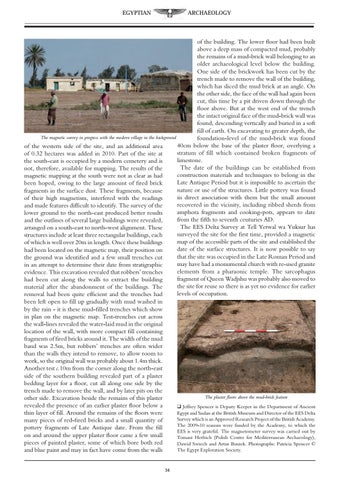
of the building. The lower floor had been built above a deep mass of compacted mud, probably the remains of a mud-brick wall belonging to an older archaeological level below the building. One side of the brickwork has been cut by the trench made to remove the wall of the building, which has sliced the mud brick at an angle. On the other side, the face of the wall had again been cut, this time by a pit driven down through the floor above. But at the west end of the trench the intact original face of the mud-brick wall was found, descending vertically and buried in a soft fill of earth. On excavating to greater depth, the The magnetic survey in progress with the modern village in the background foundation-level of the mud-brick was found 40cm below the base of the plaster floor, overlying a of the western side of the site, and an additional area stratum of fill which contained broken fragments of of 0.32 hectares was added in 2010. Part of the site at limestone. the south-east is occupied by a modern cemetery and is The date of the buildings can be established from not, therefore, available for mapping. The results of the construction materials and techniques to belong in the magnetic mapping at the south were not as clear as had Late Antique Period but it is impossible to ascertain the been hoped, owing to the large amount of fired brick nature or use of the structures. Little pottery was found fragments in the surface dust. These fragments, because in direct association with them but the small amount of their high magnetism, interfered with the readings recovered in the vicinity, including ribbed sherds from and made features difficult to identify. The survey of the amphora fragments and cooking-pots, appears to date lower ground to the north-east produced better results from the fifth to seventh centuries AD. and the outlines of several large buildings were revealed, The EES Delta Survey at Tell Yetwal wa Yuksur has arranged on a south-east to north-west alignment. These surveyed the site for the first time, provided a magnetic structures include at least three rectangular buildings, each map of the accessible parts of the site and established the of which is well over 20m in length. Once these buildings date of the surface structures. It is now possible to say had been located on the magnetic map, their position on that the site was occupied in the Late Roman Period and the ground was identified and a few small trenches cut may have had a monumental church with re-used granite in an attempt to determine their date from stratigraphic elements from a pharaonic temple. The sarcophagus evidence. This excavation revealed that robbers’ trenches fragment of Queen Wadjshu was probably also moved to had been cut along the walls to extract the building the site for reuse so there is as yet no evidence for earlier material after the abandonment of the buildings. The levels of occupation. removal had been quite efficient and the trenches had been left open to fill up gradually with mud washed in by the rain - it is these mud-filled trenches which show in plan on the magnetic map. Test-trenches cut across the wall-lines revealed the water-laid mud in the original location of the wall, with more compact fill containing fragments of fired bricks around it. The width of the mud band was 2.5m, but robbers’ trenches are often wider than the walls they intend to remove, to allow room to work, so the original wall was probably about 1.4m thick. Another test c.10m from the corner along the north-east side of the southern building revealed part of a plaster bedding layer for a floor, cut all along one side by the trench made to remove the wall, and by later pits on the The plaster floors above the mud-brick feature other side. Excavation beside the remains of this plaster revealed the presence of an earlier plaster floor below a q Jeffrey Spencer is Deputy Keeper in the Department of Ancient Egypt and Sudan at the British Museum and Director of the EES Delta thin layer of fill. Around the remains of the floors were Survey which is an Approved Research Project of the British Academy. many pieces of red-fired bricks and a small quantity of The 2009-10 seasons were funded by the Academy, to which the pottery fragments of Late Antique date. From the fill EES is very grateful. The magnetometer survey was carried out by on and around the upper plaster floor came a few small Tomasz Herbich (Polish Centre for Mediterranean Archaeology), pieces of painted plaster, some of which bore both red Dawid Swiech and Artur Buszek. Photographs: Patricia Spencer Š The Egypt Exploration Society. and blue paint and may in fact have come from the walls 34