EGYPTIAN
ARCHAEOLOGY
A limestone crown with feathers and horns, from the Labyrinth at Hawara, Petrie 1911 (ÆIN 1418). Photograph: Ole Haupt
The crown (left) in the Glyptotek in Copenhagen belongs to a Sobek torso (also from Petrie’s excavations at Hawara 1911) in the Museum of Fine Arts in Boston. The join was verified in April 2010 with a cast of the base of the crown. (Courtesy of Museum of Fine Arts, Boston)
and Petrie commented that ‘Maspero will certainly want it as it is a new type of stone statue’. Great was his joy when a second similar naos appeared and his first thought was to offer it to ‘Carlsberg’, where it arrived in 1911. Another Hawara statue fragment at the Glyptotek is a limestone crown with tall feathers and horns that Petrie judged to belong to a royal statue. He had also uncovered three Sobek busts; the one with most of the (human) body preserved went to Cairo, another to the Ashmolean Museum in Oxford and the third to the Museum of Fine Arts, Boston. It was suggested by Ingrid Blom-Böer, who has worked on Hawara fragments, that the Glyptotek crown belonged with the Ashmolean Sobek, which has been reconstructed with a snout. Measurements and photographs were exchanged with the museum to see if the crown could fit, but it turned out not to be the case, although it had been a reasonable suggestion. A much better match was subsequently found with the Boston Sobek, which had a hanging uraeus on its left shoulder fitting well with the thin ‘string’ element on the left side of the crown. A cast of the base of the crown was brought to Boston and proved the join to be correct. After the First World War it took some time before European expeditions were back in business in Egypt, but from 1920 until 1922 Petrie finds again arrived in Copenhagen. Maria Mogensen, curator at the Glyptotek, was in charge of the selection of objects for the museum. On
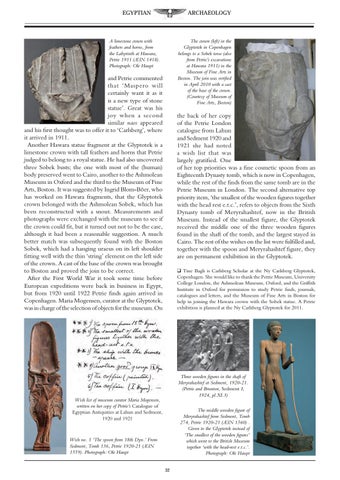
the back of her copy of the Petrie London catalogue from Lahun and Sedment 1920 and 1921 she had noted a wish list that was largely gratified. One of her top priorities was a fine cosmetic spoon from an Eighteenth Dynasty tomb, which is now in Copenhagen, while the rest of the finds from the same tomb are in the Petrie Museum in London. The second alternative top priority item, ‘the smallest of the wooden figures together with the head rest e.t.c.’, refers to objects from the Sixth Dynasty tomb of Meryrahashtef, now in the British Museum. Instead of the smallest figure, the Glyptotek received the middle one of the three wooden figures found in the shaft of the tomb, and the largest stayed in Cairo. The rest of the wishes on the list were fulfilled and, together with the spoon and Meryrahashtef figure, they are on permanent exhibition in the Glyptotek. q Tine Bagh is Carlsberg Scholar at the Ny Carlsberg Glyptotek, Copenhagen. She would like to thank the Petrie Museum, University College London, the Ashmolean Museum, Oxford, and the Griffith Institute in Oxford for permission to study Petrie finds, journals, catalogues and letters, and the Museum of Fine Arts in Boston for help in joining the Hawara crown with the Sobek statue. A Petrie exhibition is planned at the Ny Carlsberg Glyptotek for 2011.
Three wooden figures in the shaft of Meryrahashtef at Sedment, 1920-21. (Petrie and Brunton, Sedment I, 1924, pl.XI.3)
Wish list of museum curator Maria Mogensen, written on her copy of Petrie’s Catalogue of Egyptian Antiquities at Lahun and Sedment, 1920 and 1921
The middle wooden figure of Meryrahashtef from Sedment, Tomb 274, Petrie 1920-21 (ÆIN 1560) . Given to the Glyptotek instead of ‘The smallest of the wooden figures’ which went to the British Museum together ‘with the head-rest e.t.c.’. Photograph: Ole Haupt
Wish no. 1 ‘The spoon from 18th Dyn.’ From Sedment, Tomb 136, Petrie 1920-21 (ÆIN 1559). Photograph: Ole Haupt 32