EGYPTIAN
ARCHAEOLOGY
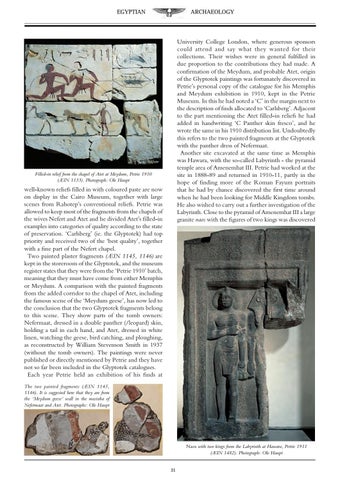
University College London, where generous sponsors could attend and say what they wanted for their collections. Their wishes were in general fulfilled in due proportion to the contributions they had made. A confirmation of the Meydum, and probable Atet, origin of the Glyptotek paintings was fortunately discovered in Petrie’s personal copy of the catalogue for his Memphis and Meydum exhibition in 1910, kept in the Petrie Museum. In this he had noted a ‘C’ in the margin next to the description of finds allocated to ‘Carlsberg’. Adjacent to the part mentioning the Atet filled-in reliefs he had added in handwriting ‘C Panther skin fresco’, and he wrote the same in his 1910 distribution list. Undoubtedly this refers to the two painted fragments at the Glyptotek with the panther dress of Nefermaat. Another site excavated at the same time as Memphis was Hawara, with the so-called Labyrinth - the pyramid temple area of Amenemhat III. Petrie had worked at the site in 1888-89 and returned in 1910-11, partly in the hope of finding more of the Roman Fayum portraits that he had by chance discovered the first time around when he had been looking for Middle Kingdom tombs. He also wished to carry out a further investigation of the Labyrinth. Close to the pyramid of Amenemhat III a large granite naos with the figures of two kings was discovered
Filled-in relief from the chapel of Atet at Meydum, Petrie 1910 (ÆIN 1133). Photograph: Ole Haupt
well-known reliefs filled in with coloured paste are now on display in the Cairo Museum, together with large scenes from Rahotep’s conventional reliefs. Petrie was allowed to keep most of the fragments from the chapels of the wives Nefert and Atet and he divided Atet’s filled-in examples into categories of quality according to the state of preservation. ‘Carlsberg’ (ie. the Glyptotek) had top priority and received two of the ‘best quality’, together with a fine part of the Nefert chapel. Two painted plaster fragments (ÆIN 1145, 1146) are kept in the storeroom of the Glyptotek, and the museum register states that they were from the ‘Petrie 1910’ batch, meaning that they must have come from either Memphis or Meydum. A comparison with the painted fragments from the added corridor to the chapel of Atet, including the famous scene of the ‘Meydum geese’, has now led to the conclusion that the two Glyptotek fragments belong to this scene. They show parts of the tomb owners: Nefermaat, dressed in a double panther (/leopard) skin, holding a tail in each hand, and Atet, dressed in white linen, watching the geese, bird catching, and ploughing, as reconstructed by William Stevenson Smith in 1937 (without the tomb owners). The paintings were never published or directly mentioned by Petrie and they have not so far been included in the Glyptotek catalogues. Each year Petrie held an exhibition of his finds at The two painted fragments (ÆIN 1145, 1146). It is suggested here that they are from the ‘Meydum geese’ wall in the mastaba of Nefermaat and Atet. Photographs: Ole Haupt
Naos with two kings from the Labyrinth at Hawara, Petrie 1911 (ÆIN 1482). Photograph: Ole Haupt 31