EGYPTIAN
ARCHAEOLOGY
Petrie finds revisited Since 2009 a three-year project supported by the Carlsberg Foundation has been documenting all the excavated material from Egypt at the Ny Carlsberg Glyptotek in Copenhagen. Tine Bagh presents the results of recent research on finds from Meydum and Hawara. During the years 1908-13 and 1920-22, the Ny Carlsberg Foundation in Copenhagen was one of the principal sponsors of Flinders Petrie’s excavations in Egypt. According to the regulations then in force, finds were divided between the Egyptian Museum in Cairo and the excavator, who distributed the objects among his sponsors. The Ny Carlsberg Foundation’s share was donated, most generously, to the Ny Carlsberg Glyptotek, founded by the brewing magnate Carl Jacobsen, and the museum thus today holds a fine collection of Petrie finds ranging from colossal statues to fragments of faience. The Foundation’s first financial support for Flinders Petrie and his British School of Archaeology was agreed in 1908 and may have contributed to Petrie’s decision to launch what would be his largest and most demanding fieldwork project in Egypt, the excavation of the ancient metropolis of Memphis, continued annually until 1913.
Each year, during the wet autumn period when it was not possible to excavate at Memphis, Petrie and his team worked at other sites; so, together with finds from each of the six seasons at Memphis, the Glyptotek also received objects from Meydum, Hawara, el-Gerzeh, Shurafa, Tarkhan, Riqqeh and Harageh, and later (1920-22) Lahun, Sedment and Abydos. Petrie had already visited Meydum on an early photographic tour in 1881 when he first worked in Egypt, and in 1890-91 he had copied scenes from the tomb chapels of Nefermaat and Atet as well as those of Rahotep and Nefert from the time of King Snofru. He returned to the site in 1910 with his assistants Gerald Wainwright and Ernest MacKay and it was agreed with the Antiquities Service, then headed by Gaston Maspero, that they should dismantle the tomb chapels, as they were much decayed. The more complete inner chapel of Nefermaat with the
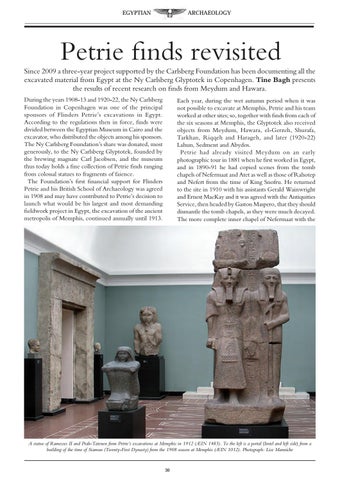
A statue of Ramesses II and Ptah-Tatenen from Petrie’s excavations at Memphis in 1912 (ÆIN 1483). To the left is a portal (lintel and left side) from a building of the time of Siamun (Twenty-First Dynasty) from the 1908 season at Memphis (ÆIN 1012). Photograph: Lise Manniche
30