EGYPTIAN
ARCHAEOLOGY
its SE. Ceramic evidence indicates that the site was occupied from the fourth to sixth centuries AD.
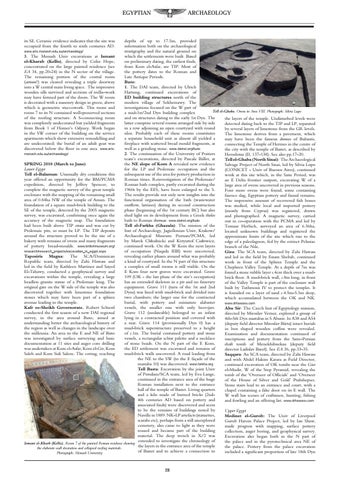
depths of up to 17.5m, provided information both on the archaeological www.arts.monash.edu.au/archaeology/ stratigraphy and the natural ground on 3. The Monash Univ excavations at Ismant which the settlements were built. Based el-Kharab (Kellis), directed by Colin Hope, on preliminary dating, the earliest finds, concentrated on the large painted residence (see from Kom el-Asfar, are TIP. Most of EA 34, pp.20-24) in the N sector of the village. the pottery dates to the Roman and The remaining portion of the central room Late Antique Periods. (atrium?) was cleared revealing a triple doorway Buto: into a W central main living space. The impressive 1. The DAI team, directed by Ulrich wooden sills survived and sections of trellis-work Hartung, continued excavations of may have formed part of the doors. The W room ED building structures north of the is decorated with a masonry design in green, above modern village of Sekhemawy. The which is geometric stuccowork. This room and investigations focused on the W part of Tell el-Ghaba. Ovens in Area VIII. Photograph: Silvia Lupo room 7 to its N contained well-preserved sections a mid-1st/2nd Dyn building complex of the roofing structure. A S-connecting room and on structures dating to the early 1st Dyn. The the layers of the temple. Undisturbed levels were was completely undecorated but yielded fragments latter comprise several rooms arranged side by side detected dating back to the TIP and LP, separated from Book 1 of Homer’s Odyssey. Work began in a row adjoining an open courtyard with round by several layers of limestone from the GR levels. in the SW corner of the building on the service silos. Probably each of these rooms constitutes The limestone derives from a pavement, which apartments which show extensive remodelling and a separate household unit as almost all yielded a may have been the famous dromos of Bubastis, are undecorated; the burial of an adult goat was fireplace with scattered bread mould fragments, as connecting the Temple of Hermes in the centre of discovered below the floor in one area. www.arts. well as a grinding stone. www.dainst.org/buto the city with the temple of Bastet, as described by monash.edu.au/archaeology/ 2. The continuation of the University of Poitiers Herodotus (II, 137-138). See also pp.17-20. team’s excavations, directed by Pascale Ballet, at Tell el-Ghaba (North Sinai): The Archaeological SPRING 2010 (March to June) the NE slope of Kom A revealed new evidence Salvage Project of North Sinai, led by Silvia Lupo Lower Egypt for the LP and Ptolemaic occupation and the (CONICET - Univ of Buenos Aires), continued Tell el-Balamun: Unusually dry conditions this subsequent use of the area for pottery production in work at this site which, in the Saite Period, was year offered an opportunity for the BM/PCMA Roman times. Reinvestigation of the Ptolemaic/ an E Delta frontier outpost, excavating W of a expedition, directed by Jeffrey Spencer, to Roman bath complex, partly excavated during the large area of ovens uncovered in previous seasons. complete the magnetic survey of the great temple 1960s by the EES, have been enlarged to the S. Four more ovens were found, some containing enclosure with the mapping of the remaining small The results provide not only new insights into the faience slag, Egyptian pottery and faunal remains. area of 0.84ha NW of the temple of Amun. The functional organisation of the bath (wastewater The impressive amount of recovered fish bones foundation of a square mud-brick building to the outflow, latrines) during its second construction was studied, while local and imported pottery SE of the temple, detected by the 2005 magnetic phase (beginning of the 1st century BC) but also (mostly from Cyprus) was registered, drawn survey, was excavated, confirming once again the shed light on its development from a Greek tholos and photographed. A magnetic survey, carried accuracy of the magnetic map. The foundation bath to Roman thermae. www.dainst.org/buto out in co-operation with the PCMA and led by had been built above TIP strata and was cut by Tell el-Farkha (Ghazala): The mission of the Tomasz Herbich, surveyed an area of 6.56ha, Ptolemaic pits, so must be LP. The TIP deposits Inst of Archaeology, Jagiellonian Univ, Krakow/ located unknown buildings and registered the around the structure proved to be the site of a Archaeological Museum Poznan/PCMA, led approximate limits of the site which run to the bakery with remains of ovens and many fragments by Marek Chłodnicki and Krzysztof Ciałowicz, edge of a paleolagoon, fed by the extinct Pelusiac of pottery bread-moulds. www.britishmuseum.org/ continued work. On the W Kom the next layers branch of the Nile. research/research_projects/excavation_in_egypt.aspx of occupation (Naqada IIIB) were uncovered, Giza: The SCA team, directed by Zahi Hawass Taposiris Magna: The SCA/Dominican revealing earlier phases around what was probably and led in the field by Essam Shebab, continued Republic team, directed by Zahi Hawass and a kind of courtyard. In the N part of this structure work in front of the Sphinx Temple and the led in the field by Kathleen Martinez and Sayed a complex of small rooms is still visible. On the Chephren Valley Temple. At a depth of 7m was El-Tahawy, conducted a geophysical survey and E Kom four new graves were excavated. Grave found a stone rubble layer c.4cm thick over a mudexcavations within the temple, revealing a large 109 (OK - the last phase of the site’s occupation) brick floor. A mud-brick wall, c.8m long, in front headless granite statue of a Ptolemaic king. The has an extended skeleton in a pit and no funerary of the Valley Temple is part of the enclosure wall original gate on the W side of the temple was also equipment. Grave 111 (turn of the 1st and 2nd built by Tuthmosis IV to protect the temples. It discovered together with limestone foundation Dyns) was lined with mud-brick and divided into is founded on a layer of sand c.4.5m-5.5m deep, stones which may have been part of a sphinx two chambers; the larger one for the contracted which accumulated between the OK and NK. avenue leading to the temple. burial, with pottery and miniature alabaster www.drhawass.com Kafr es-Sheikh Governorate. Robert Schiestl vessels, the smaller one with only beer-jars. Abu Sir: The Czech Inst of Egyptology mission, conducted the first season of a new DAI regional Grave 112 (undateable) belonged to an infant directed by Miroslav Verner, explored a group of survey, in the area around Buto, aimed at lying in a contracted position and covered with 4th-5th Dyn mastabas in S Abusir. In A38 and A54 understanding better the archaeological history of a mat. Grave 114 (provisionally Dyn 0) has a (deputy field director Miroslav Bárta) intact burials the region as well as changes in the landscape over mud-brick superstructure preserved to a height in box shaped wooden coffins were revealed. the millennia. An area to the E and NE of Buto of c.1m. The burial contained pottery and stone Examination and documentation continued of was investigated by surface surveying and basic vessels, a rectangular schist palette and a necklace inscriptions and pottery from the Saite-Persian documentation at 11 sites and auger core drilling of stone beads. On the N part of the E Kom, shaft tomb of Menekhibnekau (deputy field was undertaken at Kom el-Asfar, Kom el-Gir, Kom the ED settlement was excavated and remains of director Ladislav Bareš). See EA 36, pp.33-35. Saleh and Kom Sidi Salem. The coring, reaching mud-brick walls uncovered. A road leading from Saqqara: An SCA team, directed by Zahi Hawass the NE to the SW (to the E façade of the and with Abdel Hakim Karara as Field Director, mastaba 10) was discovered. www.farkha.org continued excavation of OK tombs near the Gisr Tell Basta: Excavation by the joint Univ el-Mudir, W of the Step Pyramid, revealing the of Potsdam/SCA team, led by Eva Lange, tomb of the ‘Overseer of Officials’ and ‘Overseer continued in the entrance area of the huge of the House of Silver and Gold’ Ptahshepses. Roman installation next to the entrance Stone stairs lead to an entrance and court, with a hall of the temple of Bastet. Living quarters chapel containing a false door on its E wall. The and a kiln made of burned bricks (2ndW wall has scenes of craftsmen, hunting, fishing 4th centuries AD based on pottery and and fowling and an offering list. www.drhawass.com associated finds) were discovered and seem to be the remains of buildings noted by Upper Egypt Naville in 1889. NK-LP artefacts (statuettes, Medinet el-Gurob: The Univ of Liverpool scarabs etc), perhaps from a still unexplored Gurob Harem Palace Project, led by Ian Shaw, cemetery, also came to light as they were made progress with mapping, surface pottery reused and became part of the building collection, auger boring, and geophysical survey. material. The deep trench in X/2 was Excavation also began both in the N part of extended to investigate the chronology of the palace and in the pyrotechnical area NE of Ismant el-Kharb (Kellis). Room 7 of the painted Roman residence showing the layers in the entrance area of the temple the palace. Pottery from the palace excavation the elaborate wall decoration and collapsed roofing materials. of Bastet and to achieve a connection to included a significant proportion of late 18th Dyn Photograph: Monash University 28