EGYPTIAN
Kom el-Hettan. The monumental red granite head found in the Peristyle Court. Photograph: The Colossi of Memnon and Amenhotep III Temple Conservation Project
dated to the 26th Dyn, that located in the open courtyard, next to the façade, was probably intended for a close relative of Djehuty. Cleaning started of the walls of the chapel and fallen blocks were replaced. In the tomb of Hery (TT 12), the ceiling of the innermost chamber was consolidated prior to excavation next season. 3. At Khokha the OI team, led by W Raymond Johnson, began a condition study and preliminary photographic documentation of the tomb of Amenhotep III’s Steward of Malkata Palace, the nobleman Nefersekheru (TT 107), in preparation for the stabilisation and drawing of the portico. http://oi.uchicago.edu/research/projects/epi/
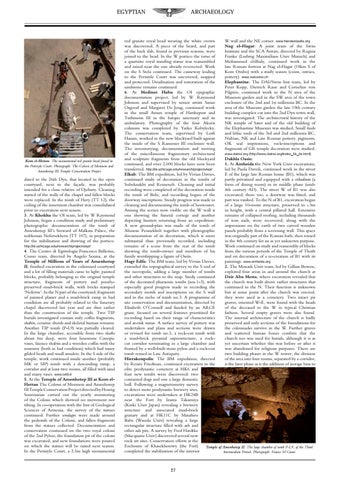
4. The Centro di Egittologia Francesco Ballerini, Como team, directed by Angelo Sesana, at the Temple of Millions of Years of Amenhotep II, finished excavation in the columned courtyard and a lot of filling materials came to light: painted blocks, probably belonging to the original temple structure, fragments of pottery and poorlypreserved mud-brick walls, with bricks stamped ‘Neferiw’. In the N part of the courtyard, fragments of painted plaster and a mud-brick ramp in bad condition are all probably related to the funerary chapel discovered last year and are thus earlier than the construction of the temple. Two TIP burials investigated contain only coffin fragments, shabtis, ceramic sherds and skeletal human remains. Another TIP tomb (P-L9) was partially cleared. In the large chamber, accessible from two shafts about 6m deep, were four limestone Canopic vases, faience shabtis and a wooden coffin with the mummy (both in bad condition) which had many gilded beads and small amulets. In the S side of the temple, work continued inside another (probably MK or SIP) tomb with a descending ramp, a corridor and at least two rooms, all filled with sand and many vases. www.cefb.it 5. At the Temple of Amenhotep III at Kom elHettan The Colossi of Memnon and Amenhotep III Temple Conservation Project directed by Hourig Sourouzian carried out the yearly monitoring of the Colossi which showed no movement nor tilting. In co-operation with the Inst of Geological Sciences of Armenia, the survey of the statues continued. Further sondages were made around the pedestals of the Colossi, and fallen fragments from the statues collected. Documentation and conservation continued on the two royal colossi of the 2nd Pylon; the foundation pit of the colossi was excavated, and new foundations were poured on which the statues will be raised next season. In the Peristyle Court, a 2.5m high monumental
ARCHAEOLOGY
red granite royal head wearing the white crown W wall and the NE corner. www.hierakonpolis.org was discovered. A piece of the beard, and part Nag el-Hagar: A joint team of the Swiss of the back slab, found in previous seasons, were Institute and the SCA Aswan, directed by Regina joined to the head. In the W portico the torso of Franke (Ludwig Maximilians Univ Munich) and a quartzite royal standing statue was reassembled Mohammed el-Bialy, continued work in the and raised near the one already re-erected. Work late Roman fortress at Nag el-Hagar (18km S of on the S Stela continued. The causeway leading Kom Ombo) with a study season (coins, ostraca, to the Peristyle Court was uncovered, mapped pottery). www.swissinst.ch and protected. Desalination and restoration of the Elephantine: The DAI/Swiss Inst team, led by sandstone remains continued. Peter Kopp, Dietrich Raue and Cornelius von 6. At Medinet Habu the OI epigraphic Pilgrim, continued work in the N area of the documentation project, led by W Raymond Museum garden and in the SW area of the town Johnson and supervised by senior artists Susan enclosure of the 2nd and 1st millennia BC. In the Osgood and Margaret De Jong, continued work area of the Museum garden the late 19th century in the small Amun temple of Hatshepsut and building complex cut into the 2nd Dyn town wall, Tuthmosis III in the barque sanctuary and its was investigated. The architectural history of the ambulatory. Photography of the four Akoris NK temple of Satet and of the old building of columns was completed by Yarko Kobylecky. the Elephantine Museum was studied. Small finds The conservation team, supervised by Lotfi and lithic tools of the 3rd and 2nd millennia BC, Hassan, worked in the new blockyard built against Nubian, NK and Late Roman pottery, pigments, the inside of the S Ramesses III enclosure wall. OK seal impressions, rock-inscriptions and The inventorying, documentation and moving fragments of GR temple decoration were studied. of the miscellaneous fragmentary architectural www.dainst.org (http://www.dainst.org/index_56_de.html) and sculpture fragments from the old blockyard Dakhla Oasis: continued, and over 2,000 blocks have now been 1. At Amheida the New York Univ excavations, transferred. http://oi.uchicago.edu/research/projects/epi/ led by Paola Davoli, continued work in the street Elkab: The BM expedition, led by Vivian Davies, E of the large late Roman house (B1), which was continued study of decoration in the tombs of partly privatised and equipped with a stibadium (a Sobeknakht and Renseneb. Cleaning and initial form of dining room) in its middle phase (midrecording were completed of the decoration inside 4th century AD). The street W of B1 was also the tomb of Bebi, and recording begun of the excavated; there too, a doorway was fitted, and doorway inscriptions. Steady progress was made in part was vaulted. To the N of B1, excavation began cleaning and documenting the tomb of Senwosret. of a large 10-room structure, preserved to c.3m Among the scenes now visible on the W wall is in height, with a central pillared hall. Extensive one showing the funeral cortege and another remains of collapsed roofing, including thousands depicting hunters returning from an expedition. of iron nails, were recovered, along with the A new ground-plan was made of the tomb of impressions on the earth of two carved wooden Ahmose Pennekheb together with photographic panels probably from a screening wall. This space documentation of its decoration, which is more was originally part of the Roman bath, then reused substantial than previously recorded, including in the 4th century for an as yet unknown purpose. remains of a scene from the rear of the tomb Work continued on study and reassembly of blocks showing the tomb-owner and members of his from the various periods of the Temple of Thoth family worshipping a figure of Osiris. and on decoration of a re-creation of B1 with its Hagr Edfu: The BM team, led by Vivian Davies, paintings. www.amheida.org extended the topographical survey to the S end of 2. The Monash Univ team, led by Gillian Bowen, the necropolis, adding a large number of tombs explored four areas in and around the church at and other structures to the map. Study continued Deir Abu Metta, where excavation revealed that of the decorated pharaonic tombs (nos.1-3), with the church was built above earlier structures that especially good progress made in recording the continued to the N. Their function is unknown secondary motifs and inscriptions on the S wall but at some point after the church was erected, and in the niche of tomb no.3. A programme of they were used as a cemetery. Two intact pit site conservation and documentation, directed by graves, oriented W-E, were found with the heads Elisabeth O’Connell and funded by an ARCE of the deceased to the W in typical Christian grant, focused on several features prioritised for fashion. Several empty graves were also found. recording based on their range of characteristics The internal architecture of the church is badly and at-risk status. A surface survey of pottery was preserved and only sections of the foundations for undertaken and plans and sections were drawn the colonnades survive in the W. Further graves or revised for tomb no.3, a rock-cut tomb with and scattered human bones confirm that the a mud-brick pyramid superstructure, a rockchurch too was used for burials, although it is as cut corridor terminating in a large chamber and yet uncertain whether this was before or after it fronted by a well-built stone pylon and a rock-cut was abandoned for religious purposes. There are tomb reused in Late Antiquity. two building phases in the W tower; the division Hierakonpolis: The BM expedition, directed of the area into four rooms, separated by a corridor, by Renée Friedman, continued excavation in the is the later phase as is the addition of storage bins to elite predynastic cemetery at HK6 and four new tombs were discovered: two contained dogs and one a large domestic bull. Following a magnetometry survey to detect more predynastic brewery sites, excavations were undertaken at HK24B near the Fort by Izumi Takamiya (Kinki Univ Japan) revealing a brewery structure and associated mud-brick granary and at HK11C by Masahiro Baba (Waseda Univ) revealing a large rectangular structure filled with ash and other ash pits. A survey by Fred Hardtke (Macquarie Univ) discovered several new rock art sites. Conservation efforts at the Enclosure of Khasekhemwy (the Fort) Temple of Amenhotep II. The large chamber of tomb P-L9, of the Third completed the stabilization of the interior Intermediate Period. Photograph: Franco M Giani
27