EGYPTIAN
ARCHAEOLOGY
monastic cemetery. The hilltop above the tomb was excavated uncovering a tower of 9m x 9m with walls 1.5m thick and still standing to 1.5m in height; its entrance had been on the second floor. An escape tunnel under the wall had been left unfinished. Late Roman pottery was sparse but many glazed wares have been found, so this hermitage can be dated to the 10th century, much later than the others in the vicinity. Work continued also in the rock necropolis (directed by Luis Gonzálves), completing research in tomb T24, where falcon and ibis mummy galleries were uncovered. A new tomb (M8b, end of OK) was opened; it has a chapel with an anepigraphic falsedoor. The court of the tomb was reused for burials in Ptolemaic and Coptic times. www.ianes.uni-
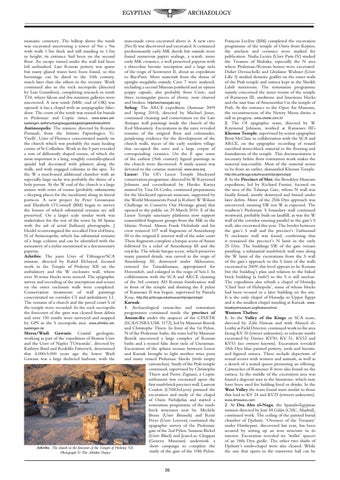
man-made caves excavated above it. A new cave (No.8) was discovered and excavated. It contained predominantly early MK sherds but outside were found numerous papyri sealings, a scarab, more early MK ceramics, a well preserved papyrus with a three-line hieratic inscription and a large stela of the reign of Senwosret II, about an expedition to Bia-Punt. More materials from the shrine of upright megaliths outside Cave 7 were analysed, including a second Minoan potsherd and an opium poppy capsule, also probably from Crete, and three rectangular pieces of ebony, now charred and broken. http//archaeogate.org Sohag: The ARCE expedition (Autumn 2009 and Spring 2010), directed by Michael Jones, continued cleaning and conservation on the Late tuebingen.de/forschung/aegyptologie/projekte/index/html Antique wall paintings inside the church of the Antinoopolis: The mission, directed by Rosario Red Monastery. Excavations in the nave revealed Pintaudi, from the Istituto Papirologico ‘G. remains of the original floor and colonnades, Vitelli’, Univ of Florence concentrated mainly on perplexing evidence for the development of the the church which was probably the main healing church walls, traces of the early modern village centre of St Colluthos. Work in the S part revealed that occupied the nave and a large corpus of a row of differently shaped rooms, of which the corresponding ceramics. On the E apse some most important is a long, roughly centrally-placed of the earliest (?6th century) figural paintings in apsidal hall decorated with pilasters along the the church were discovered. A study season was walls, and with engaged columns in the apse. To devoted to the ceramic material. www.arce.org the W a much-used additional chamber with an Luxor: The OI’s Luxor Temple blockyard especially large niche was probably the shrine of a conservation programme, directed by W Raymond holy person. At the W end of the church is a large Johnson and co-ordinated by Hiroko Kariya atrium with rows of rooms (probably enkoimeteria assisted by Tina Di Cerbo, continued preparations - sleeping places for the incubants) along its lateral for the blockyard open-air museum, supported by porticos. A new project by Peter Grossmann the World Monuments Fund (a Robert W Wilson and Elizabeth O’Connell (BM) began to survey Challenge to Conserve Our Heritage grant) that the houses of which substantial remains are still opened to the public on 29 March 2010. E of the preserved. On a larger scale similar work was Luxor Temple sanctuary platforms now support undertaken for the rest of the town by M Spanu reassembled fragment groups from the MK to the with the aid of aerial (balloon) photographs. J Islamic Period. Mason Frank Helmholz and his Heidel re-investigated the so-called Deir el-Hawa, crew restored 107 wall fragments of Amenhotep N of Antinoopolis, which has substantial remains III to the original E interior wall of the solar court of a huge column and can be identified with the These fragments complete a barque scene of Amun monastery of a stylite mentioned in a documentary followed by a relief of Amenhotep III and the papyrus. royal ka. The whole barque scene, which preserves Athribis: The joint Univ of Tübingen/SCA many painted details, was carved in the reign of mission, directed by Rafed El-Sayed, focused Amenhotep III, destroyed under Akhenaten, work in the Temple of Ptolemy XII on the restored for Tutankhamun, appropriated for ambulatory and the W enclosure wall, where Horemheb, and enlarged in the reign of Seti I. In over 30 stone blocks were moved. The epigraphic collaboration with the SCA and ARCE cleaning survey and recording of the inscriptions and scenes of the 3rd century AD Roman fortification wall on the outer enclosure walls were completed. in front of the temple and abutting the E pylon Conservation treatments of wall paintings of Ramesses II was begun, supervised by Pamela concentrated on corridor C5 and ambulatory L1. Rose. http://oi.uchicago.edu/research/projects/epi/ The remains of a church and the paved court S of Karnak: the temple were recorded. In the rock necropolis 1. Archaeological researches and restoration the forecourt of the speos was cleared from debris programmes continued inside the precinct of and over 150 tombs were surveyed and mapped Amun-Re under the auspices of the CFEETK by GPS in the S necropolis area. www.athribis.uni(SCA/CNRS USR 3172), led by Mansour Boreik tuebingen.de and Christophe Thiers. In front of the 1st Pylon, Mersa/Wadi Gawasis: Coastal geologists, N of the Ptolemaic baths, the team led by Mansour working as part of the expedition of Boston Univ Boreik uncovered a large complex of Roman and the Univ of Naples ‘l’Orientale’, directed by baths and a reused false door stela of Useramun. Kathryn Bard and Rodolfo Fattovich, determined Excavation of the sphinx avenue between Luxor that 4,000-5,000 years ago the lower Wadi and Karnak brought to light another wine press Gawasis was a large sheltered harbour, with the and many reused Ptolemaic blocks (with empty cartouches). Study of the Ptah temple continued, supervised by Christophe Thiers and Pierre Zignani; a Coptic settlement was excavated upon the first mud-brick precinct wall. Laurent Coulon (CNRS-Lyon) pursued the excavation and study of the chapel of Osiris Nebdjefau and started a restoration programme of the mudbrick structures near by. Michèle Broze (Univ Brussels) and René Preys (Univ Leuven) continued the epigraphic survey of the Ptolemaic gate of the 2nd Pylon. Susanne Bickel (Univ Bäsel) and Jean-Luc Chappaz (Geneva Museum) undertook a short campaign to complete the Athribis. The church in the forecourt of the Temple of Ptolemy XII. study of the gate of the 10th Pylon. Photograph © The Athribis Project
26
François Leclère (BM) completed the excavation programme of the temple of Osiris from Koptos; the artefacts and ceramics were studied for publication. Nadia Licitra (Univ Paris IV) studied the Treasure of Shabaka, especially the N area where Ptolemaic/Roman houses were excavated. Didier Devauchelle and Ghislaine Widmer (Univ Lille 3) studied demotic graffiti on the outer walls of the Ptah temple and ostraca kept in the Sheikh Labib storeroom. The restoration programme mainly concerned the inner rooms of the temple of Ramesses III, sandstone and limestone blocks and the naos base of Amenemhat I in the temple of Ptah. At the entrance to the Open Air Museum, the reconstruction of the Netery Menu shrine is still in progress. www.cfeetk.cnrs.fr/ 2. The OI epigraphic team, directed by W Raymond Johnson, worked at Ramesses III’s Khonsu Temple, supervised by senior epigrapher Brett McClain in collaboration with the SCA and ARCE, on the epigraphic recording of reused inscribed stone-block material in the flooring and foundations of the temple This documentation is necessary before floor restoration work makes the material inaccessible. Most of the material seems to be from an earlier, dismantled Khonsu Temple. http://oi.uchicago.edu/research/projects/epi/
3. In the Precinct of Mut, the Brooklyn Museum expedition, led by Richard Fazzini, focused on the area of the Taharqo Gate, whose N wall was finally found, mostly destroyed and buried under later debris. More of the 25th Dyn approach was uncovered, running SW not W as expected. The roadway’s Ptolemaic S boundary wall continued westward, probably built on landfill, as was the W wall of the corridor running parallel to the gate’s S wall, also excavated this year. The border between the gate’s S wall and the precinct’s Tuthmosid N enclosure wall was found, confirming that it remained the precinct’s N limit in the early 25 Dyn. The buildings SW of the gate remain puzzling; a substantial mud-brick wall runs along the W limit of the excavations from the S wall of the gate’s approach to the S limit of the walls excavated in 2009; this level appears to be Roman but the building’s plan and relation to the baked brick building (a bath?) to the S is still unclear. The expedition also rebuilt a chapel of Horudja ‘Chief Seer of Heliopolis’, some of whose blocks had been re-used in a later building on the site. It is the only chapel of Horudja in Upper Egypt and is the smallest chapel standing at Karnak. www. brooklynmuseum.org/features/mut
Western Thebes: 1. In the Valley of the Kings an SCA team, directed by Zahi Hawass and with Ahmed elLeithy as Field Director, continued work in the area facing KV 30 (owner unknown), to relocate tombs excavated by Davies: KV50, KV 51, KV52 and KV53 (no owners known). Excavation revealed 18th Dyn blue painted pottery, tools and hieratic and figured ostraca. These include depictions of sexual scenes with women and animals, as well as a sketch of a seated queen presenting an offering. Cartouches of Ramesses II were also found on the ostraca. In the middle of the excavation area was found a dug-out area in the limestone, which may have been used for holding food or drinks. In the West Valley the team found stairs similar to those that lead to KV 24 and KV25 (owners unknown). www.drhawass.com
2. At Dra Abu el-Naga, the Spanish-Egyptian mission directed by José M Galán (CSIC, Madrid), continued work. The ceiling of the painted burial chamber of Djehuty, ‘Overseer of the Treasury’ under Hatshepsut, discovered last year, has been secured by setting up an iron structure in its interior. Excavation revealed six ‘wallet’ spacers of an 18th Dyn girdle. The other two shafts of Djehuty’s tomb-chapel were also cleared. While the one that opens in the transverse hall can be