EGYPTIAN
ARCHAEOLOGY
Digging Diary 2009-10 Summaries of some of the archaeological work undertaken in Egypt during the Winter of 2009-10 and the Spring of 2010 appear below. The sites are arranged geographically from north to south, ending with the Oases. Field Directors who would like reports on their work to appear in EA are asked to e-mail a short summary, with a website address if available, as soon as possible after the end of each season to: patricia.spencer@ees.ac.uk PATRICIA SPENCER Abbreviations: ED Early Dynastic; OK Old Kingdom; FIP First Intermediate Period; MK Middle Kingdom; SIP Second Intermediate Period; NK New Kingdom; TIP Third Intermediate Period; LP Late Period; GR GraecoRoman; GPR Ground Penetrating Radar; GPS Global Positioning System. Institutes and Research Centres: ARCE American Research Center in Egypt; BM British Museum, London; CFEETK Franco-Egyptian Centre, Karnak; CNRS French National Research Centre; CONICET National Scientific and Technical Research Council, Buenos Aires; CSIC Spanish National Research Council; DAI German Institute, Cairo; IFAO French Institute, Cairo; NVIC Dutch-Flemish Institute, Cairo; OI Oriental Institute, University of Chicago; PCMA Polish Centre for Mediterranean Archaeology; SCA Supreme Council for Antiquities, Cairo: Swiss Inst Swiss Institute for Architectural Research and Archaeology, Cairo; USR research group of the CNRS. WINTER 2009-10 (November to March) Lower Egypt Memphis, Kom Tuman. Since 2001 a New Univ of Lisbon mission, led by Maria Helena Trindade Lopes, has been working at the ‘Palace of Apries’. Post-excavation analysis of materials found during 2008, at the area known as the ‘Mercenary camp’, were studied and a habitat structure was identified, divided into two main areas: a ‘kitchen’ with fire structures and some Greek decorated sherds, and an external area with a well and associated ceramics. Deir Abu Maqar (Wadi Natrun): Survey work continued by the Leiden Univ/NVIC team, led by Karel Innemée, around the monastery of St Macarius, within the new perimeter wall of the monastery. So far more than 160 structures, ranging from pottery dumps to manshubiyyas and large walled complexes, have been mapped. In
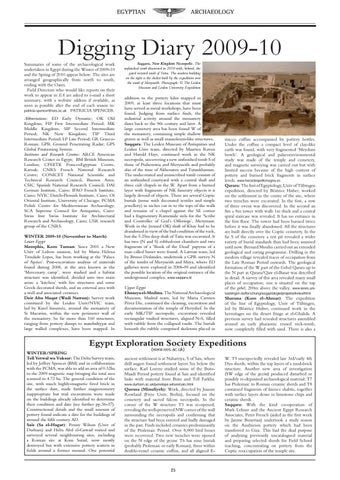
Saqqara, New Kingdom Necropolis. The unfinished tomb discovered in 2010 with, behind, the gated restored tomb of Tatia. The modern building on the right is the shelter built by the expedition over the tomb of Meryneith. Photograph: © The Leiden Museum and Leiden University Expedition
addition to the pottery kilns mapped in 2009, at least three locations that must have served as metal workshops, have been found. Judging from surface finds, the industrial activity around the monastery dates back to the 9th century and later. A large cemetery area has been found W of the monastery, containing simple shallow graves as well as small mausoleum-like structures. Saqqara: The Leiden Museum of Antiquities and Leiden Univ team, directed by Maarten Raven and Harold Hays, continued work in the NK necropolis, uncovering a new unfinished tomb S of those of Ptahemwia and Meryneith and probably also of the time of Akhenaten and Tutankhamun. The undecorated and uninscribed tomb consists of an unfinished courtyard with a central shaft and three cult chapels in the W. Apart from a burned layer with fragments of NK funerary objects it is largely devoid of objects. There are several Coptic burials (some with decorated textiles and simple jewellery) in niches cut in to the tops of the walls and remains of a chapel against the SE corner had a fragmentary Ramesside stela for the ‘Scribe and Controller of God’s Offerings’, Merymaat. Work in the (reused OK) shaft of Khay had to be abandoned in view of the bad condition of the rock, but the 5.25m deep shaft of Tatia was excavated. It has two (N and S) robbed-out chambers and two fragments of a ‘Book of the Dead’ papyrus of a man called Suner were found. A Latvian team, led by Bruno Deslandes, undertook a GPR survey N of the tombs of Meryneith and Maya, where ED galleries were explored in 2008-09 and identified the possible location of the original entrance of the underground complex. www.saqqara.nl Upper Egypt Ehnasya el-Medina. The National Archaeological Museum, Madrid team, led by Maria Carmen Pérez Die, continued the cleaning, excavation and documentation of the temple of Heryshef. In the early MK/TIP necropolis, excavation revealed rectangular vaulted structures, aligned N-S, filled with rubble from the collapsed vaults. The burials beneath the rubble comprised skeletons placed in
stucco coffins accompanied by pottery bottles. Under the coffins a compact level of clay-like earth was found, with very fragmented ‘Meydum bowls’. A geological and palaeoenvironmental study was made of the temple and cemetery, and magnetic surveying was carried out but with limited success because of the high content of pottery and burned brick fragments in surface levels. www.heracleopolismagna.es Qarara: The Inst of Egyptology, Univ of Tübingen expedition, directed by Béatrice Huber, worked on the settlement in the centre of the site, where two trenches were excavated. In the first, a row of three ovens was discovered. In the second an 8m x 8m tower with walls 1m thick and a central spiral staircase was revealed. It has no entrance in the first floor. The tower had been burned twice before it was finally abandoned. All the structures are built directly over the Coptic cemetery. In the far S of the cemetery a test pit revealed a wider variety of burial standards than had been assumed until now. Bernard Moulin carried out an extended geological and coring programme. Drilling in the modern village revealed traces of occupation from the Late Roman Period onwards. The geological formation of the W part of the Gebel Qarara up to the N part at Qarara/Qasr el-Banat was described in detail. A survey of this area revealed many small places of occupation; one is situated on the top of the gebel, 200m above the valley. www.ianes.unituebingen.de/forschung/aegyptologie/projekte/index/html
Sharuna (Kom el-Ahmar): The expedition of the Inst of Egyptology, Univ of Tübingen, led by Béatrice Huber, continued work in the hermitages on the desert fringe at el-Ghalida. A previous survey had revealed structures assembled around an early pharaonic reused rock-tomb, now completely filled with sand. There is also a
Egypt Exploration Society Expeditions WINTER/SPRING Tell Yetwal wa Yuksur: The Delta Survey team, led by Jeffrey Spencer (BM) and in collaboration with the PCMA, was able to add an area of 0.32ha to the 2009 magnetic map bringing the total area scanned to 4.72 ha. The general condition of the site, with much highly-magnetic fired brick in the surface dust, made further magnetometry inappropriate but trial excavations were made on the buildings already identified to determine their condition and date (see further pp.36-37). Constructional details and the small amount of pottery found indicate a date for the buildings of around the fifth century AD. Sais (Sa el-Hagar): Penny Wilson (Univ of Durham) and Heba Abd el-Gawad visited and surveyed several neighbouring sites, including a Roman site at Kom Surad, now mostly destroyed but with extensive pottery scatters in fields around a former mound. One potential
(www.ees.ac.uk)
ancient settlement is at Naharriya, S of Sais, where drill augers found settlement layers 5m below the surface. Karl Lorenz studied some of the ButoMaadi Period pottery found at Sais and identified links with material from Buto and Tell Farkha. www.durham.ac.uk/penelope.wilson/sais.html
Quesna (Minufiyeh): Work, directed by Joanne Rowland (Freie Univ, Berlin), focused on the cemetery and sacred falcon necropolis. In the corner of the W structure T3 was re-opened, revealing the well-preserved NW corner of the wall surrounding the necropolis and confirming that the structure had been entered and badly damaged in the past. Finds included ceramics predominantly of the Ptolemaic Period. Over 8,000 bird bones were recovered. Two new trenches were opened on the N edge of the gezira: T6 has nine burials (probably Ptolemaic or early Roman), three within double-vessel ceramic coffins, and all aligned E-
25
W. T5 unexpectedly revealed late 3rd/early 4th Dyn sherds, within the top layers of a mud-brick structure. Another new area of investigation (SW edge of the gezira) produced disturbed or possibly re-deposited archaeological material: T7 has Ptolemaic to Roman ceramic sherds and T8 contained fragments of faience shabtis, together with surface layers dense in limestone chips and ceramic sherds. Saqqara: With the kind co-operation of Mark Lehner and the Ancient Egypt Research Associates, Peter French (aided in the first week by Janine Bourriau) undertook a study season on the Anubieion pottery which had been transferred to Giza. This had the dual purpose of analysing previously uncatalogued material and preparing selected sherds for Field School teaching, concentrating on pottery from the Coptic reoccupation of the temple site.