EGYPTIAN
ARCHAEOLOGY
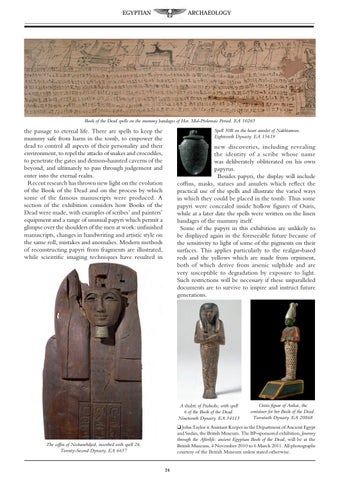
Book of the Dead spells on the mummy bandages of Hor. Mid-Ptolemaic Period. EA 10265
the passage to eternal life. There are spells to keep the mummy safe from harm in the tomb, to empower the dead to control all aspects of their personality and their environment, to repel the attacks of snakes and crocodiles, to penetrate the gates and demon-haunted caverns of the beyond, and ultimately to pass through judgement and enter into the eternal realm. Recent research has thrown new light on the evolution of the Book of the Dead and on the process by which some of the famous manuscripts were produced. A section of the exhibition considers how Books of the Dead were made, with examples of scribes’ and painters’ equipment and a range of unusual papyri which permit a glimpse over the shoulders of the men at work: unfinished manuscripts, changes in handwriting and artistic style on the same roll, mistakes and anomalies. Modern methods of reconstructing papyri from fragments are illustrated, while scientific imaging techniques have resulted in
Spell 30B on the heart amulet of Nakhtamun. Eighteenth Dynasty. EA 15619
new discoveries, including revealing the identity of a scribe whose name was deliberately obliterated on his own papyrus. Besides papyri, the display will include coffins, masks, statues and amulets which reflect the practical use of the spells and illustrate the varied ways in which they could be placed in the tomb. Thus some papyri were concealed inside hollow figures of Osiris, while at a later date the spells were written on the linen bandages of the mummy itself. Some of the papyri in this exhibition are unlikely to be displayed again in the foreseeable future because of the sensitivity to light of some of the pigments on their surfaces. This applies particularly to the realgar-based reds and the yellows which are made from orpiment, both of which derive from arsenic sulphide and are very susceptible to degradation by exposure to light. Such restrictions will be necessary if these unparalleled documents are to survive to inspire and instruct future generations.
A shabti of Pashedu, with spell 6 of the Book of the Dead. Nineteenth Dynasty. EA 34113
Osiris figure of Anhai, the container for her Book of the Dead. Twentieth Dynasty. EA 20868
q John Taylor is Assistant Keeper in the Department of Ancient Egypt and Sudan, the British Museum. The BP-sponsored exhibition, Journey through the Afterlife: ancient Egyptian Book of the Dead, will be at the British Museum, 4 November 2010 to 6 March 2011. All photographs courtesy of the British Museum unless stated otherwise.
The coffin of Nesbanebdjed, inscribed with spell 26. Twenty-Second Dynasty. EA 6657 24