EGYPTIAN
ARCHAEOLOGY
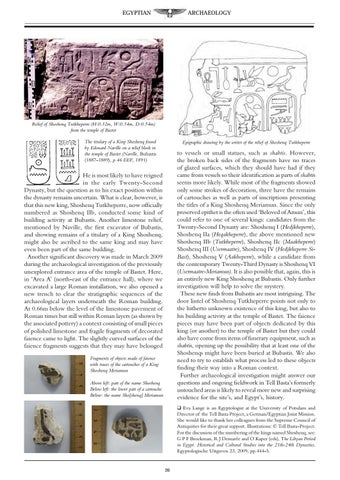
Relief of Shoshenq Tutkheperre (H:0.32m, W:0.54m, D:0.54m) from the temple of Bastet The titulary of a King Shoshenq found by Edouard Naville on a relief block in the temple of Bastet (Naville, Bubastis (1887-1889), p.46 EEF, 1891)
Epigraphic drawing by the writer of the relief of Shoshenq Tutkheperre
to vessels or small statues, such as shabtis. However, the broken back sides of the fragments have no traces of glazed surfaces, which they should have had if they came from vessels so their identification as parts of shabtis seems more likely. While most of the fragments showed only some strokes of decoration, three have the remains of cartouches as well as parts of inscriptions presenting the titles of a King Shoshenq Meriamun. Since the only preserved epithet is the often used ‘Beloved of Amun’, this could refer to one of several kings: candidates from the Twenty-Second Dynasty are: Shoshenq I (Hedjkheperre), Shoshenq IIa (Heqakheperre), the above mentioned new Shoshenq IIb (Tutkheperre), Shoshenq IIc (Maakheperre) Shoshenq III (Usermaatre), Shoshenq IV (Hedjkheperre SiBast), Shoshenq V (Aakheperre), while a candidate from the contemporary Twenty-Third Dynasty is Shoshenq VI (Usermaatre-Meriamun). It is also possible that, again, this is an entirely new King Shoshenq at Bubastis. Only further investigation will help to solve the mystery. These new finds from Bubastis are most intriguing. The door lintel of Shoshenq Tutkheperre points not only to the hitherto unknown existence of this king, but also to his building activity at the temple of Bastet. The faience pieces may have been part of objects dedicated by this king (or another) to the temple of Bastet but they could also have come from items of funerary equipment, such as shabtis, opening up the possibility that at least one of the Shoshenqs might have been buried at Bubastis. We also need to try to establish what process led to these objects finding their way into a Roman context. Further archaeological investigation might answer our questions and ongoing fieldwork in Tell Basta’s formerly untouched areas is likely to reveal more new and surprising evidence for the site’s, and Egypt’s, history.
He is most likely to have reigned in the early Twenty-Second Dynasty, but the question as to his exact position within the dynasty remains uncertain. What is clear, however, is that this new king, Shoshenq Tutkheperre, now officially numbered as Shoshenq IIb, conducted some kind of building activity at Bubastis. Another limestone relief, mentioned by Naville, the first excavator of Bubastis, and showing remains of a titulary of a King Shoshenq, might also be ascribed to the same king and may have even been part of the same building. Another significant discovery was made in March 2009 during the archaeological investigation of the previously unexplored entrance area of the temple of Bastet. Here, in ‘Area A’ (north-east of the entrance hall), where we excavated a large Roman installation, we also opened a new trench to clear the stratigraphic sequences of the archaeological layers underneath the Roman building. At 0.66m below the level of the limestone pavement of Roman times but still within Roman layers (as shown by the associated pottery) a context consisting of small pieces of polished limestone and fragile fragments of decorated faience came to light. The slightly curved surfaces of the faience fragments suggests that they may have belonged Fragments of objects made of faience with traces of the cartouches of a King Shoshenq Meriamun Above left: part of the name Shoshenq Below left: the lower part of a cartouche Below: the name Sho[shenq] Meriamun
q Eva Lange is an Egyptologist at the University of Potsdam and Director of the Tell Basta Project, a German/Egyptian Joint Mission. She would like to thank her colleagues from the Supreme Council of Antiquities for their great support. Illustrations: © Tell Basta-Project. For the discussion of the numbering of the kings named Shoshenq, see: G P F Broekman, R J Demarée and O Kaper (eds), The Libyan Period in Egypt. Historical and Cultural Studies into the 21th-24th Dynasties. Egyptologische Uitgaven 23, 2009, pp.444-5. 20