EGYPTIAN
ARCHAEOLOGY
King Shoshenqs at Bubastis The chronology and political history of the Third Intermediate Period is still a much disputed matter. Eva Lange considers the role which Bubastis played in the Twenty-Second Dynasty and publishes evidence for new kings named Shoshenq.
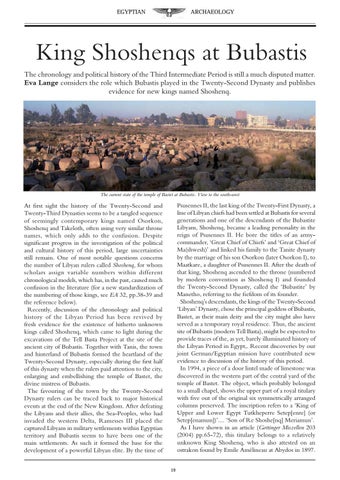
The current state of the temple of Bastet at Bubastis. View to the south-west
Psusennes II, the last king of the Twenty-First Dynasty, a line of Libyan chiefs had been settled at Bubastis for several generations and one of the descendants of the Bubastite Libyans, Shoshenq, became a leading personality in the reign of Psusennes II. He bore the titles of an armycommander, ‘Great Chief of Chiefs’ and ‘Great Chief of Ma(shwesh)’ and linked his family to the Tanite dynasty by the marriage of his son Osorkon (later Osorkon I), to Maatkare, a daughter of Psusennes II. After the death of that king, Shoshenq ascended to the throne (numbered by modern convention as Shoshenq I) and founded the Twenty-Second Dynasty, called the ‘Bubastite’ by Manetho, referring to the fiefdom of its founder. Shoshenq’s descendants, the kings of the Twenty-Second ‘Libyan’ Dynasty, chose the principal goddess of Bubastis, Bastet, as their main deity and the city might also have served as a temporary royal residence. Thus, the ancient site of Bubastis (modern Tell Basta), might be expected to provide traces of the, as yet, barely illuminated history of the Libyan Period in Egypt,. Recent discoveries by our joint German/Egyptian mission have contributed new evidence to discussion of the history of this period. In 1994, a piece of a door lintel made of limestone was discovered in the western part of the central yard of the temple of Bastet. The object, which probably belonged to a small chapel, shows the upper part of a royal titulary with five out of the original six symmetrically arranged columns preserved. The inscription refers to a ‘King of Upper and Lower Egypt Tutkheperre Setep[enre] (or Setep[enamun])’.... ‘Son of Re Shoshe[nq] Meriamun’. As I have shown in an article (Gottinger Miszellen 203 (2004) pp.65-72), this titulary belongs to a relatively unknown King Shoshenq, who is also attested on an ostrakon found by Emile Amélineau at Abydos in 1897.
At first sight the history of the Twenty-Second and Twenty-Third Dynasties seems to be a tangled sequence of seemingly contemporary kings named Osorkon, Shoshenq and Takeloth, often using very similar throne names, which only adds to the confusion. Despite significant progress in the investigation of the political and cultural history of this period, large uncertainties still remain. One of most notable questions concerns the number of Libyan rulers called Shoshenq, for whom scholars assign variable numbers within different chronological models, which has, in the past, caused much confusion in the literature (for a new standardization of the numbering of those kings, see EA 32, pp.38-39 and the reference below). Recently, discussion of the chronology and political history of the Libyan Period has been revived by fresh evidence for the existence of hitherto unknown kings called Shoshenq, which came to light during the excavations of the Tell Basta Project at the site of the ancient city of Bubastis. Together with Tanis, the town and hinterland of Bubastis formed the heartland of the Twenty-Second Dynasty, especially during the first half of this dynasty when the rulers paid attention to the city, enlarging and embellishing the temple of Bastet, the divine mistress of Bubastis. The favouring of the town by the Twenty-Second Dynasty rulers can be traced back to major historical events at the end of the New Kingdom. After defeating the Libyans and their allies, the Sea-Peoples, who had invaded the western Delta, Ramesses III placed the captured Libyans in military settlements within Egyptian territory and Bubastis seems to have been one of the main settlements. As such it formed the base for the development of a powerful Libyan elite. By the time of 19