EGYPTIAN
ARCHAEOLOGY
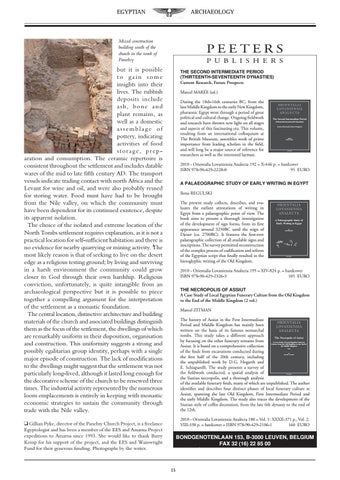
Mixed construction building south of the church in the tomb of Panehsy
E::I:GH E J 7 A > H = : G H
but it is possible to gain some insights into their lives. The rubbish deposits include ash, bone and plant remains, as well as a domestic assemblage of pottery, indicating activities of food storage, preparation and consumption. The ceramic repertoire is consistent throughout the settlement and includes datable wares of the mid to late fifth century AD. The transport vessels indicate trading contact with north Africa and the Levant for wine and oil, and were also probably reused for storing water. Food must have had to be brought from the Nile valley, on which the community must have been dependent for its continued existence, despite its apparent isolation. The choice of the isolated and extreme location of the North Tombs settlement requires explanation, as it is not a practical location for self-sufficient habitation and there is no evidence for nearby quarrying or mining activity. The most likely reason is that of seeking to live on the desert edge as a religious testing ground; by living and surviving in a harsh environment the community could grow closer to God through their own hardship. Religious conviction, unfortunately, is quite intangible from an archaeological perspective but it is possible to piece together a compelling argument for the interpretation of the settlement as a monastic foundation. The central location, distinctive architecture and building materials of the church and associated buildings distinguish them as the focus of the settlement, the dwellings of which are remarkably uniform in their disposition, organisation and construction. This uniformity suggests a strong and possibly egalitarian group identity, perhaps with a single major episode of construction. The lack of modifications to the dwellings might suggest that the settlement was not particularly long-lived, although it lasted long enough for the decorative scheme of the church to be renewed three times. The industrial activity represented by the numerous loom emplacements is entirely in keeping with monastic economic strategies to sustain the community through trade with the Nile valley.
I=: H:8DC9 >CI:GB:9>6I: E:G>D9 I=>GI::CI="H:K:CI::CI= 9NC6HI>:H 8jggZci GZhZVgX]! ;jijgZ EgdheZXih BVgXZa B6Gw: ZY# 9jg^c\ i]Z &-i]"&+i] XZcijg^Zh 78! [gdb i]Z aViZ B^YYaZ @^c\Ydb id i]Z ZVgan CZl @^c\Ydb! e]VgVdc^X :\nei lZci i]gdj\] V eZg^dY d[ \gZVi eda^i^XVa VcY XjaijgVa X]Vc\Z# Dc\d^c\ ÒZaYldg` VcY gZhZVgX] ]VkZ i]gdlc cZl a^\]i dc Vaa hiV\Zh VcY VheZXih d[ i]^h [VhX^cVi^c\ ZgV# I]^h kdajbZ! gZhjai^c\ [gdb Vc ^ciZgcVi^dcVa Xdaadfj^jb Vi I]Z 7g^i^h] BjhZjb! VhhZbWaZh ldg` d[ eg^bZ ^bedgiVcXZ [gdb aZVY^c\ hX]daVgh ^c i]Z ÒZaY! VcY l^aa adc\ WZ V bV_dg hdjgXZ d[ gZ[ZgZcXZ [dg gZhZVgX]Zgh Vh lZaa Vh i]Z ^ciZgZhiZY aVnbVc#
O R I E N TA L I A L O VA N I E N S I A A N A L E C TA The Second Intermediate Period (Thirteenth–Seventeenth Dynasties) Current Research, Future Prospects
HGLWHG E\ 0$5&(/ 0$5e(
3((7(56
'%&% " Dg^ZciVa^V AdkVc^Zch^V 6cVaZXiV &.' Ä M"))+ e# Ä ]VgYXdkZg >H7C .,-".%")'."'''-"% .* :JGD 6 E6A6:D<G6E=>8 HIJ9N D; :6GAN LG>I>C< >C :<NEI >adcV G:<JAH@> I]Z egZhZci hijYn XdaaZXih! YZhXg^WZh! VcY ZkV" ajViZh i]Z ZVga^Zhi ViiZhiVi^dch d[ lg^i^c\ ^c :\nei [gdb V eVaVZd\gVe]^X ed^ci d[ k^Zl# I]Z Wdd` V^bh id egZhZci V i]dgdj\] ^ckZhi^\Vi^dc d[ i]Z YZkZadebZci d[ h^\c [dgbh! [gdb ^ih Òghi VeeZVgVcXZ VgdjcY ('*%78 jci^a i]Z gZ^\c d[ 9_dhZg XV# ',%%78 # >i [ZVijgZh i]Z Òghi"ZkZg eVaVZd\gVe]^X XdaaZXi^dc d[ Vaa VkV^aVWaZ h^\ch VcY ^chXg^ei^dch# I]Z hjgkZn eZgb^iiZY gZXdchigjXi^dc d[ i]Z XdbeaZm egdXZhh d[ XdY^ÒXVi^dc VcY gZ[dgb d[ i]Z :\nei^Vc hXg^ei i]Vi ÒcVaan gZhjaiZY ^c i]Z ]^Zgd\ane]^X lg^i^c\ d[ i]Z DaY @^c\Ydb#
O R I E N TA L I A L O VA N I E N S I A A N A L E C TA 7 FWbW[e]hWf^_Y IjkZo e\ ;Whbo Mh_j_d] _d ;]ofj E\ ,/21$ 5(*8/6.,
3((7(56
'%&% " Dg^ZciVa^V AdkVc^Zch^V 6cVaZXiV &.* Ä M>K"-') e# Ä ]VgYXdkZg >H7C .,-".%")'."'('+"( &%* :JGD I=: C:8GDEDA>H D; 6HH>JI 6 8VhZ HijYn d[ AdXVa :\nei^Vc ;jcZgVgn 8jaijgZ [gdb i]Z DaY @^c\Ydb id i]Z :cY d[ i]Z B^YYaZ @^c\Ydb ' kda# BVgXZa O>IB6C I]Z ]^hidgn d[ 6hh^ji ^c i]Z ;^ghi >ciZgbZY^ViZ O R I E N TA L I A EZg^dY VcY B^YYaZ @^c\Ydb ]Vh bV^can WZZc L O VA N I E N S I A lg^iiZc dc i]Z WVh^h d[ ^ih [Vbdjh cdbVgX]Va A N A L E C TA idbWh# I]^h hijYn iV`Zh V Y^[[ZgZci VeegdVX] The Necropolis of Assiut Wn [dXjh^c\ dc i]Z di]Zg [jcZgVgn gZbV^ch [gdb 6hh^ji# >i ^h WVhZY dc V XdbegZ]Zch^kZ XdaaZXi^dc d[ i]Z ÒcYh [gdb ZmXVkVi^dch XdcYjXiZY Yjg^c\ i]Z Òghi ]Va[ d[ i]Z '%i] XZcijgn! ^cXajY^c\ i]Z jcejWa^h]ZY ldg` Wn 9#<# =d\Vgi] VcY :# HX]^VeVgZaa^# I]Z hijYn egZhZcih V hjgkZn d[ i]Z ÒZaYldg` XdcYjXiZY! V heVi^Va VcVanh^h d[ i]Z H^ji^Vc cZXgdeda^h! VcY V i]dgdj\] VcVanh^h d[ i]Z VkV^aVWaZ [jcZgVgn ÒcYh! bVcn d[ l]^X] VgZ jcejWa^h]ZY# I]Z Vji]dg ^YZci^ÒZh VcY YZhXg^WZh [djg Y^hi^cXi e]VhZh d[ adXVa [jcZgVgn XjaijgZ Vi 6hh^ji! heVcc^c\ i]Z aViZ DaY @^c\Ydb! ;^ghi >ciZgbZY^ViZ EZg^dY VcY i]Z ZVgan B^YYaZ @^c\Ydb# I]Z hijYn Vahd igVXZh i]Z YZkZadebZci d[ i]Z H^ji^Vc hinaZ d[ Xd[Òc YZXdgVi^dc! [gdb i]Z aViZ +i] YncVhin id i]Z ZcY d[ i]Z &'i]# A Case Study of Local Egyptian Funerary Culture from the Old Kingdom to the End of the Middle Kingdom Text E\
0$5&(/ =,70$1
3((7(56
'%&% " Dg^ZciVa^V AdkVc^Zch^V 6cVaZXiV &-% Ä Kda# &/ MMM>>"(,& e#! Kda# '/ K>>>"((- e# Ä ]VgYXdkZg Ä >H7C .,-".%")'."'&%+"& &+% :JGD
q Gillian Pyke, director of the Panehsy Church Project, is a freelance Egyptologist and has been a member of the EES and Amarna Project expeditions to Amarna since 1993. She would like to thank Barry Kemp for his support of the project, and the EES and Wainwright Fund for their generous funding. Photographs by the writer.
7DC9<:CDI:CA66C &*(! 7"(%%% A:JK:C! 7:A<>JB ;6M (' &+ '' -* %% eZZiZgh5eZZiZgh"aZjkZc#WZ Ã lll#eZZiZgh"aZjkZc#WZ 15 93559_Adv_EgyptArcheo.indd 1