EGYPTIAN
ARCHAEOLOGY
some of which may be raised on an artificial platform flanking the entrance to the interior space. The adjacent area is open, using the remaining space on the ledge or its artificially constructed equivalent, reinforced with a sturdy revetment wall and with a drop beyond that was convenient for the disposal of refuse. Access between the dwellings is provided by narrow paths, sometimes augmented by a slight boulder-built revetment, and staircases built of stones or making use of the natural strata of the limestone. Limestone boulders and cobbles are the main building blocks of the settlement, with limestone chips, either from the dynastic excavation of the tombs or from the natural weathering of the rock, used for raised platforms. Evidence for the use of mud- or fired-bricks is extremely limited and confined to the area immediately around
the church in the tomb of Panehsy, where a rectangular structure immediately south of the church is of mixed construction with a barrel-vaulted mud-brick roof. The great consistency in the layout and construction of the individual dwellings comprising the settlement is striking, as is the fact that while a low level of technical expertise was required, the building process was labour-intensive and most dwellings would have been a group effort. The same was probably the case for the construction phase of the church conversion. The decoration of the church required a greater level of expertise, at least artistically. It is interesting to note that there are no remaining traces of painted decoration in any of the dwellings, apart from a series of red-painted crosses on the ceiling of the interior element of one, located just to the north of the church. Information on the inhabitants themselves is minimal,
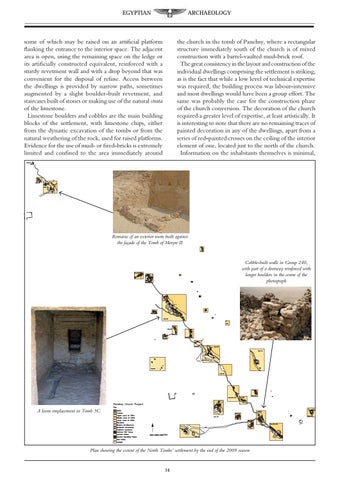
Remains of an exterior room built against the façade of the Tomb of Meryre II
Cobble-built walls in Group 240, with part of a doorway reinforced with longer boulders in the centre of the photograph
A loom emplacement in Tomb 3C
Plan showing the extent of the North Tombs’ settlement by the end of the 2009 season
14