EGYPTIAN
ARCHAEOLOGY
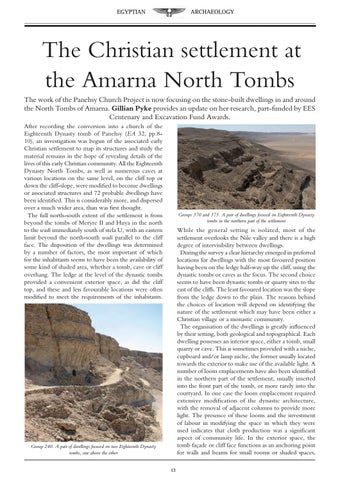
The Christian settlement at the Amarna North Tombs The work of the Panehsy Church Project is now focusing on the stone-built dwellings in and around the North Tombs of Amarna. Gillian Pyke provides an update on her research, part-funded by EES Centenary and Excavation Fund Awards. After recording the conversion into a church of the Eighteenth Dynasty tomb of Panehsy (EA 32, pp.810), an investigation was begun of the associated early Christian settlement to map its structures and study the material remains in the hope of revealing details of the lives of this early Christian community. All the Eighteenth Dynasty North Tombs, as well as numerous caves at various locations on the same level, on the cliff top or down the cliff-slope, were modified to become dwellings or associated structures and 72 probable dwellings have been identified. This is considerably more, and dispersed over a much wider area, than was first thought. The full north-south extent of the settlement is from beyond the tombs of Meryre II and Huya in the north to the wadi immediately south of stela U, with an eastern limit beyond the north-south wadi parallel to the cliff face. The disposition of the dwellings was determined by a number of factors, the most important of which for the inhabitants seems to have been the availability of some kind of shaded area, whether a tomb, cave or cliff overhang. The ledge at the level of the dynastic tombs provided a convenient exterior space, as did the cliff top, and these and less favourable locations were often modified to meet the requirements of the inhabitants.
Groups 370 and 375. A pair of dwellings focused on Eighteenth Dynasty tombs in the northern part of the settlement
While the general setting is isolated, most of the settlement overlooks the Nile valley and there is a high degree of intervisibility between dwellings. During the survey a clear hierarchy emerged in preferred locations for dwellings with the most favoured position having been on the ledge half-way up the cliff, using the dynastic tombs or caves as the focus. The second choice seems to have been dynastic tombs or quarry sites to the east of the cliffs. The least favoured location was the slope from the ledge down to the plain. The reasons behind the choices of location will depend on identifying the nature of the settlement which may have been either a Christian village or a monastic community. The organisation of the dwellings is greatly influenced by their setting, both geological and topographical. Each dwelling possesses an interior space, either a tomb, small quarry or cave. This is sometimes provided with a niche, cupboard and/or lamp niche, the former usually located towards the exterior to make use of the available light. A number of loom emplacements have also been identified in the northern part of the settlement, usually inserted into the front part of the tomb, or more rarely into the courtyard. In one case the loom emplacement required extensive modification of the dynastic architecture, with the removal of adjacent columns to provide more light. The presence of these looms and the investment of labour in modifying the space in which they were used indicates that cloth production was a significant aspect of community life. In the exterior space, the tomb faรงade or cliff face functions as an anchoring point for walls and beams for small rooms or shaded spaces,
Group 240. A pair of dwellings focused on two Eighteenth Dynasty tombs, one above the other 13