EGYPTIAN
ARCHAEOLOGY
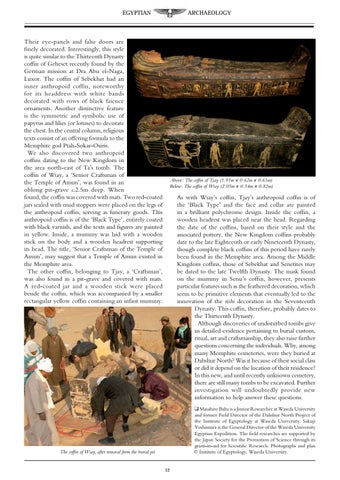
Their eye-panels and false doors are finely decorated. Interestingly, this style is quite similar to the Thirteenth Dynasty coffin of Geheset recently found by the German mission at Dra Abu el-Naga, Luxor. The coffin of Sebekhat had an inner anthropoid coffin, noteworthy for its headdress with white bands decorated with rows of black faience ornaments. Another distinctive feature is the symmetric and symbolic use of papyrus and lilies (or lotuses) to decorate the chest. In the central column, religious texts consist of an offering formula to the Memphite god Ptah-Sokar-Osiris. We also discovered two anthropoid coffins dating to the New Kingdom in the area north-east of Ta’s tomb. The coffin of Wiay, a ‘Senior Craftsman of the Temple of Amun’, was found in an oblong pit-grave c.2.5m deep. When found, the coffin was covered with mats. Two red-coated jars sealed with mud stoppers were placed on the legs of the anthropoid coffin, serving as funerary goods. This anthropoid coffin is of the ‘Black Type’, entirely coated with black varnish, and the texts and figures are painted in yellow. Inside, a mummy was laid with a wooden stick on the body and a wooden headrest supporting its head. The title, ‘Senior Craftsman of the Temple of Amun’, may suggest that a Temple of Amun existed in the Memphite area. The other coffin, belonging to Tjay, a ‘Craftsman’, was also found in a pit-grave and covered with mats. A red-coated jar and a wooden stick were placed beside the coffin, which was accompanied by a smaller rectangular yellow coffin containing an infant mummy.
Above: The coffin of Tjay (1.91m x 0.62m x 0.61m) Below: The coffin of Wiay (2.05m x 0.54m x 0.82m)
As with Wiay’s coffin, Tjay’s anthropoid coffin is of the ‘Black Type’ and the face and collar are painted in a brilliant polychrome design. Inside the coffin, a wooden headrest was placed near the head. Regarding the date of the coffins, based on their style and the associated pottery, the New Kingdom coffins probably date to the late Eighteenth or early Nineteenth Dynasty, though complete black coffins of this period have rarely been found in the Memphite area. Among the Middle Kingdom coffins, those of Sebekhat and Senetites may be dated to the late Twelfth Dynasty. The mask found on the mummy in Senu’s coffin, however, presents particular features such as the feathered decoration, which seem to be primitive elements that eventually led to the innovation of the rishi decoration in the Seventeenth Dynasty. This coffin, therefore, probably dates to the Thirteenth Dynasty. Although discoveries of undisturbed tombs give us detailed evidence pertaining to burial custom, ritual, art and craftsmanship, they also raise further questions concerning the individuals. Why, among many Memphite cemeteries, were they buried at Dahshur North? Was it because of their social class or did it depend on the location of their residence? In this new, and until recently unknown cemetery, there are still many tombs to be excavated. Further investigation will undoubtedly provide new information to help answer these questions. q Masahiro Baba is a Junior Researcher at Waseda University and former Field Director of the Dahshur North Project of the Institute of Egyptology at Waseda University. Sakuji Yoshimura is the General Director of the Waseda University Egyptian Expedition. The field researches are supported by the Japan Society for the Promotion of Science through its grant-in-aid for Scientific Research. Photographs and plan © Institute of Egyptology, Waseda University.
The coffin of Wiay, after removal from the burial pit 12