EGYPTIAN
ARCHAEOLOGY
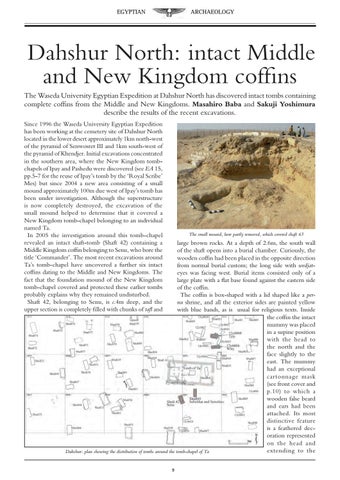
Dahshur North: intact Middle and New Kingdom coffins The Waseda University Egyptian Expedition at Dahshur North has discovered intact tombs containing complete coffins from the Middle and New Kingdoms. Masahiro Baba and Sakuji Yoshimura describe the results of the recent excavations. Since 1996 the Waseda University Egyptian Expedition has been working at the cemetery site of Dahshur North located in the lower desert approximately 1km north-west of the pyramid of Senwosret III and 1km south-west of the pyramid of Khendjer. Initial excavations concentrated in the southern area, where the New Kingdom tombchapels of Ipay and Pashedu were discovered (see EA 15, pp.5-7 for the reuse of Ipay’s tomb by the ‘Royal Scribe’ Mes) but since 2004 a new area consisting of a small mound approximately 100m due west of Ipay’s tomb has been under investigation. Although the superstructure is now completely destroyed, the excavation of the small mound helped to determine that it covered a New Kingdom tomb-chapel belonging to an individual named Ta. In 2005 the investigation around this tomb-chapel revealed an intact shaft-tomb (Shaft 42) containing a Middle Kingdom coffin belonging to Senu, who bore the title ‘Commander’. The most recent excavations around Ta’s tomb-chapel have uncovered a further six intact coffins dating to the Middle and New Kingdoms. The fact that the foundation mound of the New Kingdom tomb-chapel covered and protected these earlier tombs probably explains why they remained undisturbed. Shaft 42, belonging to Senu, is c.4m deep, and the upper section is completely filled with chunks of tafl and
The small mound, here partly removed, which covered shaft 65
large brown rocks. At a depth of 2.6m, the south wall of the shaft opens into a burial chamber. Curiously, the wooden coffin had been placed in the opposite direction from normal burial custom; the long side with wedjateyes was facing west. Burial items consisted only of a large plate with a flat base found against the eastern side of the coffin. The coffin is box-shaped with a lid shaped like a pernu shrine, and all the exterior sides are painted yellow with blue bands, as is usual for religious texts. Inside the coffin the intact mummy was placed in a supine position with the head to the north and the face slightly to the east. The mummy had an exceptional cartonnage mask (see front cover and p.10) to which a wooden false beard and ears had been attached. Its most distinctive feature is a feathered decoration represented on the head and extending to the Dahshur: plan showing the distribution of tombs around the tomb-chapel of Ta