EGYPTIAN
ARCHAEOLOGY
One of Hekekyan’s watercolour maps of Memphis
A pen and ink sketch of one of the sphinxes at Heliopolis
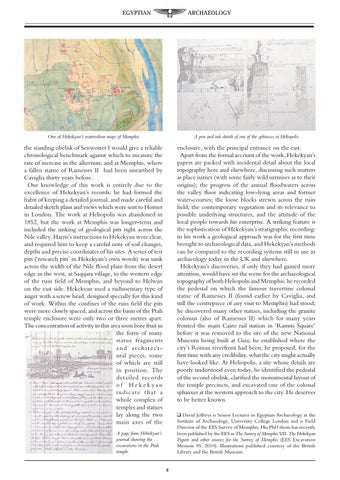
the standing obelisk of Senwosret I would give a reliable chronological benchmark against which to measure the rate of increase in the alluvium; and at Memphis, where a fallen statue of Ramesses II had been unearthed by Caviglia thirty years before. Our knowledge of this work is entirely due to the excellence of Hekekyan’s records: he had formed the habit of keeping a detailed journal, and made careful and detailed sketch plans and views which were sent to Horner in London. The work at Heliopolis was abandoned in 1852, but the work at Memphis was longer-term and included the sinking of geological pits right across the Nile valley. Harris’s instructions to Hekekyan were clear, and required him to keep a careful note of soil changes, depths and precise coordinates of his sites. A series of test pits (‘research pits’ in Hekekyan’s own words) was sunk across the width of the Nile flood plain from the desert edge in the west, at Saqqara village, to the western edge of the ruin field of Memphis, and beyond to Helwan on the east side. Hekekyan used a rudimentary type of auger with a screw head, designed specially for this kind of work. Within the confines of the ruin field the pits were more closely spaced, and across the basin of the Ptah temple enclosure were only two or three metres apart. The concentration of activity in this area soon bore fruit in the form of many statue fragments and architectural pieces, some of which are still in position. The detailed records of Hekekyan indicate that a whole complex of temples and statues lay along the two main axes of the
enclosure, with the principal entrance on the east. Apart from the formal account of the work, Hekekyan’s papers are packed with incidental detail about the local topography here and elsewhere, discussing such matters as place names (with some fairly wild surmises as to their origins); the progress of the annual floodwaters across the valley floor indicating low-lying areas and former water-courses; the loose blocks strewn across the ruin field; the contemporary vegetation and its relevance to possible underlying structures, and the attitude of the local people towards his enterprise. A striking feature is the sophistication of Hekekyan’s stratigraphic recording: in his work a geological approach was for the first time brought to archaeological data, and Hekekyan’s methods can be compared to the recording systems still in use in archaeology today in the UK and elsewhere. Hekekyan’s discoveries, if only they had gained more attention, would have set the scene for the archaeological topography of both Heliopolis and Memphis: he recorded the pedestal on which the famous travertine colossal statue of Ramesses II (found earlier by Caviglia, and still the centrepiece of any visit to Memphis) had stood; he discovered many other statues, including the granite colossus (also of Ramesses II) which for many years fronted the main Cairo rail station in ‘Ramsis Square’ before it was removed to the site of the new National Museum being built at Giza; he established where the city’s Roman riverfront had been; he proposed, for the first time with any credibility, what the city might actually have looked like. At Heliopolis, a site whose details are poorly understood even today, he identified the pedestal of the second obelisk, clarified the monumental layout of the temple precincts, and excavated one of the colossal sphinxes at the western approach to the city. He deserves to be better known. q David Jeffreys is Senior Lecturer in Egyptian Archaeology at the Institute of Archaeology, University College London and is Field Director of the EES Survey of Memphis. His PhD thesis has recently been published by the EES as The Survey of Memphis VII. The Hekekyan Papers and other sources for the Survey of Memphis (EES Excavation Memoir 95, 2010). Illustrations published courtesy of the British Library and the British Museum.
A page from Hekekyan’s journal showing the excavations in the Ptah temple