EGYPTIAN
ARCHAEOLOGY
Qasr Ibrim’s crowning glory: a Napatan Period wig Fragments of an elaborate wig were found in stratified deposits of the Napatan Period during the most recent EES excavations at Qasr Ibrim.The wig was studied during the autumn 2005 study season by Gillian Pyke who reports on its significance and appearance. Elements of an extraordinary wig were found in 2004 and 2005 in a number of contexts of Napatan date, including one that was extremely rich in organic material, within a single area measuring approximately 3m x 4m (Trench 25, Area A) to the north-west of the Cathedral. Many of the fragments, the majority of which are from braids, were found in discrete groups within these contexts. The careful lifting of the fragments was rewarded, as a number of wig braids are still strung on cords, and the associations between many broken fragments could be reconstructed. The wig comprised two main elements: a lower braided part, consisting of at least eight different types of braid, and a curled topknot.Virtually all the elements, including the cords on which the braids were strung, seem to have been made of hair, but whether this was human or animal is not yet certain.The topknot and braids were made of dark brown or black hair which is relatively coarse and, for the braids at least, quite long.
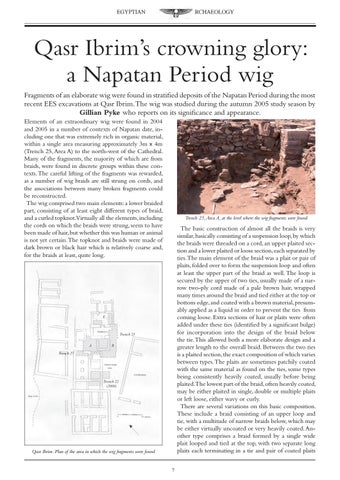
Trench 25,Area A, at the level where the wig fragments were found
The basic construction of almost all the braids is very similar, basically consisting of a suspension loop, by which the braids were threaded on a cord, an upper plaited section and a lower plaited or loose section,each separated by ties.The main element of the braid was a plait or pair of plaits, folded over to form the suspension loop and often at least the upper part of the braid as well. The loop is secured by the upper of two ties, usually made of a narrow two-ply cord made of a pale brown hair, wrapped many times around the braid and tied either at the top or bottom edge, and coated with a brown material, presumably applied as a liquid in order to prevent the ties from coming loose. Extra sections of hair or plaits were often added under these ties (identified by a significant bulge) for incorporation into the design of the braid below the tie.This allowed both a more elaborate design and a greater length to the overall braid. Between the two ties is a plaited section, the exact composition of which varies between types.The plaits are sometimes patchily coated with the same material as found on the ties, some types being consistently heavily coated, usually before being plaited.The lowest part of the braid, often heavily coated, may be either plaited in single, double or multiple plaits or left loose, either wavy or curly. There are several variations on this basic composition. These include a braid consisting of an upper loop and tie, with a multitude of narrow braids below, which may be either virtually uncoated or very heavily coated. Another type comprises a braid formed by a single wide plait looped and tied at the top, with two separate long plaits each terminating in a tie and pair of coated plaits
Qasr Ibrim. Plan of the area in which the wig fragments were found 7