EGYPTIAN
ARCHAEOLOGY
that the tell, now 3m at its highest point, stood as high as 15m during his youth. Nonetheless, pottery sherds dating from the Late Roman Period to the Islamic Period were observed in ditches at the edge of the town, in a construction trench and at Umm Harb (the raised area of the old tombs), a five minute drive from the modern village. Kafr Suleyman,only a couple of kilometres from Mustay, also revealed pottery lying on the surface in fields where many scarabs are said to have been collected by local people in recent times.These sherds are somewhat earlier in date than those at Mustay, ranging from the Ptolemaic and Early Roman to the Late Roman and Late Antique Periods.The village of El-Rimaly,between Kafr Suleyman and Mustay, was also surveyed and two limestone blocks,
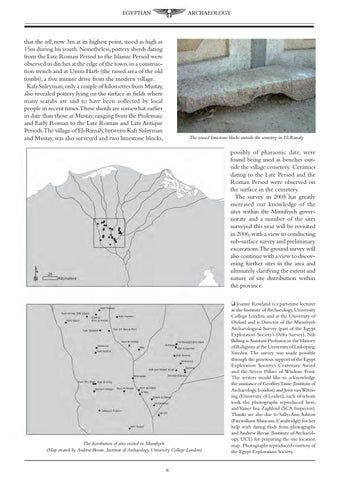
The reused limestone blocks outside the cemetery in El-Rimaly
possibly of pharaonic date, were found being used as benches outside the village cemetery. Ceramics dating to the Late Period and the Roman Period were observed on the surface in the cemetery. The survey in 2005 has greatly increased our knowledge of the sites within the Minufiyeh governorate and a number of the sites surveyed this year will be revisited in 2006, with a view to conducting sub-surface survey and preliminary excavations.The ground survey will also continue with a view to discovering further sites in the area and ultimately clarifying the extent and nature of site distribution within the province.
The distribution of sites visited in Minufiyeh. (Map created by Andrew Bevan, Institute of Archaeology, University College London)
6
Ô Joanne Rowland is a part-time lecturer at the Institute of Archaeology, University College London, and at the University of Oxford and is Director of the Minufiyeh Archaeological Survey (part of the Egypt Exploration Society’s Delta Survey). Nils Billing is Assistant Professor in the History of Religions at the University of Linköping, Sweden. The survey was made possible through the generous support of the Egypt Exploration Society’s Centenary Award and the Seven Pillars of Wisdom Trust. The writers would like to acknowledge the assistance of GeoffreyTassie (Institute of Archaeology,London) and Joris vanWetering (University of Leiden), each of whom took the photographs reproduced here, and Yasser Issa Zaghloul (SCA Inspector). Thanks are also due to Sally-Ann Ashton (Fitzwilliam Museum, Cambridge) for her help with dating finds from photographs and Andrew Bevan (Institute of Archaeology, UCL) for preparing the site location map. Photographs reproduced courtesy of the Egypt Exploration Society.