EGYPTIAN
ARCHAEOLOGY
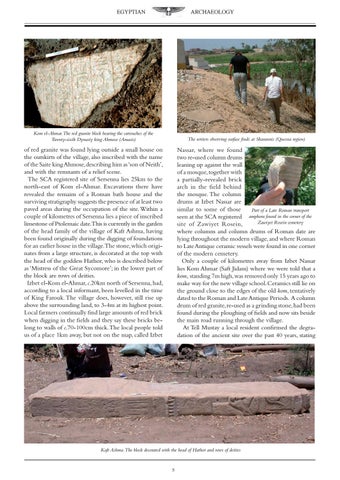
Kom el-Ahmar.The red granite block bearing the cartouches of the Twenty-sixth Dynasty king Ahmose (Amasis)
The writers observing surface finds at Sharannis (Quesna region)
of red granite was found lying outside a small house on the outskirts of the village, also inscribed with the name of the Saite king Ahmose,describing him as‘son of Neith’, and with the remnants of a relief scene. The SCA registered site of Sersenna lies 25km to the north-east of Kom el-Ahmar. Excavations there have revealed the remains of a Roman bath house and the surviving stratigraphy suggests the presence of at least two paved areas during the occupation of the site. Within a couple of kilometres of Sersenna lies a piece of inscribed limestone of Ptolemaic date.This is currently in the garden of the head family of the village of Kafr Ashma, having been found originally during the digging of foundations for an earlier house in the village.The stone, which originates from a large structure, is decorated at the top with the head of the goddess Hathor, who is described below as ‘Mistress of the Great Sycomore’; in the lower part of the block are rows of deities. Izbet el-Kom el-Ahmar, c.20km north of Sersenna, had, according to a local informant, been levelled in the time of King Farouk. The village does, however, still rise up above the surrounding land, to 3-4m at its highest point. Local farmers continually find large amounts of red brick when digging in the fields and they say these bricks belong to walls of c.70-100cm thick.The local people told us of a place 1km away, but not on the map, called Izbet
Nassar, where we found two re-used column drums leaning up against the wall of a mosque, together with a partially-revealed brick arch in the field behind the mosque. The column drums at Izbet Nassar are similar to some of those Part of a Late Roman transport seen at the SCA registered amphora found in the corner of the Zawiyet Rosein cemetery site of Zawiyet Rosein, where columns and column drums of Roman date are lying throughout the modern village, and where Roman to Late Antique ceramic vessels were found in one corner of the modern cemetery. Only a couple of kilometres away from Izbet Nassar lies Kom Ahmar (Saft Jidam) where we were told that a kom, standing 7m high, was removed only 15 years ago to make way for the new village school. Ceramics still lie on the ground close to the edges of the old kom, tentatively dated to the Roman and Late Antique Periods. A column drum of red granite, re-used as a grinding stone, had been found during the ploughing of fields and now sits beside the main road running through the village. At Tell Mustay a local resident confirmed the degradation of the ancient site over the past 40 years, stating
Kafr Ashma.The block decorated with the head of Hathor and rows of deities
5