EGYPTIAN
ARCHAEOLOGY
The view from Minshat Damallu to the main Quesna archaeological area
Stone sarcophagi in situ in the Quesna mausolea
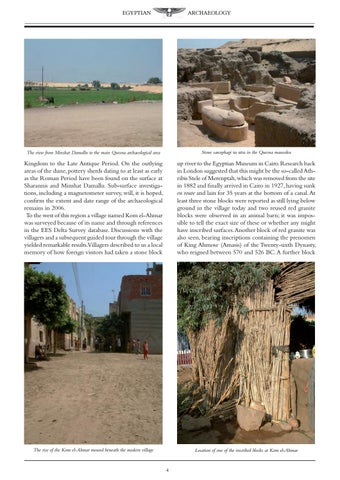
Kingdom to the Late Antique Period. On the outlying areas of the dune, pottery sherds dating to at least as early as the Roman Period have been found on the surface at Sharannis and Minshat Damallu. Sub-surface investigations, including a magnetometer survey, will, it is hoped, confirm the extent and date range of the archaeological remains in 2006. To the west of this region a village named Kom el-Ahmar was surveyed because of its name and through references in the EES Delta Survey database. Discussions with the villagers and a subsequent guided tour through the village yielded remarkable results.Villagers described to us a local memory of how foreign visitors had taken a stone block
up river to the Egyptian Museum in Cairo.Research back in London suggested that this might be the so-called Athribis Stele of Merenptah,which was removed from the site in 1882 and finally arrived in Cairo in 1927, having sunk en route and lain for 35 years at the bottom of a canal.At least three stone blocks were reported as still lying below ground in the village today and two reused red granite blocks were observed in an animal barn; it was impossible to tell the exact size of these or whether any might have inscribed surfaces.Another block of red granite was also seen, bearing inscriptions containing the prenomen of King Ahmose (Amasis) of the Twenty-sixth Dynasty, who reigned between 570 and 526 BC. A further block
The rise of the Kom el-Ahmar mound beneath the modern village
Location of one of the inscribed blocks at Kom el-Ahmar
4