EGYPTIAN
ARCHAEOLOGY
The EES Delta Survey: Minufiyeh 2005
In summer 2005 an EES team undertook a ground survey in the central Delta province of Minufiyeh, one of the least known areas of the Delta, visiting thirty sites. Joanne Rowland and Nils Billing describe the archaeological evidence encountered. The Minufiyeh Archaeological Survey has been instigated with the aim of enhancing our understanding of site distribution in the central Delta throughout antiquity.The itinerary for the first season of work included sites already known and referenced on the EES Delta Survey database (www.ees.ac.uk) and previously unrecorded sites suggested either by their having names including kom or tell, or by their situation on high contour areas, possibly indicating the presence of a mound of human occupation. Local information obtained during the course of the survey added to this initial list.At each site,the residents were first interviewed about their knowledge of any archaeological remains in the area and then the site was investigated for any visible surface finds, which were subsequently documented in a photographic and written report. Five sites in this region have already been excavated and registered by the Egyptian Supreme Council for Antiqui-
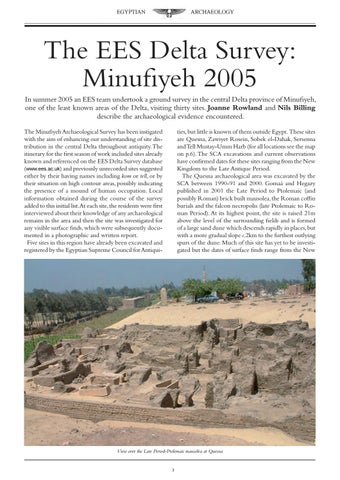
ties, but little is known of them outside Egypt. These sites are Quesna, Zawiyet Rosein, Sobek el-Dahak, Sersenna andTell Mustay-Umm Harb (for all locations see the map on p.6). The SCA excavations and current observations have confirmed dates for these sites ranging from the New Kingdom to the Late Antique Period. The Quesna archaeological area was excavated by the SCA between 1990-91 and 2000. GomaĂ and Hegazy published in 2001 the Late Period to Ptolemaic (and possibly Roman) brick built mausolea, the Roman coffin burials and the falcon necropolis (late Ptolemaic to Roman Period). At its highest point, the site is raised 21m above the level of the surrounding fields and is formed of a large sand dune which descends rapidly in places, but with a more gradual slope c.2km to the furthest outlying spurs of the dune. Much of this site has yet to be investigated but the dates of surface finds range from the New
View over the Late Period-Ptolemaic mausolea at Quesna
3