EGYPTIAN
ARCHAEOLOGY
Membership Matters
EES Officers. In the autumn of 2005 the Society’s Vice-Chairman, John Tait, and the Treasurer, Michael Pike both resigned. Professor Tait, who had been Vice-Chairman since 2001, had been in overall charge of the Society’s publications programme and the results of his hard work can be seen in the number of new and forthcoming EES publications (see further p.2). Mr Pike, who had been Treasurer since 2003 and had been responsible for several new initiatives at the Society, resigned to take up a post in Mauritius.At the Society’s Annual General Meeting on 3 December 2005, Ian Shaw, a Lecturer in Egyptology at the University of Liverpool was elected asVice-Chairman and Stewart White, a company director, was elected as Treasurer. Egyptology in East Anglia. EES member, Dee Mason, has sent the following message: ‘Given the lack of a society devoted to ancient Egypt in East Anglia, we are contemplating setting one up in Norwich. Our first priority is to ascertain if there is a demand for such a society and in this respect we would be pleased to hear from any readers of Egyptian Archaeology who would like to be involved. In the first instance, please contact Dee Mason in writing at 31 Caernarvon Road, Norwich NR2 3HZ, by email at deebunce@hotmail.com or by phone on 01603 628570’.
EES Annual Subscriptions for 2006-2007 are due on 1 April 2006. A renewal notice will be sent in the spring mailing and it would be appreciated if members could pay their subscriptions promptly,without the need for further reminders. UK-based members are encouraged to take out Banker’s Orders and, if they are taxpayers, to make a declaration of ‘Gift Aid’ which augments the value of their subscription. Further information and forms can be obtained from Tracey Gagetta at the London Office. Phone: +44 (0)207 242 2268. Email: tracey. gagetta@ees.ac.uk Members based outside the UK who prefer to pay their subscriptions by credit/debit card will be sent details of how to do so in the spring mailing.
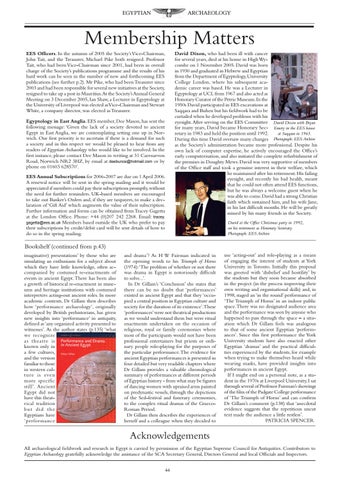
David Dixon, who had been ill with cancer for several years, died at his home in High Wycombe on 1 November 2005. David was born in 1930 and graduated in Hebrew and Egyptian from the Department of Egyptology,University College London, where his subsequent academic career was based. He was a Lecturer in Egyptology at UCL from 1967 and also acted as Honorary Curator of the Petrie Museum.In the 1950s David participated in EES excavations at Saqqara and Buhen but his fieldwork had to be curtailed when he developed problems with his eyesight.After serving on the EES Committee David Dixon with Bryan for many years, David became Honorary Sec- Emery in the EES house at Saqqara in 1963. retary in 1983 and held the position until 1992. During this time David oversaw many changes Photograph: EES Archive as the Society’s administration became more professional. Despite his own lack of computer expertise, he actively encouraged the Office’s early computerisation, and also initiated the complete refurbishment of the premises in Doughty Mews. David was very supportive of members of the Office staff and took a genuine interest in their welfare, which he maintained after his retirement. His failing eyesight, and recently his bad health, meant that he could not often attend EES functions, but he was always a welcome guest when he was able to come.David had a strong Christian faith which sustained him, and his wife Jane, in his last difficult months. He will be greatly missed by his many friends in the Society. David at the Office Christmas party in 1992, on his retirement as Honorary Secretary. Photograph: EES Archive
Bookshelf (continued from p.43) imaginative) presentations’ by those who are simulating an enthusiasm for a subject about which they have little knowledge, often accompanied by costumed re-enactments of events in ancient Egypt. There has been also a growth of historical re-enactment in museums and heritage institutions with costumed interpreters acting-out ancient roles. In more academic contexts, Dr Gillam then describes how ‘performance archaeology’, originally developed by British prehistorians, has given new insights into ‘performance’ in antiquity, defined as ‘any organized activity presented to witnesses’. As the author states (p.135) ‘what we recognize as theatre is known only in a few cultures, and the version familiar to those in western culture is even more specific still’. Ancient Egypt did not have this theatrical tradition bu t d i d t h e Egyptians have ‘perfor mance
and drama’? As H W Fairman indicated in the opening words to his Triumph of Horus (1974):‘The problem of whether or not there was drama in Egypt is notoriously difficult to solve...’. In Dr Gillam’s ‘Conclusion’ she states that there can be no doubt that ‘performances’ existed in ancient Egypt and that they ‘occupied a central position in Egyptian culture and society for the duration of its existence’.These ‘performances’were not theatrical productions as we would understand them but were ritual enactments undertaken on the occasion of religious, royal or family ceremonies where most of the participants would not have been professional entertainers but priests or ordinary people role-playing for the purposes of the particular performance.The evidence for ancient Egyptian performances is presented in four detailed but very readable chapters where Dr Gillam provides a valuable chronological summary of performances at different periods of Egyptian history - from what may be figures of dancing women with upraised arms painted on predynastic vessels, through the depictions of the Sed-festival and funerary ceremonies, to the complex ritual dramas of the GraecoRoman Period. Dr Gillam then describes the experiences of herself and a colleague when they decided to
use ‘acting-out’ and role-playing as a means of engaging the interest of students at York University in Toronto. Initially this proposal was greeted with ‘disbelief and hostility’ by the students but they soon became absorbed in the project (in the process improving their own writing and organisational skills) and, in 1998, staged an ‘in the round’ performance of ‘The Triumph of Horus’ in an indoor public space.There was no designated audience area and the performance was seen by anyone who happened to pass through the space – a situation which Dr Gillam feels was analogous to that of some ancient Egyptian ‘performances’. Since this first performance the York University students have also enacted other Egyptian ‘dramas’ and the practical difficulties experienced by the students, for example when trying to make themselves heard while wearing masks, have provided insights into performances in ancient Egypt. If I might end on a personal note, as a student in the 1970s at Liverpool University, I sat through several of Professor Fairman’s showings of the film of the Padgate College performance of ‘The Triumph of Horus’ and can confirm Dr Gillam’s comment (p.138) that ‘anecdotal evidence suggests that the repetitious uncut text made the audience a little restless’. PATRICIA SPENCER
Acknowledgements All archaeological fieldwork and research in Egypt is carried by permission of the Egyptian Supreme Council for Antiquities. Contributors to Egyptian Archaeology gratefully acknowledge the assistance of the SCA Secretary General, Dirctors General and local Officials and Inspectors. 44