EGYPTIAN
ARCHAEOLOGY
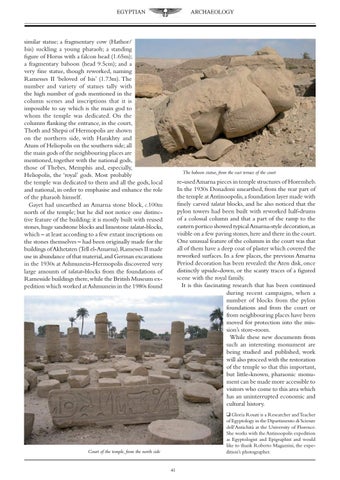
similar statue; a fragmentary cow (Hathor/ Isis) suckling a young pharaoh; a standing figure of Horus with a falcon head (1.65m); a fragmentary baboon (head 9.5cm); and a very fine statue, though reworked, naming Ramesses II ‘beloved of Isis’ (1.73m). The number and variety of statues tally with the high number of gods mentioned in the column scenes and inscriptions that it is impossible to say which is the main god to whom the temple was dedicated. On the columns flanking the entrance, in the court, Thoth and Shepsi of Hermopolis are shown on the northern side, with Harakhty and Atum of Heliopolis on the southern side; all the main gods of the neighbouring places are mentioned, together with the national gods, those of Thebes, Memphis and, especially, Heliopolis, the ‘royal’ gods. Most probably the temple was dedicated to them and all the gods, local and national, in order to emphasise and enhance the role of the pharaoh himself. Gayet had unearthed an Amarna stone block, c.100m north of the temple; but he did not notice one distinctive feature of the building: it is mostly built with reused stones,huge sandstone blocks and limestone talatat-blocks, which – at least according to a few extant inscriptions on the stones themselves – had been originally made for the buildings of Akhetaten (Tell el-Amarna).Ramesses II made use in abundance of that material,and German excavations in the 1930s at Ashmunein-Hermopolis discovered very large amounts of talatat-blocks from the foundations of Ramesside buildings there,while the British Museum expedition which worked at Ashmunein in the 1980s found
The baboon statue, from the east terrace of the court
re-used Amarna pieces in temple structures of Horemheb. In the 1930s Donadoni unearthed, from the rear part of the temple at Antinoopolis, a foundation layer made with finely carved talatat blocks, and he also noticed that the pylon towers had been built with reworked half-drums of a colossal column and that a part of the ramp to the eastern portico showed typical Amarna-style decoration,as visible on a few paving stones, here and there in the court. One unusual feature of the columns in the court was that all of them have a deep coat of plaster which covered the reworked surfaces. In a few places, the previous Amarna Period decoration has been revealed: the Aten disk, once distinctly upside-down, or the scanty traces of a figured scene with the royal family. It is this fascinating research that has been continued during recent campaigns, when a number of blocks from the pylon foundations and from the court or from neighbouring places have been moved for protection into the mission’s store-room. While these new documents from such an interesting monument are being studied and published, work will also proceed with the restoration of the temple so that this important, but little-known, pharaonic monument can be made more accessible to visitors who come to this area which has an uninterrupted economic and cultural history. Ô Gloria Rosati is a Researcher and Teacher of Egyptology in the Dipartimento di Scienze dell’Antichità at the University of Florence. She works with the Antinoopolis expedition as Egyptologist and Epigraphist and would like to thank Roberto Magazzini, the expedition’s photographer.
Court of the temple, from the north side 41