EGYPTIAN
ARCHAEOLOGY
uncovered the standing columns of the court and the hypostyle hall, whose decoration he reproduced in the plates of his publication. Before the outbreak of the war, Donadoni succeeded in publishing a nearly complete description of the temple as it then appeared, showing a traditional plan: facing west, toward the river - it may have been connected by means of a long dromos to a landing stage. The temple consists of a square court entered through the usual pylon (the gate decorated with a blue ceiling and yellow stars), c.18m wide. The twin towers flanking the entrance are now destroyed,with only the foundation grooves extant, though a number of their fallen blocks have survived, together with blocks from the cavetto cornice which surmounted the towers.The open court,with six columns on each side and a terraced portico in front of the entrance, with a double row of columns,drew attention to the king: on the huge architraves,above the columns,his titulary and epithets were incised with carefully carved and painted hieroglyphs. From the central aisle, the king is always in sight on the column shafts,where he is shown performing the ritual offering scenes before gods and goddesses. On the eastern portico, however, it was an oversize statue of a baboon (1.60m) which dominated the court, sitting on a base just like the colossal ones, dedicated to Thoth by Amenhotep III, which were discovered in Hermopolis some years later.The front part of the baboon is severely damaged, but when unearthed the statue still showed traces of brilliant colours, with red fur and blue skin. The external walls of the temple have been destroyed, and only one fragment of the bas-reliefs and inscriptions which would have covered every surface is extant; it comes from the rear wall of the terrace which separated the court from the hypostyle hall. It is decorated in a very low relief and shows the king followed by his ka, making offering to Amun-Re. The wide hypostyle hall would have been rather impressive, with its four rows of columns, at least 16 originally (24 according to the excavator):the columns of the central rows,with plain closed papyrus capitals,are higher than the side rows, and supported walls with open-work windows - Donadoni recorded one of them, with a falcon head. The decoration of the shafts is different here: only one scene on each of the four extant axial columns, showing Ramesses II offering in front of a pair of seated gods. On the columns of the side aisles, which were not reproduced in the publication by Gayet,there is no figured decoration, but only a square with the royal titulary and epithets. At present it is not possible to reconstruct the sanctuary area but a row of three rooms is very probable, as three architraves are extant. However, this part of the temple was changed when some private houses were built there, making use also of stones from the temple itself. Many statues (now in the Egyptian Museum in Cairo) have been recovered from the same area: the goddess Sekhmet, standing (1.85m), and a head from another
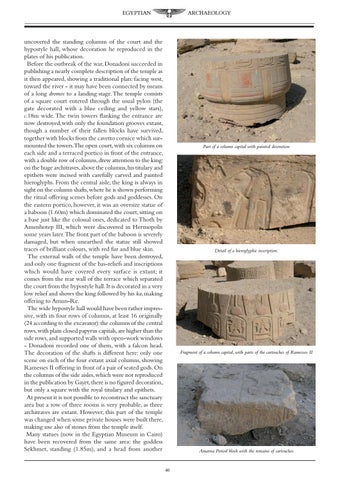
Part of a column capital with painted decoration
Detail of a hieroglyphic inscription.
Fragment of a column capital, with parts of the cartouches of Ramesses II
Amarna Period block with the remains of cartouches
40