EGYPTIAN
ARCHAEOLOGY
The temple of Ramesses II at El-Sheikh Ibada
El-Sheikh Ibada in Middle Egypt is the site of the Roman city of Antinoopolis but among its earlier monuments is a temple of Ramesses II. Gloria Rosati describes the temple which is now being restored and recorded for publication.
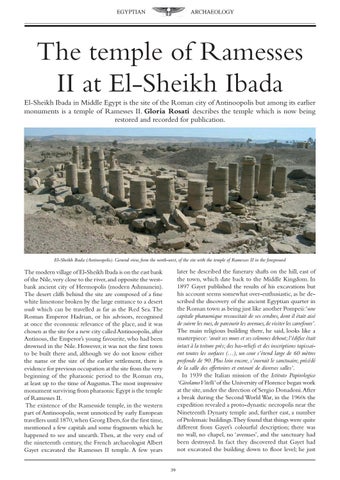
El-Sheikh Ibada (Antinoopolis). General view, from the north-west, of the site with the temple of Ramesses II in the foreground
later he described the funerary shafts on the hill, east of the town, which date back to the Middle Kingdom. In 1897 Gayet published the results of his excavations but his account seems somewhat over-enthusiastic, as he described the discovery of the ancient Egyptian quarter in the Roman town as being just like another Pompeii:‘une capitale pharaonique ressuscitait de ses cendres, dont il était aisé de suivre les rues,de parcourir les avenues,de visiter les carrefours’. The main religious building there, he said, looks like a masterpiece:‘avait ses murs et ses colonnes debout;l’édifice était intact à la toiture près; des bas-reliefs et des inscriptions tapissaient toutes les surfaces (…), un cour s’étend large de 60 mètres profonde de 90. Plus loin encore, s’ouvrait le sanctuaire, précédé de la salle des offertoires et entouré de diverses salles’. In 1939 the Italian mission of the Istituto Papirologico ‘GirolamoVitelli’of the University of Florence began work at the site, under the direction of Sergio Donadoni.After a break during the Second World War, in the 1960s the expedition revealed a proto-dynastic necropolis near the Nineteenth Dynasty temple and, further east, a number of Ptolemaic buildings.They found that things were quite different from Gayet’s colourful description; there was no wall, no chapel, no ‘avenues’, and the sanctuary had been destroyed. In fact they discovered that Gayet had not excavated the building down to floor level; he just
The modern village of El-Sheikh Ibada is on the east bank of the Nile, very close to the river, and opposite the westbank ancient city of Hermopolis (modern Ashmunein). The desert cliffs behind the site are composed of a fine white limestone broken by the large entrance to a desert wadi which can be travelled as far as the Red Sea. The Roman Emperor Hadrian, or his advisors, recognised at once the economic relevance of the place, and it was chosen as the site for a new city called Antinoopolis, after Antinous, the Emperor’s young favourite, who had been drowned in the Nile. However, it was not the first town to be built there and, although we do not know either the name or the size of the earlier settlement, there is evidence for previous occupation at the site from the very beginning of the pharaonic period to the Roman era, at least up to the time of Augustus.The most impressive monument surviving from pharaonic Egypt is the temple of Ramesses II. The existence of the Ramesside temple, in the western part of Antinoopolis, went unnoticed by early European travellers until 1870, when Georg Ebers, for the first time, mentioned a few capitals and some fragments which he happened to see and unearth. Then, at the very end of the nineteenth century, the French archaeologist Albert Gayet excavated the Ramesses II temple. A few years 39