EGYPTIAN
ARCHAEOLOGY
Perunefer: at Memphis or Avaris?
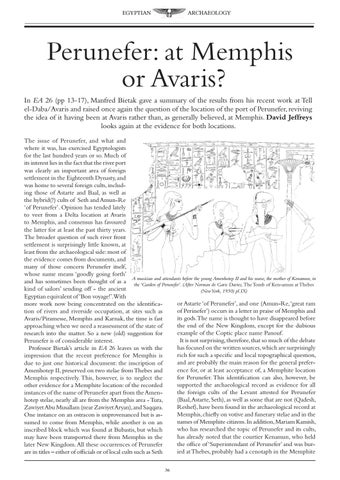
In EA 26 (pp 13-17), Manfred Bietak gave a summary of the results from his recent work at Tell el-Daba/Avaris and raised once again the question of the location of the port of Perunefer, reviving the idea of it having been at Avaris rather than, as generally believed, at Memphis. David Jeffreys looks again at the evidence for both locations. The issue of Perunefer, and what and where it was, has exercised Egyptologists for the last hundred years or so. Much of its interest lies in the fact that the river port was clearly an important area of foreign settlement in the Eighteenth Dynasty, and was home to several foreign cults, including those of Astarte and Baal, as well as the hybrid(?) cults of Seth and Amun-Re ‘of Perunefer’. Opinion has tended lately to veer from a Delta location at Avaris to Memphis, and consensus has favoured the latter for at least the past thirty years. The broader question of such river front settlement is surprisingly little known, at least from the archaeological side: most of the evidence comes from documents, and many of those concern Perunefer itself, whose name means ‘goodly going forth’ A musician and attendants before the young Amenhotep II and his nurse, the mother of Kenamun, in and has sometimes been thought of as a the ‘Garden of Perunefer’. (After Norman de Garis Davies, The Tomb of Ken-amun at Thebes kind of sailors’ sending off - the ancient (New York, 1930) pl.IX) Egyptian equivalent of ‘Bon voyage!’.With or Astarte ‘of Perunefer’, and one (Amun-Re,‘great ram more work now being concentrated on the identificaof Perinefer’) occurs in a letter in praise of Memphis and tion of rivers and riverside occupation, at sites such as its gods.The name is thought to have disappeared before Avaris/Piramesse, Memphis and Karnak, the time is fast the end of the New Kingdom, except for the dubious approaching when we need a reassessment of the state of example of the Coptic place name Panouf. research into the matter. So a new (old) suggestion for It is not surprising, therefore, that so much of the debate Perunefer is of considerable interest. has focused on the written sources, which are surprisingly Professor Bietak’s article in EA 26 leaves us with the rich for such a specific and local topographical question, impression that the recent preference for Memphis is and are probably the main reason for the general preferdue to just one historical document: the inscription of ence for, or at least acceptance of, a Memphite location Amenhotep II, preserved on two stelae from Thebes and for Perunefer. This identification can also, however, be Memphis respectively. This, however, is to neglect the supported the archaeological record as evidence for all other evidence for a Memphite location: of the recorded the foreign cults of the Levant attested for Perunefer instances of the name of Perunefer apart from the Amen(Baal,Astarte, Seth), as well as some that are not (Qadesh, hotep stelae, nearly all are from the Memphis area - Tura, Reshef), have been found in the archaeological record at Zawiyet Abu Musallam (near Zawiyet Aryan),and Saqqara. Memphis, chiefly on votive and funerary stelae and in the One instance on an ostracon is unprovenanced but is asnames of Memphite citizens.In addition,Mariam Kamish, sumed to come from Memphis, while another is on an who has researched the topic of Perunefer and its cults, inscribed block which was found at Bubastis, but which has already noted that the courtier Kenamun, who held may have been transported there from Memphis in the the office of ‘Superintendant of Perunefer’ and was burlater New Kingdom. All these occurrences of Perunefer ied at Thebes, probably had a cenotaph in the Memphite are in titles – either of officials or of local cults such as Seth 36