EGYPTIAN
ARCHAEOLOGY
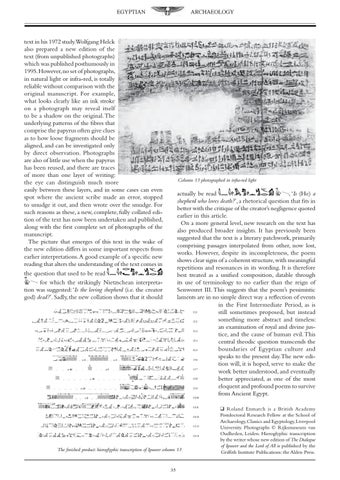
text in his 1972 study.Wolfgang Helck also prepared a new edition of the text (from unpublished photographs) which was published posthumously in 1995.However,no set of photographs, in natural light or infra-red, is totally reliable without comparison with the original manuscript. For example, what looks clearly like an ink stroke on a photograph may reveal itself to be a shadow on the original. The underlying patterns of the fibres that comprise the papyrus often give clues as to how loose fragments should be aligned, and can be investigated only by direct observation. Photographs are also of little use when the papyrus has been reused, and there are traces of more than one layer of writing: the eye can distinguish much more easily between these layers, and in some cases can even spot where the ancient scribe made an error, stopped to smudge it out, and then wrote over the smudge. For such reasons as these, a new, complete, fully collated edition of the text has now been undertaken and published, along with the first complete set of photographs of the manuscript. The picture that emerges of this text in the wake of the new edition differs in some important respects from earlier interpretations.A good example of a specific new reading that alters the understanding of the text comes in the question that used to be read for which the strikingly Nietzschean interpretation was suggested: ‘Is the loving shepherd (i.e. the creator god) dead?’. Sadly, the new collation shows that it should
Column 13 photographed in infra-red light
actually be read , ‘Is (He) a shepherd who loves death?’, a rhetorical question that fits in better with the critique of the creator’s negligence quoted earlier in this article. On a more general level, new research on the text has also produced broader insights. It has previously been suggested that the text is a literary patchwork, primarily comprising passages interpolated from other, now lost, works. However, despite its incompleteness, the poem shows clear signs of a coherent structure, with meaningful repetitions and resonances in its wording. It is therefore best treated as a unified composition, datable through its use of terminology to no earlier than the reign of Senwosret III. This suggests that the poem’s pessimistic laments are in no simple direct way a reflection of events in the First Intermediate Period, as is still sometimes proposed, but instead something more abstract and timeless: an examination of royal and divine justice, and the cause of human evil. This central theodic question transcends the boundaries of Egyptian culture and speaks to the present day.The new edition will, it is hoped, serve to make the work better understood, and eventually better appreciated, as one of the most eloquent and profound poems to survive from Ancient Egypt.
The finished product: hieroglyphic transcription of Ipuwer column 13
35
Ô Roland Enmarch is a British Academy Postdoctoral Research Fellow at the School of Archaeology, Classics and Egyptology, Liverpool University. Photographs © Rijksmuseum van Oudheden, Leiden. Hieroglyphic transcription by the writer whose new edition of The Dialogue of Ipuwer and the Lord of All is published by the Griffith Institute Publications: the Alden Press.