EGYPTIAN
ARCHAEOLOGY
One other aspect of the Giza website will be of great value to researchers who may not have easy access to a conventional Egyptological library or need access to a vast bibliography while ‘in the field’: the ‘Giza Digital Library’ where, to date, about 200 works have been posted for free downloading. This page currently contains every Gizarelated book and article ever written by Harvard–MFA Egyptologists George Reisner, Dows Dunham and William Stevenson Smith. It also contains works by a host of other scholars, both past and present. All seven volumes of the MFA’s Giza Mastabas series are online, and all 166 Bulletin of the Museum of Fine Arts articles are likewise available for free downloading.These PDF files reproduce the look and feel of their original publications’ design and layout, but they also contain a second,‘hidden’ layer beneath each page where the text has been converted to searchable type. This means that one can search for terms within the PDF file: one major advantage of digital publication over print publication. Thousands more images and documents have yet to be processed in the coming years at the Museum of Fine Arts, Boston, and added to the website. They concern primarily the Harvard University–Boston Museum of Fine Arts Expedition and its derivative field seasons, but there have been, of course, other important excavations at Giza besides those conducted until 1942 by George Reisner.For those studying Giza in toto,the arbitrary pres-
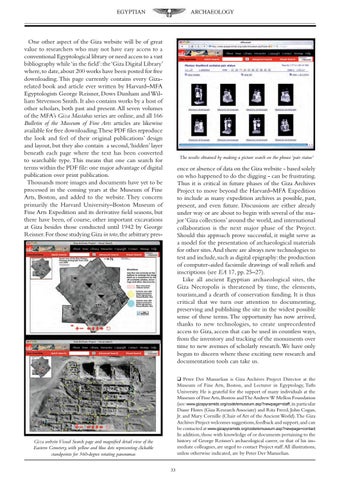
The results obtained by making a picture search on the phrase ‘pair statue’
ence or absence of data on the Giza website - based solely on who happened to do the digging - can be frustrating. Thus it is critical in future phases of the Giza Archives Project to move beyond the Harvard–MFA Expedition to include as many expedition archives as possible, past, present, and even future. Discussions are either already under way or are about to begin with several of the major ‘Giza collections’ around the world, and international collaboration is the next major phase of the Project. Should this approach prove successful, it might serve as a model for the presentation of archaeological materials for other sites.And there are always new technologies to test and include, such as digital epigraphy: the production of computer-aided facsimile drawings of wall reliefs and inscriptions (see EA 17, pp. 25–27). Like all ancient Egyptian archaeological sites, the Giza Necropolis is threatened by time, the elements, tourism,and a dearth of conservation funding. It is thus critical that we turn our attention to documenting, preserving and publishing the site in the widest possible sense of these terms. The opportunity has now arrived, thanks to new technologies, to create unprecedented access to Giza, access that can be used in countless ways, from the inventory and tracking of the monuments over time to new avenues of scholarly research.We have only begun to discern where these exciting new research and documentation tools can take us. Ô Peter Der Manuelian is Giza Archives Project Director at the Museum of Fine Arts, Boston, and Lecturer in Egyptology, Tufts University. He is grateful for the support of many individuals at the Museum of Fine Arts, Boston and The Andrew W Mellon Foundation (see: www.gizapyramids.org/code/emuseum.asp?newpage=staff,in particular Diane Flores (Giza Research Associate) and Rita Freed, John Cogan, Jr. and Mary Cornille (Chair of Art of the Ancient World).The Giza Archives Project welcomes suggestions, feedback and support, and can be contacted at www.gizapyramids.org/code/emuseum.asp?newpage=contact In addition, those with knowledge of or documents pertaining to the history of George Reisner’s archaeological career, or that of his immediate colleagues, are urged to contact Project staff.All illustrations, unless otherwise indicated, are by Peter Der Manuelian.
Giza website Visual Search page and magnified detail view of the Eastern Cemetery, with yellow and blue dots representing clickable standpoints for 360-degree rotating panoramas 33