EGYPTIAN
ARCHAEOLOGY
The Giza Archives Project
A new internet resource aims to serve as a centralised online repository for all archaeological activity at the Giza Necropolis,beginning with the Harvard University/Boston Museum of Fine Arts excavations from the first half of the twentieth century. Peter Der Manuelian, who first reported on the genesis of the work in EA 17 (pp.25-27), now provides an update and describes plans for the Project’s future. The Giza Pyramids may be the most famous, if not the most important, archaeological monuments in the world. Surrounding these royal monuments are hundreds of mastabas and rock-cut tombs, in addition to workmen’s barracks, industrial areas, royal administrative buildings, and quarries.Along with the other Memphite cemeteries further to the south,Giza is one of the primary sources for almost every conceivable aspect of Old Kingdom society, and it also contains significant monuments from the Archaic Period, the New Kingdom, and the Late Period. Two of the founding fathers of modern scientific archaeological method,Flinders Petrie and George Reisner, both worked at Giza and several expeditions, down to the present day, have over the decades made important contributions to our understanding of the site. In fact, the ‘explosion’of information amassed by various expeditions is so overwhelming that it is almost impossible to gain a clear overview of all the relevant data, for it does not reside in any one location,and much remains unpublished. Similarly, the artefacts, from the coarsest beer jars to the life-sized royal statues and other masterpieces of Old Kingdom sculpture, are now spread throughout museums in Egypt, Europe and the United States. The Giza Archives Project has now taken a step towards providing access to all this material and scholarly research. Since 2000 the Project has been working to digitise Giza materials and to present them to scholars and the interested public over the internet free of charge.The work of the Project was made possible in the autumn of 2000 by a generous award made by the Andrew W Mellon Foundation (www.mellon.org), which recognised that the largest
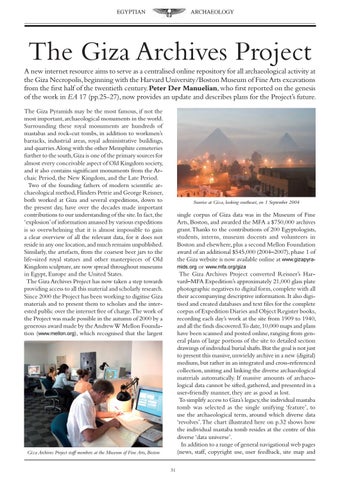
Sunrise at Giza, looking southeast, on 1 September 2004
single corpus of Giza data was in the Museum of Fine Arts, Boston, and awarded the MFA a $750,000 archives grant.Thanks to the contributions of 200 Egyptologists, students, interns, museum docents and volunteers in Boston and elsewhere, plus a second Mellon Foundation award of an additional $545,000 (2004–2007), phase 1 of the Giza website is now available online at www.gizapyramids.org or www.mfa.org/giza The Giza Archives Project converted Reisner’s Harvard–MFA Expedition’s approximately 21,000 glass plate photographic negatives to digital form, complete with all their accompanying descriptive information. It also digitised and created databases and text files for the complete corpus of Expedition Diaries and Object Register books, recording each day’s work at the site from 1909 to 1940, and all the finds discovered.To date,10,000 maps and plans have been scanned and posted online, ranging from general plans of large portions of the site to detailed section drawings of individual burial shafts.But the goal is not just to present this massive, unwieldy archive in a new (digital) medium, but rather in an integrated and cross-referenced collection, uniting and linking the diverse archaeological materials automatically. If massive amounts of archaeological data cannot be sifted, gathered, and presented in a user-friendly manner, they are as good as lost. To simplify access to Giza’s legacy, the individual mastaba tomb was selected as the single unifying ‘feature’, to use the archaeological term, around which diverse data ‘revolves’.The chart illustrated here on p.32 shows how the individual mastaba tomb resides at the centre of this diverse ‘data universe’. In addition to a range of general navigational web pages (news, staff, copyright use, user feedback, site map and
Giza Archives Project staff members at the Museum of Fine Arts, Boston 31