EGYPTIAN
ARCHAEOLOGY
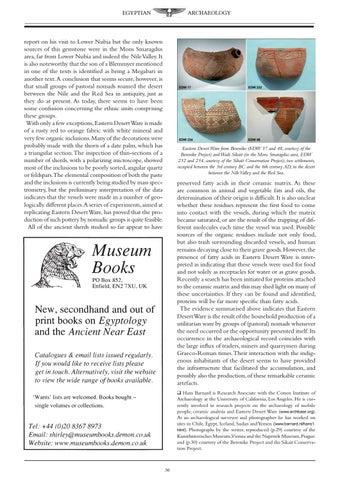
report on his visit to Lower Nubia but the only known sources of this gemstone were in the Mons Smaragdus area, far from Lower Nubia and indeed the Nile Valley. It is also noteworthy that the son of a Blemmyer mentioned in one of the texts is identified as being a Megabari in another text.A conclusion that seems secure, however, is that small groups of pastoral nomads roamed the desert between the Nile and the Red Sea in antiquity, just as they do at present. As today, there seems to have been some confusion concerning the ethnic units comprising these groups. With only a few exceptions, Eastern DesertWare is made of a rusty red to orange fabric with white mineral and very few organic inclusions.Many of the decorations were probably made with the thorn of a date palm, which has a triangular section.The inspection of thin-sections of a number of sherds, with a polarizing microscope, showed most of the inclusions to be poorly sorted, angular quartz or feldspars.The elemental composition of both the paste and the inclusions is currently being studied by mass spectrometry, but the preliminary interpretation of the data indicates that the vessels were made in a number of geologically different places.A series of experiments,aimed at replicating Eastern Desert Ware, has proved that the production of such pottery by nomadic groups is quite feasible. All of the ancient sherds studied so far appear to have
Eastern Desert Ware from Berenike (EDW 17 and 48, courtesy of the Berenike Project) and Wadi Sikait (in the Mons Smaragdus area, EDW 232 and 234, courtesy of the Sikait Conservation Project), two settlements, occupied between the 3rd century BC and the 6th century AD, in the desert between the Nile Valley and the Red Sea.
preserved fatty acids in their ceramic matrix. As these are common in animal and vegetable fats and oils, the determination of their origin is difficult. It is also unclear whether these residues represent the first food to come into contact with the vessels, during which the matrix became saturated, or are the result of the trapping of different molecules each time the vessel was used. Possible sources of the organic residues include not only food, but also trash surrounding discarded vessels, and human remains decaying close to their grave goods. However, the presence of fatty acids in Eastern Desert Ware is interpreted as indicating that these vessels were used for food and not solely as receptacles for water or as grave goods. Recently a search has been initiated for proteins attached to the ceramic matrix and this may shed light on many of these uncertainties. If they can be found and identified, proteins will be far more specific than fatty acids. The evidence summarised above indicates that Eastern DesertWare is the result of the household production of a utilitarian ware by groups of (pastoral) nomads whenever the need occurred or the opportunity presented itself. Its occurrence in the archaeological record coincides with the large influx of traders, miners and quarrymen during Graeco-Roman times.Their interaction with the indigenous inhabitants of the desert seems to have provided the infrastructure that facilitated the accumulation, and possibly also the production, of these remarkable ceramic artefacts. Ă” Hans Barnard is Research Associate with the Cotsen Institute of Archaeology at the University of California, Los Angeles. He is currently involved in research projects on the archaeology of mobile people, ceramic analysis and Eastern Desert Ware (www.archbase.org). As an archaeological surveyor and photographer he has worked on sites in Chile, Egypt, Iceland, Sudan and Yemen (www.barnard.nl/hans1. html). Photographs by the writer, reproduced (p.29) courtesy of the Kunsthistorisches Museum,Vienna and the Naprstek Museum,Prague. and (p.30) courtesy of the Berenike Project and the Sikait Conservation Project.
30